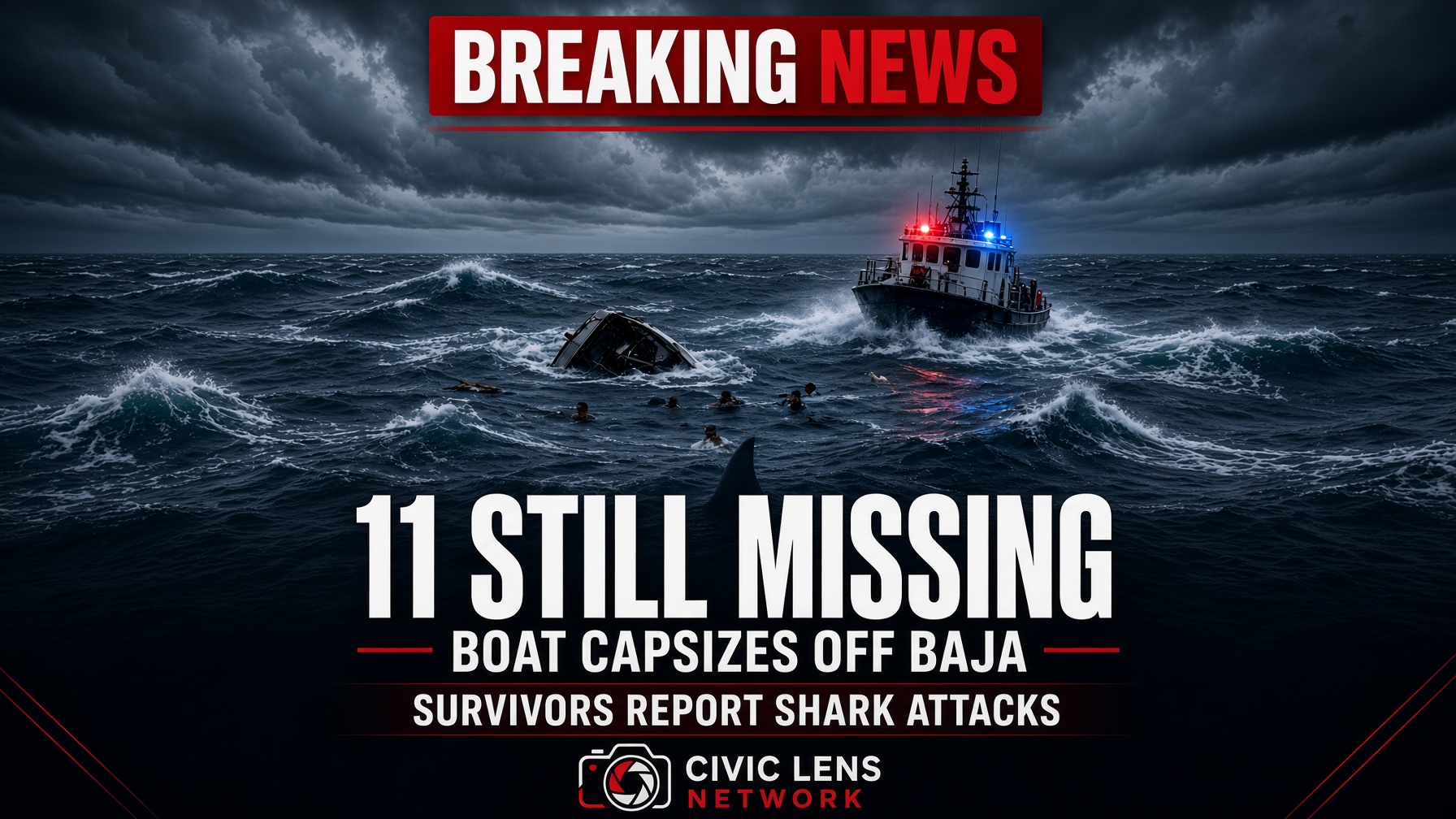
In the predawn darkness early Friday, a vessel carrying as many as 27 people sank roughly 140 miles west of Ensenada in Mexican waters. Survivors clung to debris and one another in the open Pacific while a U.S. Coast Guard helicopter reached the scene about two hours after a radio distress call. Sixteen people, all Mexican nationals, were rescued.
Several suffered severe injuries consistent with shark bites. Eleven others remain missing as joint search and rescue operations continue more than two days later. The distress call reached Coast Guard Sector San Diego watchstanders around 1 a.m. Friday, reporting a vessel taking on water and sinking.
The location was approximately 140 miles (225 kilometers) west of Ensenada, outside U.S. territorial waters but within the Coast Guard’s area of responsibility. When the helicopter arrived, crews found no intact vessel, only floating debris. People were scattered in the water, some holding onto one another or fragments of wreckage and treading to stay afloat. A rescue swimmer and crew spent roughly 90 minutes extracting the 16 survivors.
Some wore life vests; others did not. Coast Guard Lt. Santiago Tamburini described the scene: people were “holding onto each other, to debris, just treading and trying to stay above water before being rescued.” Survivors told officials that 27 people had been aboard.
The Mexican Consulate in San Diego confirmed that those rescued were Mexican nationals. The type, size, origin, and destination of the boat have not been established. No hull was recovered. Several of the rescued individuals sustained severe injuries consistent with shark bites, according to a Coast Guard statement.
The agency provided life-saving first aid while transporting them by helicopter to San Diego. At least one person was treated for a suspected shark bite. Three survivors were taken to Scripps Mercy Hospital San Diego, including the person with the suspected shark bite and two treated for cold exposure. Three others were evaluated at Scripps Memorial Hospital La Jolla and later discharged.
Two people were reported in critical condition by a city of San Diego spokesperson, though it remains unclear whether that group included the shark-bite victim or those treated for exposure. Authorities have not released the specific number of people with suspected shark injuries, the species involved, or detailed medical outcomes.
Sea conditions at the time of the call were moderate but unforgiving: winds of about 10 knots from the north and northwest, waves around 5 feet, water temperature of 68 degrees Fahrenheit, and air temperature near 70 degrees. Tamburini noted that “the sea is unforgiving” in the area and that it was unclear whether the vessel became lost, suffered engine failure, was swept offshore, or had intentionally traveled that far. The waters west of Ensenada are used by commercial fishing vessels and recreational boats.
They are also a known route for maritime smuggling attempts involving small craft such as pangas. Coast Guard Capt. Robert Tucker, commander of Sector San Diego, stated: “This case highlights the extreme dangers of taking to the sea. The vessel had a large number of people onboard and was following a route normally used in illegal maritime smuggling operations.
Offshore conditions are unforgivable and can quickly result in death.” Customs and Border Protection has been interviewing survivors. Officials have not confirmed that the boat was engaged in smuggling, fishing, or another activity. Similar fatal incidents involving vessels in the region have occurred in recent years.
Search and rescue operations remain active. The U.S. Coast Guard and U.S. Navy have deployed multiple helicopters, a fixed-wing aircraft, a cutter, and a Navy combat ship.
The Mexican Navy is assisting from Ensenada. Early efforts covered roughly 950 square nautical miles. On Saturday, U.S. Coast Guard Southwest reported that search efforts continued 140 miles west of Ensenada, that no additional individuals had been found, and that coordination with the Navy and Mexican Navy was ongoing.
Petty Officer Charlie Valor said crews were “giving it our all” and searching based on currents, waves, and wind because there remained reason to believe survivors could still be located. As of Sunday, no further survivors or confirmed remains have been publicly reported, and the 11 people remain missing. Investigators have not determined what caused the vessel to take on water and sink. Individual identities of the missing or rescued have not been released.
The precise circumstances of any shark encounters remain limited to the description of injuries consistent with bites. No official statements from Mexican maritime authorities beyond coordination of the search have detailed additional findings. Maritime rescue teams will continue coordinated air and surface searches for the missing passengers as long as conditions and assessments indicate a viable chance of survival. The investigation into the boat’s purpose and the cause of the sinking is ongoing, with survivors continuing to be interviewed.
Families of the missing face an anxious wait as the open Pacific search stretches into another day.