On a warm June afternoon in Central Park, an 18-year-old visitor from India celebrating his high school graduation climbed into a horse-drawn carriage with his family. Moments later the horse bolted. The carriage collided with another, overturned near Tavern on the Green, and Romanch Mahajan was thrown clear. He died from his injuries.
Four months later, that death has become the catalyst for what appears to be the end of one of New York City’s longest-running tourist rituals. On October 13, Mayor Zohran Mamdani and City Council Speaker Julie Menin announced they had reached agreement on legislation that would phase out the horse-drawn carriage industry entirely by June 1, 2028. The City Council is scheduled to vote on the measure, known as Romanch’s Law, on October 22. The bill already lists 29 sponsors in the 51-member body.
Menin has said she expects it to pass with a veto-proof majority. As of October 14, no vote has occurred and no ban is law. What exists is a political deal that has all but sealed the industry’s fate. The legislation, sponsored by Council Member Christopher Marte, would immediately halt the issuance of new medallions and licenses.
Existing licenses would expire by May 31, 2028. After that date, operating a horse-drawn carriage for hire in the city would be illegal, with limited exceptions for temporary exhibits or performances. Civil penalties of at least $10,000 and possible jail time would apply to violators. The bill requires city agencies to produce a workforce transition plan by April 1, 2027, covering job placement, career counseling, training, and referrals to roles with the MTA, Port Authority, Taxi and Limousine Commission, and tourism businesses.
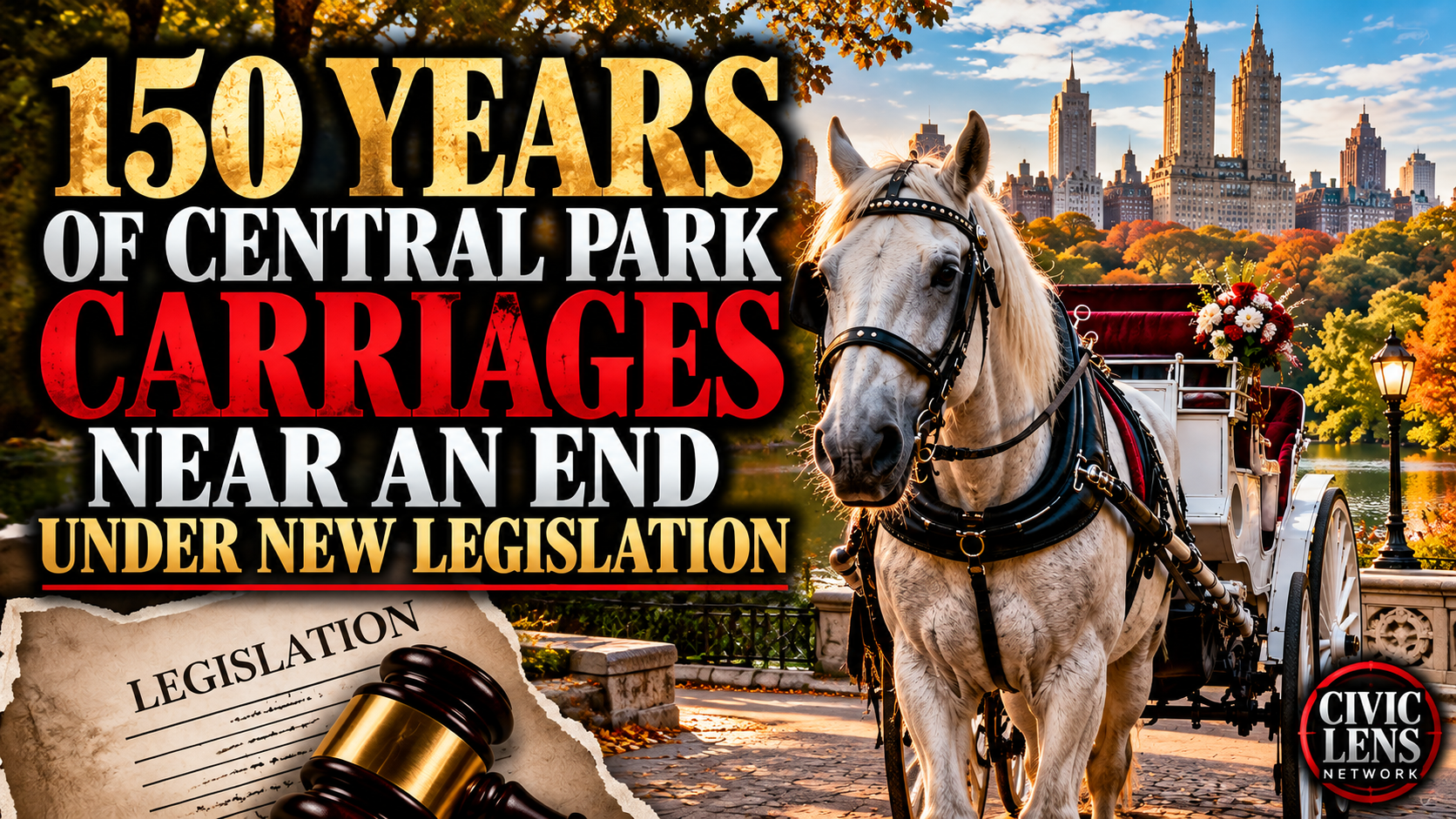
It directs officials to “consider” compensation for owners of medallions and equipment, but guarantees none. Horses must receive a “humane disposition”; they cannot be sold for slaughter or transferred to other carriage operations. The carriages have operated in and around Central Park for more than 150 years, dating to the park’s opening in the late 1850s. Frederick Law Olmsted and Calvert Vaux designed the winding drives specifically for scenic horse-drawn tours.
For generations of New Yorkers and visitors, the clip-clop of hooves along the park’s paths has been as recognizable as the skyline. The industry is regulated by the city with a fixed number of 68 medallions. Industry spokesperson Christina Hansen has put the current workforce at roughly 150 drivers and more than 180 horses, housed primarily in three remaining Manhattan stables.
One of the largest, Clinton Park Stables on the Far West Side, holds dozens of the animals in a building that has stood since the 1880s. Medallions have traded for hundreds of thousands of dollars. Many drivers, a largely immigrant workforce, treat the work as a small business or multi-generational trade. Animal welfare groups have argued for years that the setting is fundamentally incompatible with equine safety.
Horses walk city streets and park paths amid traffic, cyclists, and crowds. They work in heat and cold. Activists point to collapses, boltings, and injuries. A Manhattan Borough President report released in August 2026 documented evidence of 96 serious carriage-related incidents and 40 horse deaths over decades, with incident rates rising in recent years.
High-profile cases include the 2022 collapse of a horse named Ryder in Hell’s Kitchen (the driver was later acquitted of animal cruelty) and the August 2025 death of a horse named Lady. Days before Mahajan’s death, a horse named Deniz collapsed and died in the park. Advocates with New Yorkers for Clean, Livable and Safe Streets (NYCLASS), including executive director Edita Birnkrant, have long described the industry as inherently dangerous and the horses as overworked. PETA has called a ban long overdue.
Carriage drivers and the Transport Workers Union Local 100, which represents them, reject the portrayal. They argue that licensed operators follow city rules on rest, temperature cutoffs, and veterinary care, and that many horses live longer working lives than they would otherwise. Drivers have said they earn solid incomes—reports at a July City Council hearing put figures in the $60,000–$70,000 range for some—and that medallions represent major personal investments.
Industry representatives have pushed for targeted safety improvements, such as hitching posts in the park and stricter driver testing, rather than abolition. After Mahajan’s death, Local 100 temporarily paused operations and called for more training and infrastructure. Union leaders have described the current bill’s transition language as inadequate. International TWU President John Samuelsen called the measure’s economic provisions “weak” and accused officials of using the tourist’s death for political purposes while threatening the livelihoods of immigrant workers.
One driver has publicly described investing more than $1 million in medallions, horses, and equipment and generating hundreds of thousands in annual revenue. The political fight has stretched across multiple administrations. Animal rights groups, particularly NYCLASS, supported Bill de Blasio’s 2013 campaign in part on a promise to ban the carriages; that effort stalled. Eric Adams later issued an executive order and endorsed phasing out the industry while exploring electric carriage alternatives.
Union opposition and previous City Council majorities blocked earlier versions of the legislation, then known as Ryder’s Law. The June 2026 death of Romanch Mahajan shifted the calculus. Menin announced her support in July. Mamdani, who had previously expressed support for ending the industry provided workers were protected, formally aligned with the speaker this week.
City Hall said it has been working with the Council, union partners, drivers, and advocates on a transition. Whether real estate interest in the valuable Far West Side stable properties has played a role is a recurring claim from industry defenders; public reporting has noted the land’s development potential but has not established that such interests drove the current legislation. Proposed alternatives in past debates have included vintage-style electric carriages that could continue offering scenic park rides without live animals.
Previous mayors floated the idea, though street-safety advocates have questioned reintroducing motorized vehicles into a largely car-free park. The current bill focuses instead on human job transitions and humane retirement or rehoming of the horses, with requirements that owners notify city animal-welfare officials before disposing of animals. Sanctuaries and retirement programs have been discussed, though detailed capacity and funding remain unclear.
If the Council passes the bill on October 22 and the mayor signs it, the city will have roughly 19 months until the hard cutoff. Agencies must deliver the transition plan by April 2027. Legal challenges from the union or owners are possible, particularly over the lack of guaranteed compensation for valuable medallions. Implementation will depend on how rigorously the city enforces the license sunset and how effectively it places workers elsewhere.
The Central Park Conservancy, which manages the park, has endorsed ending the carriages on public-safety grounds and welcomed the deal. For now, the carriages still roll. Tourists still line up. Drivers still tend their horses.
But the political agreement reached this week makes clear that city leadership has decided the tradition’s risks outweigh its romance. Whether the October 22 vote matches that consensus, and how the city handles the people and animals left behind, will determine what actually ends and what, if anything, replaces it.