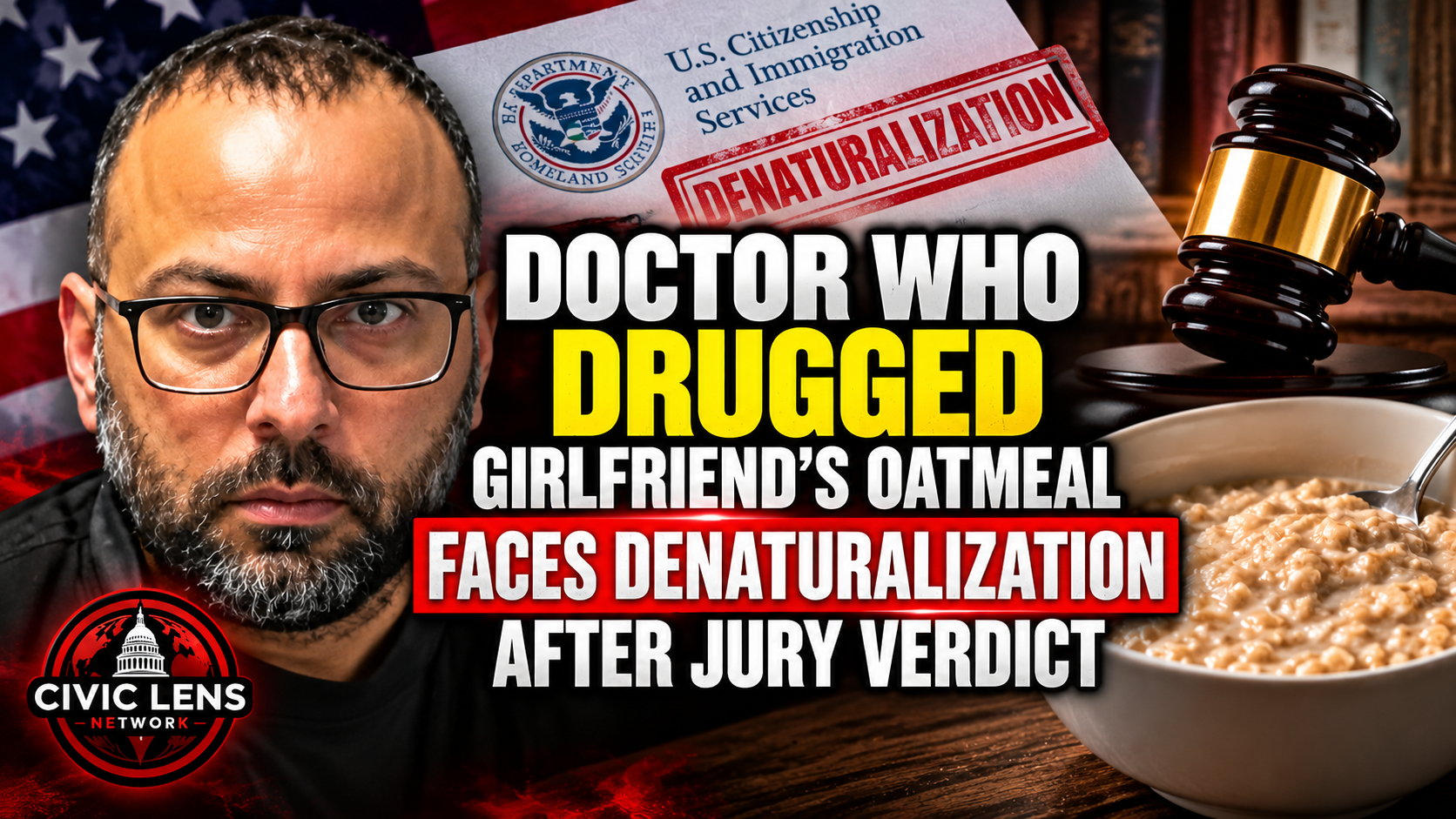
A federal jury has convicted a former Northeast Ohio physician of naturalization fraud after he concealed a 2014 attempt to terminate his girlfriend’s pregnancy without her knowledge by spiking her oatmeal with an abortion drug. The crime later led to state convictions for attempted murder and felonious assault against her and their unborn child. Yousif Abdulraouf Alhallaq, 47, of Canton, was found guilty in U.S.
District Court for the Northern District of Ohio of making false statements on his Form N-400 citizenship application and during an in-person interview. The conviction, announced in early October 2026 by the U.S. Attorney’s Office for the Northern District of Ohio and U.S. Citizenship and Immigration Services, carries a maximum of 10 years in federal prison.
Alhallaq also faces denaturalization as a result of the fraud conviction. Sentencing is scheduled for January 19, 2027. He is currently in the custody of the U.S. Marshals Service after completing a four-year state prison sentence.
The case connects a violent state offense that remained hidden for years with later federal immigration fraud. Court records establish that in December 2014, while working as an internal medicine doctor in Northeast Ohio, Alhallaq poisoned his then-girlfriend’s oatmeal with an abortion drug after she became pregnant with his child. The act was intended to terminate the pregnancy without her knowledge and caused serious physical harm to both her and the unborn child.
The victim learned the truth years later and reported the incident to police. On March 18, 2021, a Stark County grand jury indicted Alhallaq on one count of attempted murder and two counts of felonious assault. He pleaded guilty in September 2021 and received a four-year prison sentence. Ohio medical board records show his license to practice medicine was permanently revoked in January 2022 following the convictions.
The criminal conduct occurred well before Alhallaq obtained U.S. citizenship. Born in Kuwait and a Jordanian citizen at the time, he entered the United States on an H-1B visa in 2006 and became a lawful permanent resident in 2011. He began practicing as an internal medicine physician in Northeast Ohio around 2012. In late 2017, before any charges had been filed, Alhallaq submitted a Form N-400 application for naturalization.
On the form he answered “no” to questions asking whether he had ever been involved in any way with killing or trying to kill someone, whether he had ever been involved in badly hurting or trying to hurt a person on purpose, and whether he had ever committed, assisted in committing, or attempted to commit a crime or offense for which he was not arrested. During a March 2018 interview with an immigration officer, he verbally confirmed those answers under oath.
On May 4, 2018, he became a naturalized U.S. citizen during a ceremony in Stark County. Federal prosecutors established at trial that Alhallaq knowingly committed the acts of attempted murder and felonious assault in 2014 yet attested under oath that the information on his application was true. The crime had not yet been reported or charged when he applied and was naturalized. It only came to the attention of authorities years later when the victim reported it, leading to the 2021 state indictment and conviction.
The federal investigation that uncovered the naturalization fraud was conducted by the USCIS Fraud Detection and National Security Directorate and Homeland Security Investigations in Cleveland. A federal grand jury returned an indictment in June 2025. Alhallaq was released from state custody in August 2025 after serving the four-year sentence but was taken into federal custody following the jury verdict in early October 2026. The case raises questions about the limits of immigration screening when serious criminal conduct has not yet been reported, charged, or convicted.
At the time Alhallaq applied for citizenship and completed his interview, he had no criminal record related to the 2014 incident because the victim had not yet disclosed it to police. Officials granted citizenship based on the information he provided under oath. No public records indicate that immigration authorities possessed information about the unreported 2014 conduct at the time of naturalization. Alhallaq now faces both the potential additional prison term and the prospect of losing the citizenship he obtained through the false statements.
The Northern District of Ohio case was prosecuted by Assistant U.S. Attorneys Matthew W. Shepherd and Christopher Snyder. Court records show the federal charges specifically addressed the false answers on the N-400 and the sworn confirmation during the interview.
The sequence of events is documented in state court records from Stark County, the federal indictment and trial in the Northern District of Ohio, and official announcements from the U.S. Attorney’s Office and USCIS. The 2014 poisoning led to the 2021 guilty plea and four-year sentence. The 2017-2018 naturalization process occurred while that conduct remained unreported.
The 2025 federal indictment and 2026 conviction established that Alhallaq concealed the prior criminal acts when seeking citizenship. Authorities have not publicly detailed how Alhallaq obtained the abortion drug or the precise medical consequences to the victim and unborn child beyond the findings of serious physical harm established in the state case. Those details remain in the Stark County court records that supported the attempted murder and felonious assault convictions. The federal case focused on the subsequent false statements rather than re-litigating the underlying violence.
Alhallaq is scheduled to appear for sentencing on January 19, 2027. The court will consider his prior criminal record, role in the offense, and other factors when determining the federal sentence, which cannot exceed the statutory maximum of 10 years. Separate denaturalization proceedings may follow the conviction. The case illustrates how undisclosed criminal conduct can remain invisible during the naturalization process until a victim reports it years later.
Federal investigators later connected the state convictions to the earlier citizenship application through the work of USCIS and Homeland Security Investigations. No public record shows that officials knowingly overlooked known criminal information at the time citizenship was granted, because the conduct had not yet been disclosed or charged.