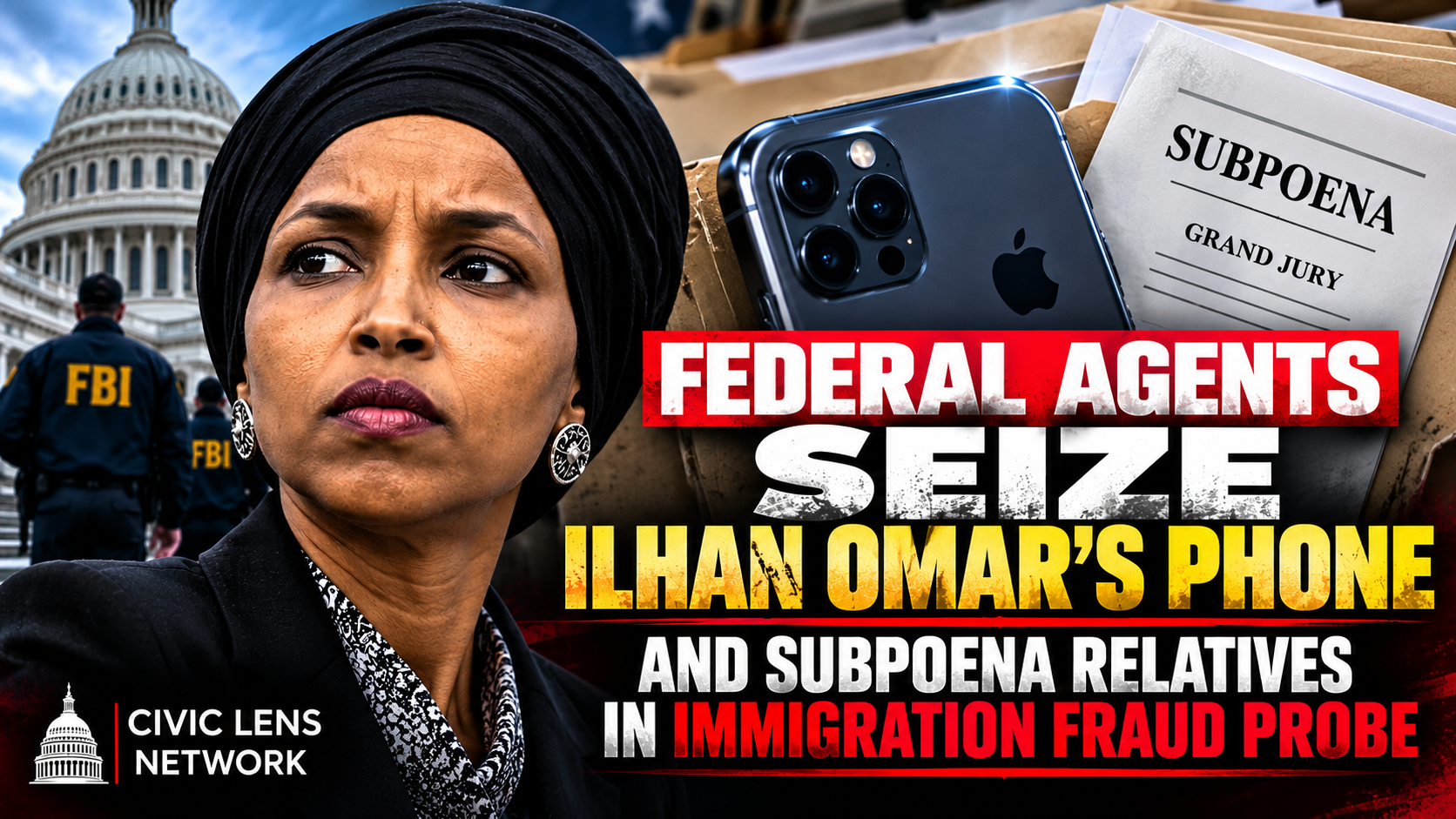
Federal agents seized the cellphone of Democratic Congresswoman Ilhan Omar of Minnesota and issued more than a dozen grand jury subpoenas, including to members of her family, after executing a court-authorized search warrant at her Washington, D.C., residence on October 12. The steps reflect an active criminal investigation into potential fraud or misrepresentations in immigration documents connected to Omar and her relatives, carried out weeks before the November midterm elections in which she is seeking reelection.
Associated Press reporting, citing a person briefed on the probe, established that the subpoenas support a Minnesota grand jury examining possible irregularities in the family’s immigration paperwork. Homeland Security Investigations agents conducted the October 12 search of the residence. Multiple outlets reported that agents took Omar’s phone, laptop, passport, notebooks, and personal computers. She was present for at least part of the search and did not provide passwords.
A source familiar with the warrant indicated it authorized seizure of electronic devices, passports, and immigration records, referencing potential violations involving immigration fraud, false statements, and conspiracy. Homeland Security Secretary Markwayne Mullin has said authorities were examining potential crimes related to the family’s immigration documents. The precise scope of the investigation remains under seal.
Reporting from The Washington Post and The Wall Street Journal, based on people familiar with the matter, indicates investigators are focused on questions surrounding Omar’s reported birth date and whether information supplied by her late father, Nur Omar Mohamed, affected her acquisition of U.S. citizenship in 2000. Omar arrived in the United States as a refugee from Somalia via a camp in Kenya in the mid-1990s and was naturalized around age 17.
Sources have described examination of whether her age was presented in a way that allowed her to derive citizenship as a minor through her father rather than through an independent process. The Wall Street Journal reported that federal officials are investigating whether grounds exist to revoke her citizenship, which could open a path to deportation proceedings. No court has revoked her citizenship, and no denaturalization case has been filed. U.S.
Attorney Jeanine Pirro of the District of Columbia has publicly confirmed that several investigations involving Omar are active. In a Fox News interview she stated that her office is also reviewing issues concerning the lawmaker’s financial disclosures and that any crime uncovered would be prosecuted. A federal magistrate judge imposed limits on Justice Department access to certain seized materials to protect legislative work under the Constitution’s Speech or Debate Clause.
Grand jury subpoenas compel the production of testimony or records and do not by themselves mean the recipients face charges. The New York Times reported that Omar’s sister, Sahra Noor, and at least one other relative received subpoenas. Investigators appear to be seeking records or accounts that could clarify representations made on immigration forms decades ago. Family members may possess original documents or direct knowledge of the circumstances surrounding the late father’s paperwork and Omar’s status at the time of naturalization.
Omar herself was not subpoenaed. From the seized phone and other devices, investigators can extract communications, location information, documents, and related data consistent with the warrant’s terms and any judicial restrictions. The supporting affidavit remains sealed, so the specific probable cause presented to the judge is not public. Securing a warrant against a sitting member of Congress so close to an election required a judicial determination that evidence of a potential federal crime was likely located at the premises.
Omar’s refusal to provide passwords means any further access would depend on technical methods or additional court authorization. Questions about Omar’s immigration history long predate the current probe. Critics have raised an unsubstantiated allegation that she entered a marriage with Ahmed Nur Said Elmi, who some claimed was her brother, to assist his immigration status. Omar has repeatedly denied the claim and described it as a smear.
No public evidence has established that allegation, and it is separate from the birth-date focus described in recent reporting. What is documented is her arrival as a child refugee, her naturalization in 2000, and her subsequent election to Congress. The present investigation, according to people familiar with it, examines specific statements on government forms that could amount to material false statements if proven. Separately, Pirro’s office is examining Omar’s congressional financial disclosures.
An earlier filing listed combined assets of Omar and her husband, Tim Mynett, between $6 million and $30 million. She later amended the disclosure to a range of approximately $18,000 to $95,000, attributing the difference to an accounting error. The Office of Congressional Conduct recommended against a finding of misconduct. A corrected disclosure does not itself prove criminal conduct.
Any criminal case would require evidence of intentional false statements or other violations of law. The financial inquiry is distinct from the immigration investigation, though both remain open. Revocation of naturalized citizenship can occur only through a federal court proceeding, not by executive order. Under the Immigration and Nationality Act, the government may seek civil denaturalization by proving, by clear, convincing, and unequivocal evidence, that naturalization was illegally procured or obtained by concealment of a material fact or willful misrepresentation.
The misrepresentation must have been willful, material, and the means by which citizenship was obtained. Criminal charges for fraud in the naturalization process carry a higher burden of proof beyond a reasonable doubt and can trigger automatic revocation upon conviction. No such case has been filed against Omar. The timing of the search and subpoenas, roughly three weeks before Election Day, has drawn attention.
Longstanding Justice Department guidance generally cautions against overt investigative steps that could be perceived as affecting an election. Officials have maintained that the probe is driven by potential violations of law rather than political considerations. A federal judge’s approval of the warrant indicates a determination of probable cause based on the evidence presented at the time. Omar has described the investigation as political intimidation.
In a statement on X after the search she wrote that it was an attempt to target political enemies and weaponize federal law enforcement, adding that Trump has targeted her for ten years with baseless claims and that she would not be silenced. A spokesperson stated she has done nothing wrong. Administration officials have said federal authorities are investigating potential violations of law and will follow the evidence. Pirro has stated that if a crime was committed, it will be prosecuted.
Investigators will next analyze the seized devices and any materials obtained through the subpoenas. Grand jury testimony from relatives could clarify the family’s immigration history. Depending on the evidence developed, the Justice Department could present findings for potential criminal charges, pursue a civil denaturalization action in federal court, or conclude that the facts do not support further proceedings. No charges have been filed, and the outcome remains unknown.