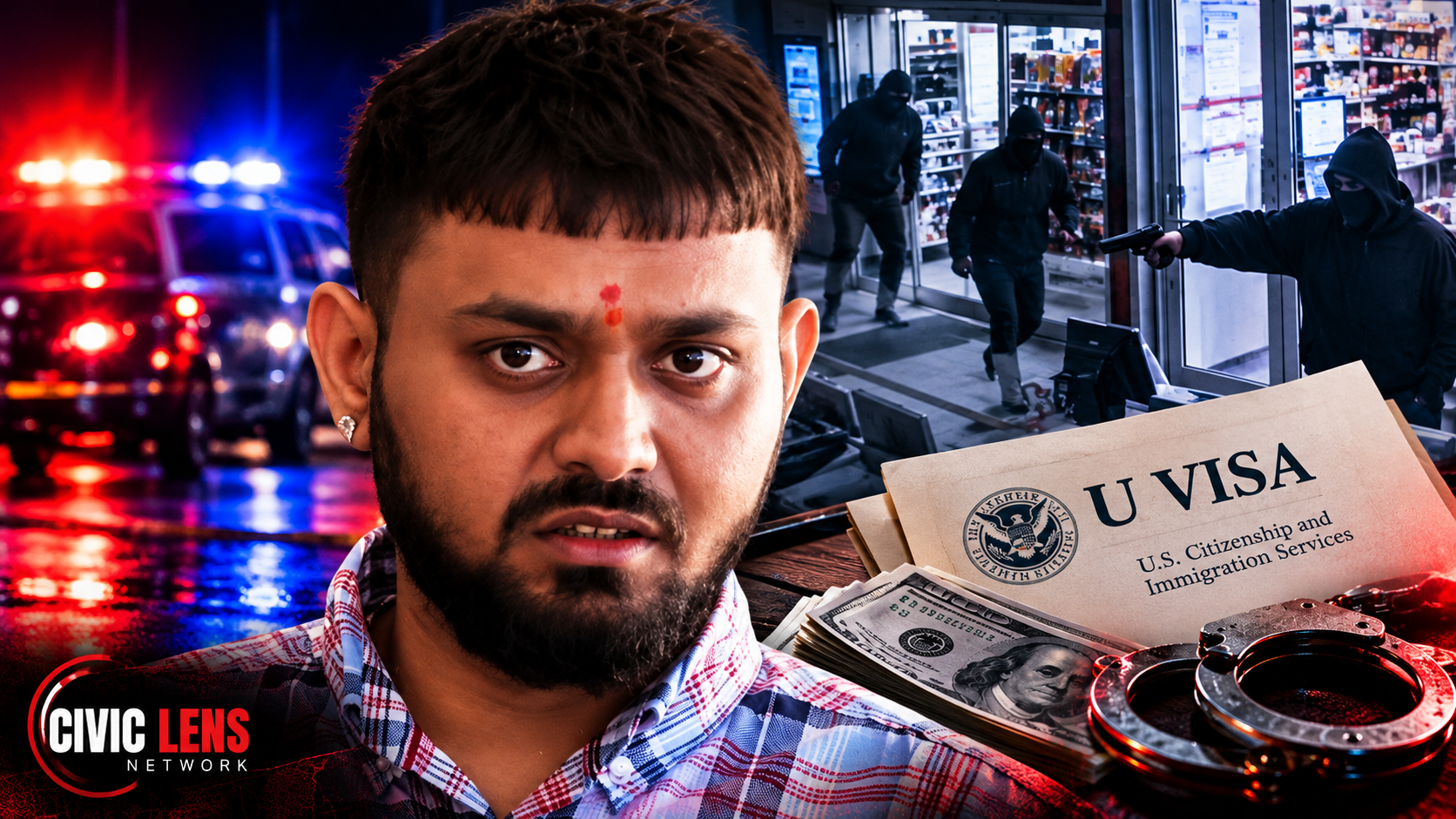
A suburban Chicago man who federal prosecutors say sat at the center of hundreds of staged armed robberies has been sentenced to two years in prison. The scheme was designed so thousands of people could pose as crime victims and seek U visas reserved for genuine victims of serious crimes who assist law enforcement. One of those staged holdups ended with a store employee critically injured by gunfire. On October 22, 2026, U.S.
District Judge Mary M. Rowland sentenced Parth Nayi, 29, of Woodridge, Illinois, to two years in federal prison and a $50,000 fine after he pleaded guilty earlier this year to conspiracy to commit visa fraud. The U.S. Attorney’s Office for the Northern District of Illinois announced the sentence the next day.
Assistant U.S. Attorney Saqib Mohammad Hussain told the court that Nayi “was the main organizer and at the center of almost every single one of the hundreds of staged robberies that were perpetrated” and “significantly corrupted the federal U Visa program, designed to provide a benefit to a particularly vulnerable group—foreign nationals who are victims of serious crimes while visiting the United States.”
Homeland Security Investigations Special Agent-in-Charge Matthew Scarpino added that Nayi “turned a program meant to protect vulnerable victims into a criminal enterprise for profit.” From 2022 to 2024, Nayi organized and participated in hundreds of staged armed robberies at coffee shops, restaurants, liquor stores, and gas stations across the country. Locations included Chicago and the Illinois suburbs of Lombard, Elmwood Park, St. Charles, Hickory Hills, River Grove, Lake Villa, and South Holland.
Court documents also list sites in Rayne, Louisiana, and Belvidere, Tennessee. Nayi and others recruited people to pose as victims, paid store owners to allow use of their locations, coordinated and paid individuals to act as robbers, and coached the purported victims on what to do afterward. During the staged events, people acting as robbers brandished what appeared to be firearms, approached the purported victims, and demanded money.
On some occasions, prosecutors said, the actors struck the supposed victims to make the scenes look more real. Thousands of individuals each paid Nayi between $5,000 and $30,000 to participate so they could later claim to be robbery victims eligible for Nonimmigrant U visas. After the staged robberies, the purported victims submitted forms to local law enforcement seeking certification that they were victims of a qualifying crime and had been or would be helpful in an investigation.
With that certification in hand, they then submitted fraudulent U-visa applications to U.S. Citizenship and Immigration Services based on their claimed status as robbery victims. The U visa, created under the 2000 Victims of Trafficking and Violence Protection Act, provides temporary legal status to foreign nationals who are victims of certain serious crimes and who assist law enforcement. It is capped at 10,000 principal approvals per year and can open a path to permanent residency for the applicant and certain family members.
The program was intended to encourage genuine victims of violence, including trafficking and domestic abuse survivors, to come forward. Federal prosecutors say the Nayi operation deliberately manufactured the appearance of those crimes for profit. The scheme turned genuinely dangerous on July 13, 2023, at Bucktown Food & Liquor at 1950 North Milwaukee Avenue in Chicago. The federal indictment lists this incident among the overt acts of the conspiracy, stating that Nayi and co-defendant Kewon Young organized and executed a staged robbery there.
Contemporaneous police reports and local coverage described three masked men, each armed with a handgun, entering the store around 9:23 p.m. and ordering five people to hand over their wallets. One of the men accidentally discharged a firearm, striking a 26-year-old store employee in the abdomen. The employee was critically injured but survived. The men fled in a Kia that had been reported stolen earlier that day.
The indictment treats the event as part of the larger staged-robbery conspiracy. An innocent worker, not a participant in the fraud, suffered a life-threatening wound so others could generate paperwork for immigration benefits. A May 2024 federal indictment charged Nayi, Kewon Young of Mansfield, Ohio, and four others—Bhikhabhai Patel, Nilesh Patel, Ravinaben Patel, and Rajnikumar Patel—with conspiracy to commit visa fraud.
Young, described as another leader who recruited people to act as robbers, pleaded guilty on the same day as Nayi and is awaiting sentencing early next year. Bhikhabhai Patel pleaded guilty and received one year of probation. Nilesh Patel and Ravinaben Patel pleaded guilty and were sentenced to time served plus one year of supervised release. Rajnikumar Patel was convicted by a jury; his sentencing is scheduled for November 30.
The Justice Department has stated that five other individuals have been convicted as part of the federal investigation. The government’s sentencing memorandum estimated Nayi’s personal proceeds at a conservative minimum of $2 million in cash. Investigators built the case through surveillance footage, financial records, communications, and the testimony of cooperating participants, including Nayi’s own testimony at Rajnikumar Patel’s trial. Local police departments that issued the certifications, combined with the sheer volume of similar reports, helped expose the pattern.
Public resources were consumed responding to fake 911 calls and processing the resulting paperwork. The government noted that a substantial percentage of U-visa applicants during the relevant period were tied to these staged events. No public statements from U.S. Citizenship and Immigration Services detailing the final disposition of every application linked to this specific scheme have been released.
The process requires law-enforcement certification of victim status and helpfulness before USCIS adjudicates the petition. Critics of the program’s safeguards have long noted that once a certification is issued, deeper verification of the underlying facts can be limited, creating an opening for organized fraud of the kind prosecutors describe here. Homeland Security Investigations has said it will continue identifying and holding accountable those who abuse immigration benefits through fraud. This Illinois-based operation is distinct from other prosecuted schemes involving staged crimes and U-visa applications.
In Massachusetts, for example, federal prosecutors charged eleven Indian nationals in connection with staged armed robberies of convenience stores and restaurants. Rambhai Patel was later sentenced to roughly 20 months and ordered to forfeit $850,000 after admitting involvement in multiple staged incidents. Separate investigations have examined clusters of suspicious police reports used in visa applications in other states. Those cases involve different organizers, different victims, and different court proceedings.
The Nayi case shows how a program created for real victims of violence was turned into a commercial enterprise. Store owners were paid to host the scenes. Actors were paid to brandish weapons. Participants paid thousands of dollars each for the chance to claim victim status.
An uninvolved employee was shot. Legitimate crime victims who truly need the protections of the U visa were competing for a capped benefit against people who manufactured the crimes. Federal prosecutors and judges have now held several participants accountable. The remaining question is whether the verification process that allowed hundreds of staged robberies to generate applications will be tightened so that the next scheme is stopped before someone else is hurt.