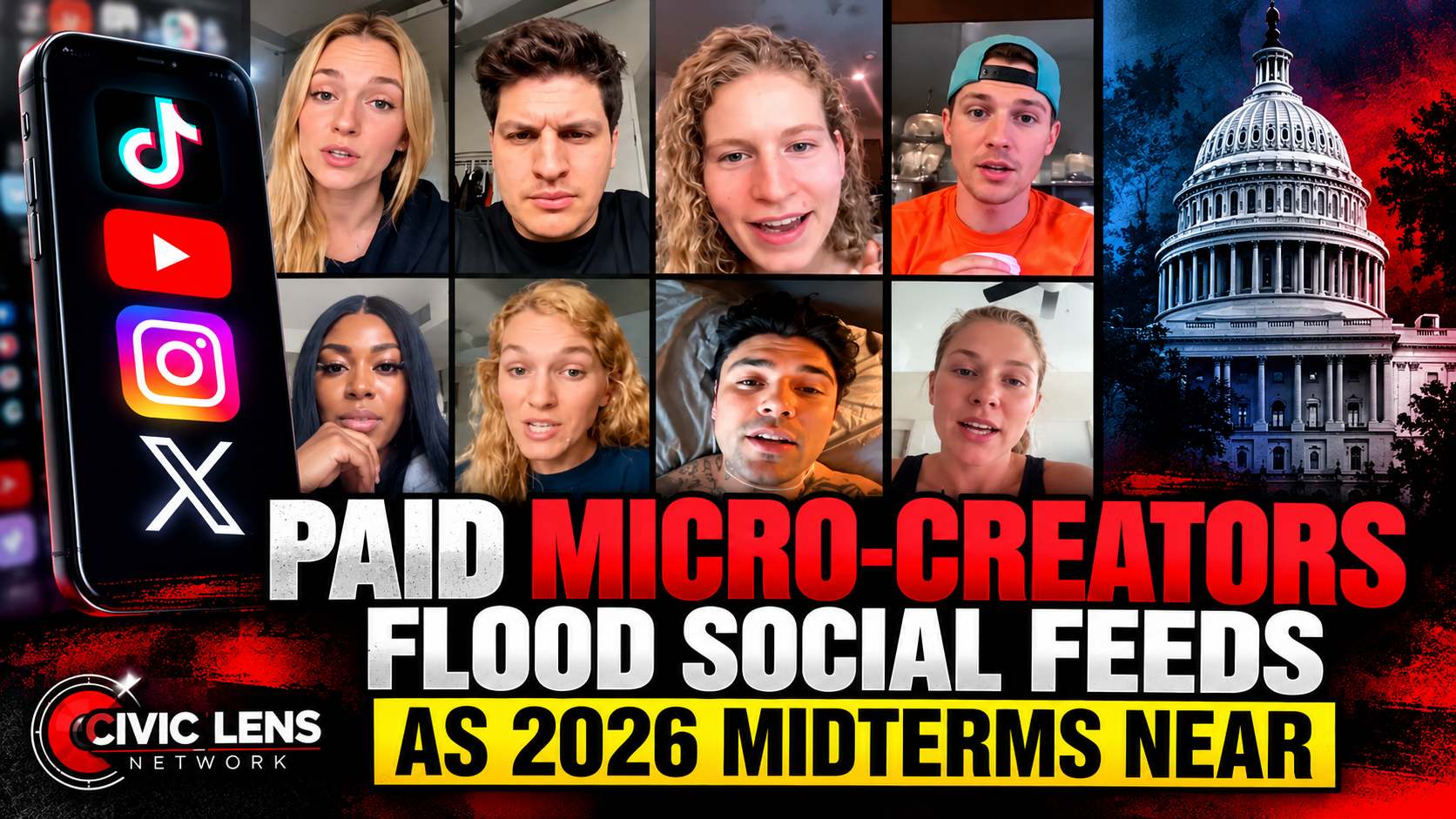
Political groups are paying large numbers of little-known social media creators to talk about elections and policy on TikTok, Instagram, YouTube, and X, often in videos that look like ordinary people venting about groceries, rent, or a candidate they just discovered. The practice is legal in most federal races. Disclosure is uneven. Voters frequently cannot tell whether a casual rant is unpaid opinion or a gig.
The strategy is different from hiring a celebrity. User generated content marketplaces such as SideShift let sponsors post briefs, hire dozens or hundreds of small accounts, and pay per video. SideShift co-founder Nick Lawton has argued that brands grew tired of paying five or six figures for a single post and now want volume. Company materials describe high output short-form video as cheaper than conventional ads.
One SideShift listing reviewed this summer by MS NOW offered about $1,500 a month, described as $30 a video plus bonuses, for posts on “the rising crisis of affordability” ahead of the midterms. Volume is the point. A few large influencers can be expensive and easy to identify. A swarm of small accounts can put similar language into many recommendation feeds at once.
Critics call that digital astroturfing: coordinated messaging designed to look spontaneous. Samuel Woolley, a University of Pittsburgh researcher who studies online influence, has said creators can be unusually persuasive precisely because they feel personal, and that many feel more pressure to label a commercial partnership than a political one. Operators pitch the same volume as a way to raise the odds that some clips go viral. There is no public proof that any single 2026 campaign secretly rewrote a platform algorithm.
There is clear evidence that sponsors are buying quantity because platforms reward engagement and repetition. Documented pay rates span a wide range. In Michigan this summer, a SideShift creator who spoke with MS NOW said she earned about $400 for 30 posts that moved from cost-of-living complaints to support for Rep. Haley Stevens in the Democratic Senate primary.
Several videos used the same phrase, “Make it make sense.” One participant was a South Carolina web designer, not a Michigan resident. Stevens’s campaign and the Senate Democratic PAC said they were not involved. Who paid the SideShift job was not identified in that reporting.
Larger checks go to bigger names and agencies. Boston Globe review of California filings found Tom Steyer’s gubernatorial campaign listed SideShift work at $1,000 a month for daily posts, paid culture account The Shade Room $25,000, and hired Latino creator Carlos Eduardo Espina as a campaign consultant for $100,000. Associated Press described Instagram creator Shaka Smith telling more than 700,000 followers he supported Steyer and stating in the caption that the campaign paid him.
Katie Porter’s campaign, in separate cycle reporting based on filings, paid multiple creators as well. On the Republican side, Hollywood Reporter found Los Angeles mayoral candidate Spencer Pratt’s committee spent $30,025 with Clipping Culture LLC and $50,000 with Cliphaus Inc. to push short clips of debates and podcast appearances. Clipping Culture later said one Pratt effort generated more than 17 million views from thousands of short videos.
Federal filings and press analyses show the National Republican Congressional Committee paid Creator Grid, which markets itself as connecting Republican candidates with conservative influencers, more than $120,000 in 2025 and 2026. Washington Post analysis of earlier filings put NRCC Creator Grid spending near $500,000 in the prior cycle. Older conservative work followed the same small-check model. Texas Tribune and Texas Monthly documented Influenceable recruiting posts in support of Attorney General Ken Paxton during his 2023 impeachment fight at $50 a tweet.
Defend Texas Liberty PAC, financed in large part by West Texas donors Tim Dunn and Farris Wilks, paid Influenceable $18,000 that May. Texas Monthly reporter Michael Hardy signed up, posted, and received $100 from Influenceable LLC. Democratic-aligned infrastructure is also paying creators at scale. Chorus, which Sixteen Thirty Fund has acknowledged as a 2025 project, offered monthly stipends.
Wired reviewed contracts describing tiers from a few hundred dollars to as much as $8,000 a month and clauses limiting public discussion of funders. Chorus now says it pays standardized stipends of $5,000 a month in its incubator and $2,000 in its accelerator for training time, not for specific posts, and that it does not pay creators to produce assigned political videos. House Oversight Chairman James Comer has subpoenaed Sixteen Thirty Fund records about the program.
Sixteen Thirty Fund has said it served as a fiscal sponsor and is not the original source of all financing. Campaigns also route money through consulting firms. Politico reported House Majority PAC paid Good Influence $349,895.50 for social media consulting this cycle, Mary Peltola’s Alaska Senate campaign paid the firm $87,000, and Mark Warner’s Virginia Senate campaign paid $60,000. CNN quoted creator accounts of an $800 Planned Parenthood post and a $2,500 prize inside a pro-Harris PAC contest.
Good Influence’s founder has said disclosure labels can reduce distribution, which is one reason some creators skip them. Federal rules leave a gap. The Federal Trade Commission requires clear disclosure of paid product endorsements. FTC staff guidance states the Endorsement Guides do not apply to political advertisements.
The Federal Election Commission requires disclaimers on “public communications,” including ads placed for a fee on a website, app, or advertising platform. The commission has treated a campaign payment to a person to post on that person’s own account as outside that category. Shanna Ports of Campaign Legal Center told ABC News that, at the federal level, there is generally no required disclaimer on an influencer’s own post, so viewers cannot tell paid support from organic support.
The DNC says its creator program shares clips and briefings and does not pay influencers to post. States have moved first. Texas requires disclosure when an influencer is paid more than $100 for a political post in state races. California has required paid political post disclaimers since 2024 and this month authorized fines of up to $5,000 per violation.
Those laws do not govern federal contests. Bills in Congress, including the PAID Act, would require a paid label when a candidate or committee pays a creator. None has become federal law. Paying a creator to discuss politics is not automatically illegal.
Issue advocacy, candidate consulting, and independent speech can be lawful. What is often missing is a label that would let a viewer know money changed hands. That is why organizations prefer user generated video that resembles a neighbor talking into a phone. It is cheaper than television.
It travels through friend networks. And under current federal rules, it frequently arrives without the “paid for by” line that still appears on a mailer or a TV spot.