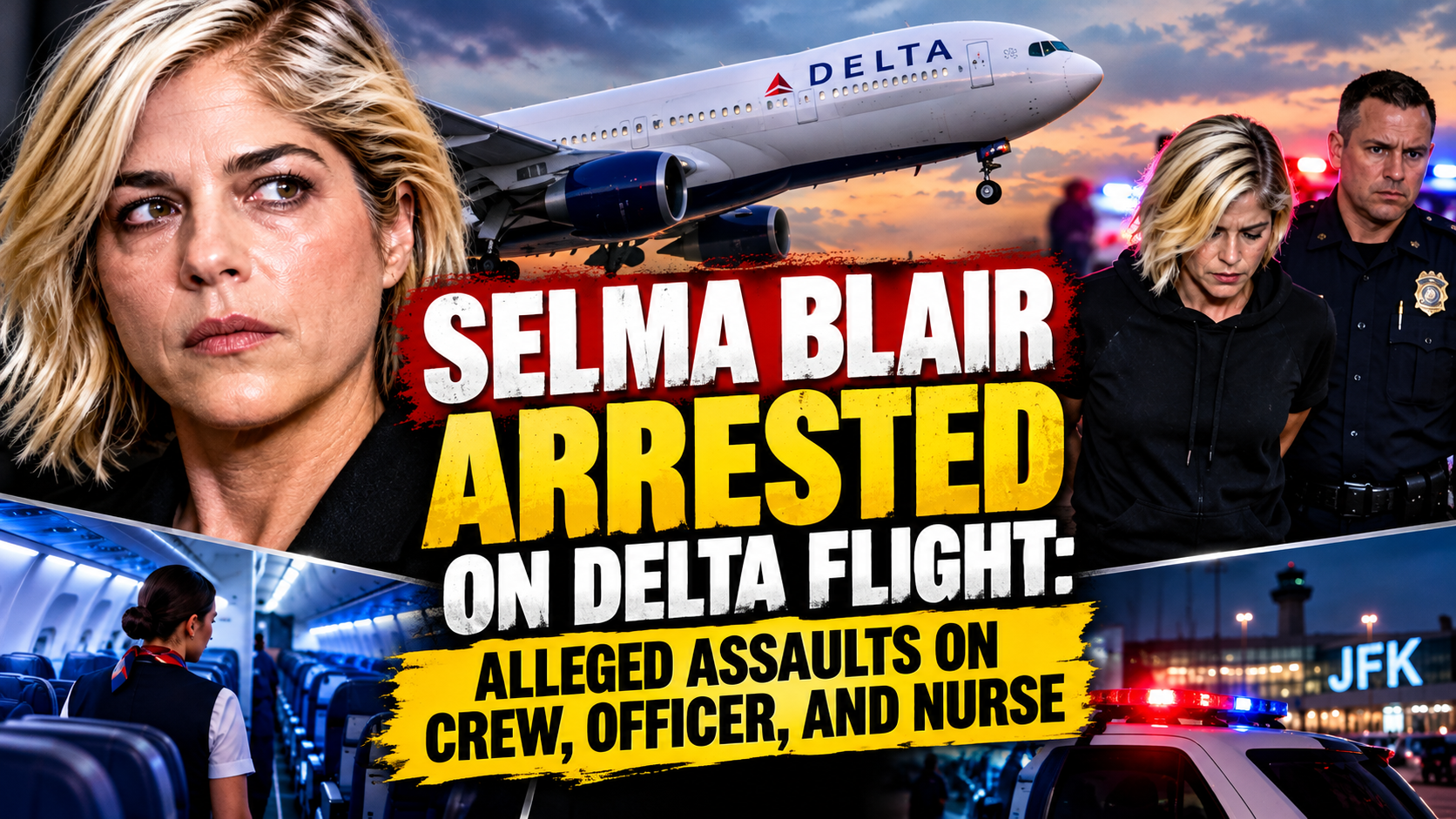
Actress Selma Blair faces felony assault charges after an alleged violent incident on a Delta flight from Los Angeles to New York, including reported attacks on flight attendants, a Port Authority officer, and a nurse. Details on bail, order of protection, medical claims, and next court date. Thousands of feet above the country on the evening of October 11, 2026, passengers aboard Delta Airlines Flight 938 from Los Angeles International Airport to New York’s John F.
Kennedy International Airport encountered a scene that escalated rapidly from disruption to physical confrontation. Port Authority of New York and New Jersey police later described responding to a call about a “physically abusive passenger” once the aircraft reached the gate around 11 p.m. The passenger was identified as actress Selma Blair, 54, known for roles in Cruel Intentions, Legally Blonde, and Hellboy. According to multiple published reports citing law enforcement sources and air traffic control audio, Blair allegedly punched one flight attendant and bit another.
Audio captured a pilot requesting medical assistance upon landing and referencing a bloody nose along with bite marks. Two flight attendants reported injuries; one was transported to a hospital. Some accounts also described Blair attempting to open an aircraft door midflight, though Delta later stated it could not corroborate that specific detail. There were additional references to the possibility that Blair had struck her head against a bulkhead.
She was restrained with plastic restraints aboard the plane before authorities boarded at the gate. Blair was taken into custody and transported by ambulance to a hospital for evaluation. The FBI is investigating the onboard events. The allegations continued after landing.
While Port Authority Police Officer Maria Suarez was securing Blair on a stretcher for transport from the terminal to an ambulance, Blair allegedly freed a leg from the straps and kicked the officer repeatedly in the face, neck, and chest. Charging documents state that Suarez sustained substantial pain and swelling and required hospital treatment. Hours later, at Jamaica Hospital Medical Center in Queens, Blair allegedly kicked a registered nurse in the chest while the nurse assisted with transport for further treatment.
The nurse reported substantial chest pain. These post-landing allegations form the basis of the state charges. In Queens Criminal Court on October 12, Blair pleaded not guilty to two counts of second-degree assault, felonies under New York law that cover assaults on protected workers such as police officers and nurses. Judge Indira Khan set bail at $20,000 cash or a $60,000 bond, including a partially secured option.
Blair posted bail and was released. The judge also issued a temporary order of protection for the nurse, identified in some reports as Ashley DeLeo. The order prohibits Blair from coming within 100 yards of the nurse and bars any contact by phone, text, email, or other electronic means. Such orders remain in effect for a defined period, in this case reported as lasting until October 11, 2027, or approximately one year.
They carry legal weight: violation can result in additional charges and is intended to prevent further contact or intimidation while the case proceeds. Blair’s next scheduled court appearance is January 19, 2027. Separately, she received a federal summons for assault within the special maritime and territorial jurisdiction of the United States related to the aircraft incident. Federal proceedings will move on their own track.
Each state felony count carries a potential sentence of up to seven years if convicted. Blair’s attorney, Shawn Barnes, told the court that his client had worked extensive hours on set before the flight, fell and hit her head aboard the plane, and missed doses of medication prescribed for multiple sclerosis. He described resulting severe confusion and disorientation and characterized the events as a medical emergency rather than intentional assault.
Blair’s publicist, Jill Fritzo, issued a statement that Blair “experienced a medical emergency that led to the alleged conduct,” received immediate medical attention upon landing, and was in stable condition. These explanations are defense claims and public statements. They have not been independently established as medical findings by outside authorities in the available reporting. Prosecutors proceeded with the charges based on the reported physical acts and injuries.
Blair has publicly documented her multiple sclerosis diagnosis since 2018. The chronic autoimmune condition affects the central nervous system and has no cure. She has spoken extensively about living with the disease, appeared in a documentary detailing her treatment, and advocated for awareness. Nothing in the public record or court filings to date establishes that the disease caused or excused the alleged violence.
Medical experts generally note that MS can produce a range of neurological symptoms, but any link to specific violent acts requires individualized clinical evidence that has not been presented here. This is not Blair’s first documented airplane incident. In June 2016, while returning from Cancun to Los Angeles with her young son and his father, she mixed alcohol with medication, experienced a blackout, and was removed from the aircraft on a stretcher and taken to a hospital.
She later issued a public apology, stating that the combination caused her to say and do things she deeply regretted, and described the episode as a total psychotic blackout. She subsequently embraced sobriety. The 2016 circumstances involved alcohol and a specific medication interaction that she herself acknowledged. Reporting on the 2026 events has not established the same combination of factors.
The earlier case remains relevant only as documented history, not as proof of identical causation. Questions have arisen about whether Blair’s celebrity status affected her treatment. During the arraignment, her attorney referenced her body of work and described her as a “gold standard.” The judge responded that she should not receive special treatment because she is a celebrity.
The bail amount and conditions align with typical arrangements for second-degree assault charges involving alleged injuries to protected workers. Federal authorities opened their own investigation without apparent delay. Available records show no public evidence of preferential charging decisions or unusual procedural leniency beyond the ordinary application of bail statutes and protective orders. Injuries have been independently confirmed at several levels.
The Port Authority stated that two flight attendants reported injuries and one was taken to a hospital. Air traffic control audio referenced a bloody nose and bite marks. The criminal complaint and affidavit detail the officer’s reported substantial pain, facial and jaw swelling, and hospital treatment, along with the nurse’s substantial chest pain. These accounts come from official statements and sworn documents rather than uncorroborated witness speculation.
Delta Airlines stated that it has zero tolerance for unruly or unlawful behavior and that the safety of customers and crew comes first. The airline confirmed law enforcement met the flight and reported no operational impact. The FBI continues its investigation into the onboard allegations. Potential consequences include state prison exposure on the felony counts and separate federal penalties if those charges advance.
The January 19, 2027, court date will determine the next steps in the Queens case. Airline safety protocols exist precisely because flight crews operate in a confined space with limited options for intervention until landing. Protecting those crews, along with police officers and medical personnel who respond afterward, remains a practical priority regardless of a passenger’s public profile or claimed medical state.
When an alleged violent incident may overlap with a genuine medical emergency, authorities must still secure the aircraft, document injuries, and allow the legal process to sort intent, capacity, and accountability. Selma Blair’s case now tests those lines in public view. The facts established so far center on reported physical acts, documented injuries, formal charges, and a defense that attributes the events to a medical crisis. Courts will decide which elements meet the standards of proof.