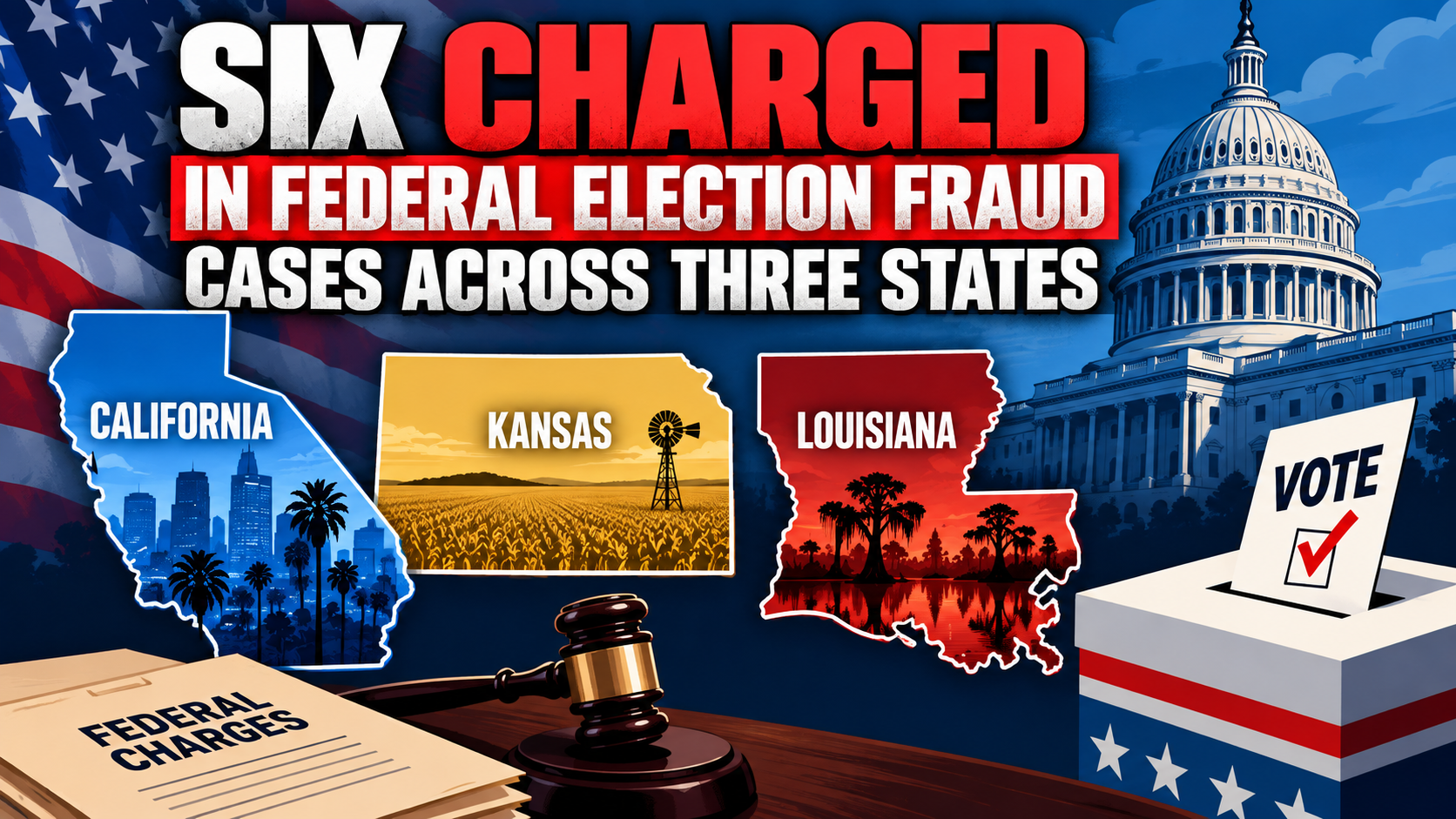
Federal prosecutors announced on September 14, 2026, that six people face criminal charges in three separate cases spanning California, Kansas, and Louisiana. The Justice Department said the cases involve alleged identity fraud on California ballot petitions, alleged illegal voting by noncitizens, and alleged fraudulent voter registration. The prosecutions were announced together. Officials did not describe them as one coordinated conspiracy.
None of the six defendants has been convicted of the federal charges described in the announcement. The allegations remain unproven in court. Attorney General Todd Blanche said, “If you are gaming the election system, voting illegally, or committing voter fraud, you are breaking the law, and the Department will ensure such individuals cannot corrupt future elections.” FBI Director Kash Patel said protecting election integrity is a top FBI priority and that every American citizen has a right to free and fair elections.
Homeland Security Secretary Markwayne Mullin said two noncitizens in Kansas and Louisiana were charged with illegally voting and argued that only U.S. citizens should decide the country’s elections. The California case is the most detailed of the three. Prosecutors in the Central District of California charged James Brass, 47, of Victorville, also known as “Lord”; Courtney Price, 49, of Jacksonville, Florida; and Jateisha Herron, 33, of Boron, California.
All three are charged with one count of conspiracy to commit identity fraud in furtherance of a state felony. Brass and Price are also charged with one additional count of identity fraud in furtherance of a state felony. If convicted, each defendant faces a maximum of five years in federal prison on each count. According to the indictment, Brass managed a team of signature collectors and collected signatures himself.
Price and Herron worked for him as petition circulators. From February through August 2026, prosecutors allege, the defendants used a database to identify registered California voters. On Skid Row in downtown Los Angeles, Brass and Price allegedly handed out those voters’ identities and paid people to copy the voters’ personal information onto ballot initiative petitions and sign the petitions in the voters’ names. Prosecutors further allege that Brass and Herron then signed declarations at the bottom of the petitions.
Those declarations, made under penalty of perjury, stated that they had personally witnessed the named registered voters sign and that each signature was genuine. Brass and Herron then turned the petitions in to petition coordinators, prosecutors say, knowing the false statements would cause fraudulent signatures to be counted toward qualifying initiatives for the California ballot. California’s initiative process requires hundreds of thousands of signatures in a short window. To qualify a proposed statute for the 2026 ballot, proponents needed 546,651 signatures.
A proposed constitutional amendment required 874,641 signatures. Petition management companies typically hire collectors and pay by the valid signature. Prosecutors allege Brass received about $41,600 from coordinators working with one such company. First Assistant U.S.
Attorney Bill Essayli said the defendants are charged with using stolen identities of registered voters to manufacture signatures on petitions used to shape California law. He said they allegedly used people, including members of Skid Row’s homeless population, to try to cover their tracks. The FBI is investigating the California case. Brass was arrested last week and has pleaded not guilty in federal court in Riverside.
A court released him on a $10,000 bond, according to contemporaneous reporting. Price and Herron have been charged. Their cases remain pending. The Kansas case is separate.
A federal grand jury in Wichita charged Mariana Alexandra Dewey, 24, a Peruvian national and lawful permanent resident, with one count of false claim of citizenship, one count of false claim of United States citizenship in order to vote, one count of fraudulent election conduct, and one count of voting by an alien in a federal election.
Prosecutors allege that in November 2024 she falsely represented herself as a U.S. citizen to register and then cast a ballot that included candidates for president, vice president, Senate, and House of Representatives. Homeland Security Investigations is investigating. U.S. Attorney Ryan A.
Kriegshauser said people not legally authorized to vote who are later found by a court to have claimed citizenship and voted in federal elections face serious criminal consequences. Dewey’s initial federal court appearance was scheduled for September 14. The Louisiana case is also separate. A federal grand jury charged Bridget Johnson, 53, of Cotton Valley, with fraudulent voter registration and voting by an alien.
It charged Michael Wedderburn, 52, a Jamaican national, with voting by an alien. Johnson was a 2024 candidate for mayor of Cotton Valley. Prosecutors allege that on July 14, 2024, she completed and electronically submitted a Louisiana voter registration application in Wedderburn’s name and falsely stated that he was a U.S. citizen. The indictment alleges Wedderburn later voted illegally in the November 5, 2024, election for a federal office and in the Cotton Valley mayoral race.
If convicted, Johnson faces a maximum of five years in prison. Wedderburn faces a maximum of one year in prison plus financial penalties. The FBI investigated with assistance from the Louisiana secretary of state’s office. U.S.
Attorney Zachary A. Keller said the right to vote is sacred and that fraud or abuse threatens public confidence in elections. Secretary of State Nancy Landry said her office referred information to federal partners and that one illegal vote is one too many. Taken together, the announcement covers alleged petition identity fraud in Los Angeles, alleged noncitizen voting in Kansas, and alleged fraudulent registration and illegal voting in a small Louisiana town.
The Justice Department presented the cases as examples of election related prosecutions, not as proof of a single nationwide scheme. Guilt or innocence will be decided in court.