On October 17, 2026, demonstrations that began weeks earlier over dilapidated French high schools and teacher shortages escalated into the most violent nationwide unrest in years. Interior Ministry figures put participation at roughly half a million people. Authorities reported more than 2,300 arrests, nearly 1,000 security personnel injured, widespread looting, arson, and attacks on public buildings and businesses. Partial curfews followed in Paris, Marseille, and other cities.
Prime Minister Sébastien Lecornu acknowledged intelligence and deployment failures and ordered troops to reinforce police ahead of further actions. Similar scenes unfolded the same day in Milan, where a cost-of-living march featuring Palestinian flags devolved into clashes, shop looting, and fires; Italian authorities later prepared to deploy 500 troops. These events did not occur in isolation. A Fox News Digital investigation by Asra Q.
Nomani, published October 20, identified 101 organizations across nine countries involved in organizing, coordinating, or amplifying the French and broader European actions. Only about one-third were student or youth groups; the rest included adult-led communist parties, revolutionary socialist organizations, labor unions, and pro-Palestinian networks. The same reporting traced amplification through media and activist outlets linked to American financier Neville Roy Singham. French officials have accused La France Insoumise of exploiting legitimate grievances.
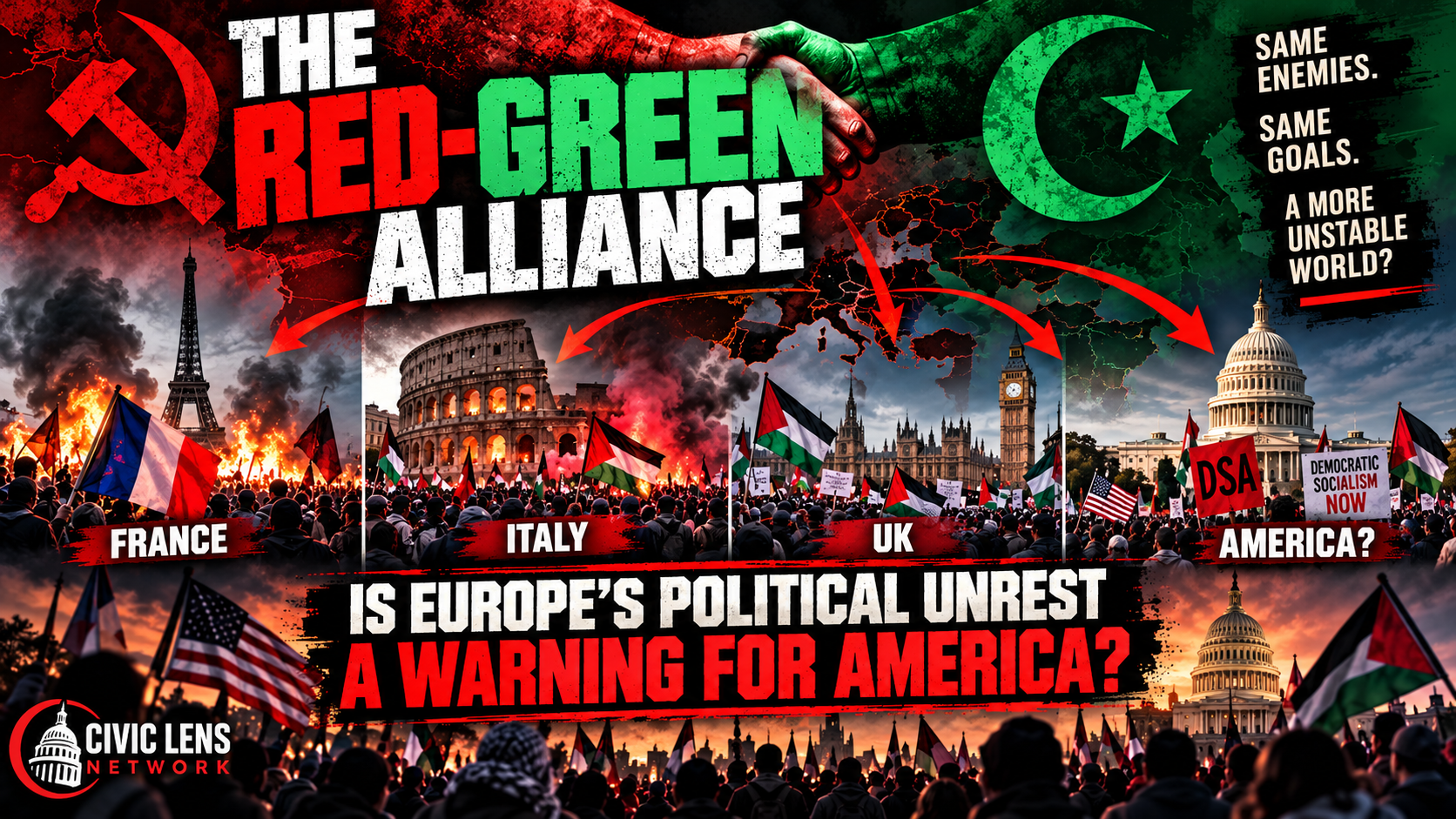
What remains contested is the precise degree of operational coordination versus overlapping ideology and opportunistic mobilization. The Red-Green Alliance in Practice The term “Red-Green Alliance” describes cooperation between revolutionary socialist, communist, and radical-left groups on one side and political Islamist organizations on the other. The groups hold incompatible views on religion, social issues, and gender roles, yet they converge on hostility to Western foreign policy, capitalism, Israel, and existing liberal democratic institutions.
Britain’s independent review Protecting Our Democracy from Coercion, delivered by Lord Walney in May 2024, documented these relationships. The review defined the Far Left as groups seeking to overturn current systems of government along communist or socialist lines or preferring direct action over democratic processes. It defined Islamism as a 20th-century political ideology treating Islam as a complete socio-political system and advocating an expansionist Islamic state under Sharia.
The review found that British Far Left and Islamist organizations have cooperated extensively on anti-Israel activism, including through the Together for Palestine coalition. That coalition included the Stop the War Coalition, the Muslim Association of Britain (linked by the UK’s own Muslim Brotherhood review to the Brotherhood’s UK network), the Palestine Solidarity Campaign, and others. Stop the War, founded in 2001 with leading roles for Socialist Workers Party figures such as Lindsey German, has long partnered with Islamist groups on anti-war and anti-Israel marches.
The review noted shared framing of “imperialism” and “the state” as common enemies, joint protest organization, and instances of antisemitic incitement and glorification of violence in post-October 7, 2023 demonstrations. These alliances are often temporary protest coalitions built around single issues. They also reflect longer-term strategic calculation: each side gains numbers, legitimacy, and street power the other cannot supply alone. Revolutionary leftists gain cover and recruits on anti-Western causes; political Islamists gain access to established left networks, media, and unions.
Neither side has abandoned its core goals. France: From Classroom Grievances to National Disorder French high-school protests began around September 18–21 in the Créteil district and poorer suburbs, sparked by teacher absences, overcrowded classes (among Europe’s largest), crumbling buildings, and lost instructional hours. Student unions, teachers’ unions, and parents joined. By early October, hundreds of lycées and some universities faced blockades.
Interior Ministry counts put one major day at approximately 256,000 participants; unions claimed higher figures. Thousands were arrested, the large majority minors. At least two dozen schools were ransacked or burned. Education Minister Édouard Geffray deployed substitute teachers and met student leaders, but concessions did not end the movement.
La France Insoumise and its youth wing publicly supported the actions. Party figures appeared at rallies; Jean-Luc Mélenchon called for adults to join while urging restraint. Government officials, including multiple former prime ministers, accused the party of stoking unrest for electoral advantage ahead of 2027 presidential contests. LFI has denied directing violence.
Communist Party activists, New Anticapitalist Party chapters, antifascist collectives, and pro-Palestinian groups were visibly present. On October 17, Yellow Vest networks focused on living costs converged with the student actions. Masked groups attacked police, set fires, and looted. French authorities have established the scale of disorder and the participation of organized political factions; they have not publicly detailed a single unified command directing the violence.
Nomani’s investigation lists French Communist Party elements, revolutionary communist organizations, regional “Block Everything” coordinations, national high-school student bodies, and various collectives promoting “Acte II” for October 24. It explicitly notes that classification of an organization as part of the network does not prove every participant engaged in violence or that a single revolutionary headquarters issues orders.
Italy and the United Kingdom In Milan on October 17, a march organized under an “Italia in Piazza” banner against rising living costs and fuel prices began with Palestinian flags and keffiyehs. It turned violent near Piazza del Duomo: stones and barricades were thrown, shops were looted, a portable toilet was set ablaze, and police used tear gas and water cannons. Roughly 50 people were detained; dozens were injured, including officers. Clashes occurred in Turin, Bologna, and other northern cities.
Earlier, on October 10, pro-Palestinian marches in Milan and elsewhere drew left-wing flags (including Rifondazione Comunista and Potere al Popolo) and, in some cases, rhetoric celebrating October 7 as resistance. Student collectives and pro-Palestinian networks participated; some later distanced themselves from the worst rioting. Deputy Prime Minister Matteo Salvini announced troop deployments to Milan. In Britain, the Stop the War Coalition remains the clearest historical example of red-green cooperation.
Its founding and leadership ties to the Socialist Workers Party and Communist Party of Britain, combined with formal alliances with the Muslim Association of Britain, produced the largest anti-Iraq War marches and later sustained pro-Palestinian mobilizations. Current British demonstrations share political causes and some participants with continental actions but show no public evidence of operational command-and-control links to the French or Italian unrest. They reflect parallel ideological networks rather than a single transnational apparatus.
The American Connection The Democratic Socialists of America has published platforms calling for the abolition of capitalism, a second constitutional convention or new democratic constitution, public ownership of major industries, and the construction of a mass working-class party capable of taking state power. Its materials describe mobilizing through strikes, occupations, and mass demonstrations to create a crisis of legitimacy for existing institutions and to advance a democratic road to socialism. DSA does not claim to control other organizations.
Documented cooperation includes joint events with the Palestinian Youth Movement. On October 10, 2026, DSA contingents in New York and Washington, D.C., joined PYM-led marches marking three years since the start of the Gaza war and demanding an arms embargo. CODEPINK organized a feminist contingent for the D.C. event. DSA’s National Arms Embargo Organizing Committee has worked with PYM and related groups to target companies shipping military material.
Students for Justice in Palestine chapters and American Muslims for Palestine have appeared in overlapping campus and street ecosystems. Party for Socialism and Liberation and BreakThrough News (funded in part through Singham-linked entities) have amplified related content. These are public, joint, or overlapping activities—not proof of a single controlling entity. House Ways and Means Committee letters and prior reporting have documented hundreds of millions of dollars flowing from Singham-linked sources into U.S. nonprofits including The People’s Forum, BreakThrough News, Tricontinental, and CODEPINK.
Singham, resident in Shanghai, has ties to Chinese state-linked propaganda efforts. Receiving funding or amplifying protests is not itself criminal activity; the documented pattern is relevant to transparency about who finances and shapes activist messaging. Is a Color Revolution Underway? Historically, “color revolutions” referred to largely nonviolent mass mobilizations in post-Soviet states—Serbia’s Bulldozer Revolution (2000), Georgia’s Rose Revolution (2003), Ukraine’s Orange Revolution (2004)—that used disputed elections, youth organizing, and sustained street presence to force leadership change.
They were not identical to classic Marxist-Leninist seizures of power, though some later analysts have applied the label more loosely to any large-scale political mobilization. European actions share mass turnout, youth involvement, and anti-incumbent framing. Some participating organizations explicitly advocate replacing existing constitutional arrangements with socialist systems. Others seek policy concessions within the current order.
French and Italian authorities have treated the worst violence as criminal disorder to be suppressed, not as an imminent coup. No public evidence has established a single international revolutionary command directing synchronized regime change across borders. The more cautious description is decentralized ideological cooperation among groups that share enemies, amplified by overlapping media networks, and capable of exploiting real grievances. Upcoming Actions French organizers and Yellow Vest coordinations have announced “Acte II” for October 24 and further activity on October 31.
The government is deploying additional forces. In Britain, Socialist Students and allied groups are building for Socialism 2026 conferences on November 14–15 in London and an International Youth Strike on November 20 under the slogan “Fight for our futures, not their wars,” involving socialist youth organizations across multiple European countries. These events are publicly announced and independently verifiable. No confirmed evidence establishes centralized cross-border operational control linking them to U.S. street actions beyond shared ideology and occasional joint messaging.
Peaceful assembly remains protected; violence is not. What This Means for America Constitutional government, national sovereignty, and public safety depend on distinguishing lawful dissent from organized political violence and on transparency about who funds and directs large-scale mobilization. Conservative analysts and some lawmakers have highlighted the documented left-Islamist cooperation, DSA’s published goals for systemic replacement of current institutions, and Singham-linked funding of activist infrastructure as reasons for scrutiny.
Alternative explanations emphasize genuine economic and educational grievances, the right to protest, and the risk of overstating coordination. Both observations can be true simultaneously: real problems exist, and political factions with revolutionary aims have sought to channel anger. The strongest documented evidence is the long record of red-green protest coalitions in Britain, the visible presence of communist, socialist, and pro-Palestinian organizations in the French and Italian unrest, DSA’s explicit platforms and joint activities with PYM, and the financial trails through Singham-linked nonprofits.
The most significant unanswered questions concern the degree of operational coordination versus parallel action, the precise role of any foreign state actors, and whether upcoming mobilizations will remain within the bounds of lawful assembly. Authorities would need concrete evidence of shared command, financing for violence, or explicit plans for unlawful overthrow—beyond shared ideology and public events—before asserting a coordinated international revolutionary campaign. Until then, the prudent course is rigorous investigation, enforcement of existing public-order laws, and clear protection of peaceful political speech.
Europe’s streets are already testing that distinction. American institutions should not wait for the same test.