For centuries, Christianity and Islam have been presented as two separate religions with fundamentally different beliefs about Jesus Christ, salvation, and the nature of God. Yet when I examine their histories, religious symbols, sacred traditions, and connections to ancient civilizations, I find similarities that raise questions I believe deserve serious examination.
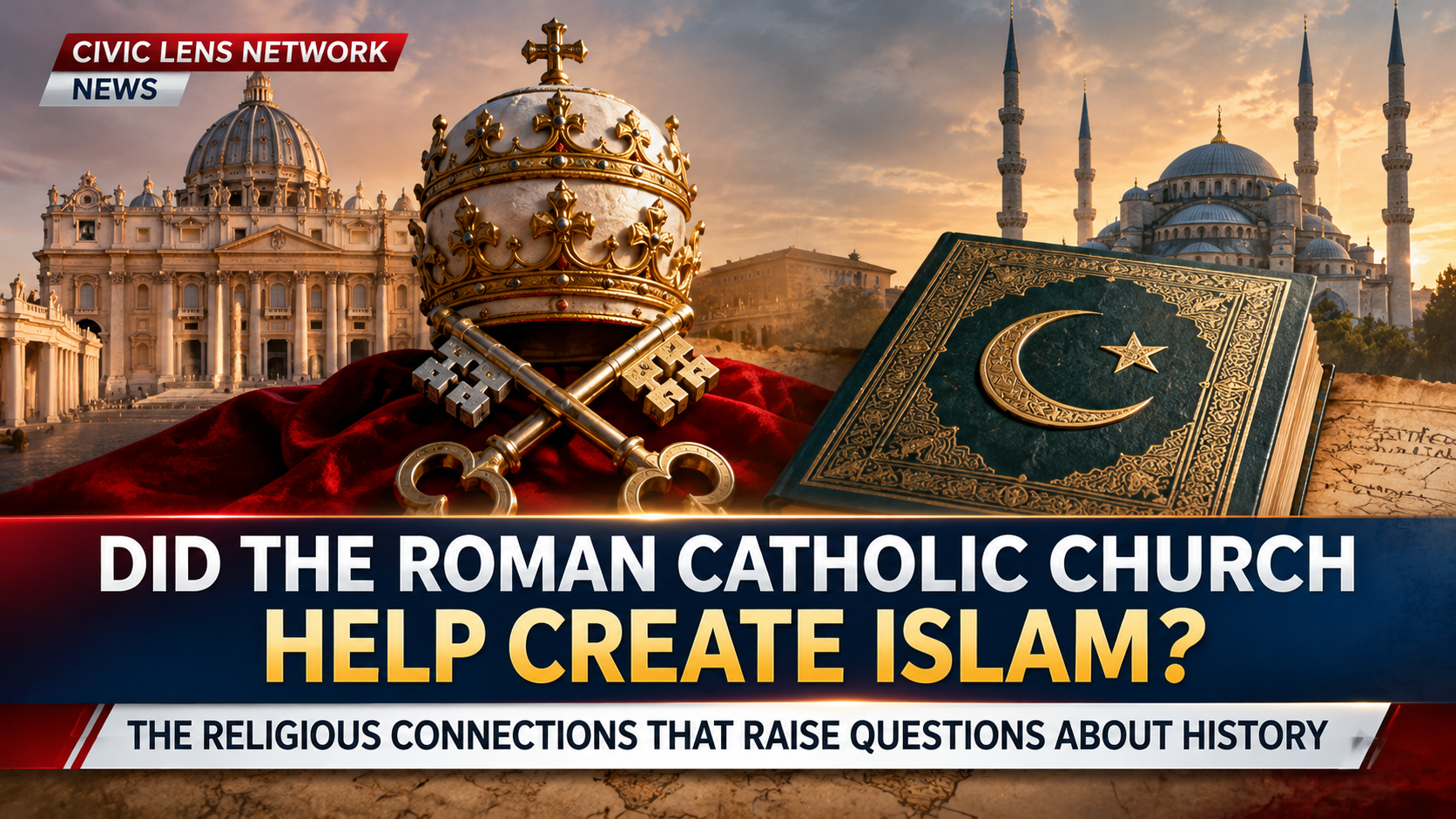
My central question is this: Could the rise of Islam have served the political and religious interests of the Roman Catholic Church?
I believe there is a much deeper story behind the relationship between Rome and Islam, one involving ancient religious traditions, political power, secret societies, and a struggle over the identity of Jesus Christ.
Muhammad, Khadija, and the Christian Connection
Muhammad was born around 570 AD and died in 632 AD. His marriage to Khadija is one of the most important events in his early life.
Khadija was a wealthy businesswoman who employed Muhammad before marrying him. Traditional accounts place Muhammad at approximately 25 years old and Khadija at approximately 40 when they married.
What interests me is the Christian connection surrounding Khadija’s family.
Her cousin, Waraqa ibn Nawfal, is described in early Islamic traditions as a man familiar with Christian scripture. Those traditions place Christian religious knowledge close to Muhammad during the earliest period of Islam.
I want to examine a much more controversial allegation: that Khadija herself had connections to a Roman Catholic convent and that Christian religious figures may have influenced Muhammad’s teachings.
This allegation is central to the theory I am investigating. I do not regard the mere existence of Christian relatives as proof that Rome created Islam, but I believe the relationship deserves examination within the larger historical argument.
Muhammad reportedly received his earliest revelations in a cave. I also find it interesting that caves and secluded religious locations appear in other traditions, including accounts involving Catholic mystics and Marian apparitions.
I see these similarities as part of a broader pattern of religious symbolism that existed long before Islam.
The Crescent Moon, the Star, and Ancient Religion
One of the most recognizable symbols associated with Islam is the crescent moon and star.
I find its resemblance to ancient celestial symbolism particularly interesting.
Throughout Mesopotamia, Egypt, and other ancient civilizations, the sun, moon, and stars played important roles in religious ceremonies.
Ancient cultures used the crescent moon in association with lunar deities, while solar disks and stars appeared in representations of divine power.
I also examine the ancient worship of Baal, Isis, Osiris, and other deities whose symbolism involved celestial bodies and the forces of nature.
In my interpretation, these traditions reveal a religious language that survived across civilizations.
When I examine Catholic religious art, I find additional celestial symbolism, including solar imagery, stars, and crescent-shaped objects.
The Catholic monstrance, which holds the consecrated Eucharistic host for adoration, is especially interesting to me because some designs include a crescent-shaped support.
I compare this imagery with ancient religious symbols and with the crescent associated with Islam.
The question I ask is whether these similarities reflect a shared inheritance from older religious traditions.
Catholic Churches and Mosques Standing Side by Side
During my examination of religious buildings in the Middle East, I have been struck by the proximity of Catholic churches and Islamic mosques.
In Amman, Jordan, I observed a Catholic cathedral situated near a major mosque.
Both buildings contain religious imagery that I compare with ancient celestial symbols.
I also examine the Umayyad Mosque in Damascus, where a shrine associated with John the Baptist occupies an important place within an Islamic house of worship.
John the Baptist is honored in both Christianity and Islam.
To me, this shared reverence is significant because it demonstrates how certain religious figures remain important across traditions that otherwise disagree on fundamental doctrines.
I also examine religious structures built on or near ancient sacred sites.
At Luxor in Egypt, a mosque stands within the ancient temple complex.
Elsewhere, Christian religious buildings occupy locations associated with earlier civilizations.
I believe these examples raise questions about the continuity of sacred places and the ways religious traditions inherit or transform earlier cultural practices.
The Role of Mary in Catholicism and Islam
One of the most important connections I examine is the place of Mary, the mother of Jesus.
In Roman Catholicism, Mary receives extraordinary religious honor. Catholic teachings include her Immaculate Conception and bodily Assumption into heaven.
Islam also honors Mary, known as Maryam, and describes her as specially chosen and purified by God.
The Quran contains accounts of Mary and the miraculous birth of Jesus.
I find this especially significant because Islam rejects the Christian doctrine of Jesus as the divine Son of God while continuing to honor his mother.
The Catholic bishop Fulton J. Sheen discussed Mary’s potential importance in relations between Catholics and Muslims.
His reflections on Mary and the Muslims are particularly relevant to my examination of possible religious reconciliation.
I also examine the Marian shrine at Fatima in Portugal.
The name Fatima has significance in Islamic history because Fatimah was the daughter of Muhammad.
I believe the shared religious attention surrounding Mary and the symbolic importance of Fatima deserve consideration when examining efforts to bring Christianity and Islam closer together.
My concern is that devotion to Mary could become a common religious foundation through which otherwise conflicting doctrines are brought into a larger religious union.
The Ancient Mystery Religions
To understand my theory, I examine the religious traditions of ancient Babylon, Egypt, and the Mediterranean world.
I believe many symbols and practices associated with ancient mystery religions survived through later religious institutions.
The worship of Isis and Osiris, for example, included elaborate symbolism involving motherhood, divine kingship, death, and rebirth.
I compare these themes with later religious images and ceremonies.
I also examine writings associated with Helena Blavatsky, Albert Pike, and other authors who discussed ancient religious symbolism.
Blavatsky’s Isis Unveiled draws comparisons between ancient goddesses and later religious representations of motherhood.
Pike’s Morals and Dogma discusses symbolic interpretations of ancient religious traditions.
These writings form an important part of my argument because they demonstrate how some esoteric authors interpreted different religions through a shared symbolic framework.
I believe this framework helps explain why similar imagery appears in religious institutions separated by centuries and geography.
The Claim That Rome Created Islam
The most controversial part of my investigation concerns the allegation that the Roman Catholic Church deliberately helped establish Islam.
A former Catholic figure, Alberto Rivera, claimed that he had been instructed about a secret Vatican role in the origins of Islam.
According to the account attributed to him, Roman Catholic authorities wanted to gain influence over Arab populations and secure their interests in Jerusalem.
I recognize that this allegation is disputed and that the account itself does not establish the existence of such an operation.
Nevertheless, I want to examine the historical circumstances surrounding the rise of Islam.
Christianity had spread widely through the Middle East, North Africa, and parts of Asia before Islam emerged.
These regions contained Christian communities with different theological traditions and different relationships to the authority of Rome.
Following the rise of Islam, Arab armies conquered territories previously governed by Christian powers.
Over the following centuries, Islamic states expanded into North Africa and the Iberian Peninsula.
I ask whether these developments could have benefited particular political or religious interests by weakening competing Christian institutions.
The expansion of Islam was a major turning point in world history. My theory is that its consequences should also be examined in relation to the struggle for religious authority.
Secret Societies, Freemasonry, and Islamic Symbolism
Another part of my investigation concerns Freemasonry and its use of religious symbols.
Masonic literature contains references to ancient Egyptian religion, biblical figures, and other historical traditions.
I am particularly interested in the Ancient Arabic Order of the Nobles of the Mystic Shrine, commonly known as the Shriners.
The organization historically adopted ceremonial imagery associated with the Middle East, including the fez and references to Allah.
I compare these elements with religious language found in Islamic traditions.
I also examine historical groups such as the Assassins, the Fatimid movement, and the Ismailis.
These organizations developed their own religious and political structures, sometimes involving different levels of initiation and authority.
I believe the resemblance between certain initiation systems and the hierarchical structures described in esoteric literature is worth investigating.
My broader theory is that powerful individuals may use religious organizations, secret societies, and political institutions to pursue objectives that ordinary members do not understand.
The Crucifixion: The Fundamental Divide
Despite the similarities I have discussed, I believe the greatest difference between Christianity and Islam concerns Jesus Christ.
The New Testament teaches that Jesus was crucified, died for humanity’s sins, and rose from the dead.
The Quran presents a different account.
In Surah 4:157, the Quran states that Jesus was not killed or crucified as his opponents believed, but that the event was made to appear otherwise.
For me, this is not a minor theological disagreement.
It strikes at the center of the Christian message of salvation.
The Christian gospel teaches that salvation comes through Jesus Christ and his sacrifice.
If Jesus did not die on the cross, the Christian understanding of redemption is fundamentally altered.
This is why I cannot accept the argument that Christianity and Islam teach essentially the same doctrine about Jesus.
They may share certain historical figures and religious traditions, but their teachings about the crucifixion are profoundly different.
The Movement Toward Religious Unity
I also examine statements made by prominent religious leaders who have encouraged closer relationships between Christianity and Islam.
Billy Graham spoke about Muhammad’s respect for Jesus.
Robert Schuller discussed his meetings with Muslim religious leaders and expressed support for greater understanding between religions.
Other religious figures have promoted interfaith dialogue among Christianity, Judaism, and Islam.
I believe these developments deserve examination because religious unity can involve questions extending beyond mutual respect.
My concern is whether efforts to unite religions could eventually require believers to minimize or abandon doctrines that distinguish their faiths.
For Christianity, the identity of Jesus Christ and the meaning of his death and resurrection are central.
I do not believe those teachings can simply be treated as interchangeable with other religious doctrines.
My Conclusion: A Question of Religious Power
After examining the symbols, historical events, religious writings, and claims of hidden connections, I believe there are important questions surrounding the relationship between Catholicism, Islam, and ancient religious traditions.
The allegation that Rome deliberately created Islam remains a historical claim requiring evidence beyond symbolic similarities and disputed testimony.
But my examination is not limited to that single allegation.
I am concerned with how religious power develops, how institutions influence populations, and how ancient traditions may survive within modern religious systems.
I also believe the growing movement toward interfaith unity deserves close attention, particularly when it concerns the fundamental Christian teachings about Jesus Christ.
I was once a Roman Catholic, and my own religious journey has shaped the way I examine these questions.
For me, the ultimate issue is not simply which institution has the greatest influence or which religion has the largest following.
It is the question of who Jesus Christ is and what his life, death, and resurrection mean.
I believe the answer must come from Scripture rather than from religious institutions, secret traditions, or political authorities.
The words of Revelation 18:4 remain central to my understanding of this issue: a call for God’s people to separate themselves from religious corruption.
I believe every person should examine these questions, study the Scriptures, and make a decision according to conscience.
For me, that decision is clear.
As for me and my household, we will serve the Lord.