The city of Jericho sat tightly shut against the Israelites. Its gates were barred from within and no one went out or came in, because the people who lived there had heard what the Lord had done for Israel at the Red Sea and at the Jordan River. The fear of the God of Israel rested on them. Joshua, the son of Nun, stood outside those walls as the newly appointed leader of a nation that had just finished forty years of wandering.
The manna had ceased the day after they ate the produce of the land. The memorial stones had been set up at Gilgal. Circumcision had been renewed and the Passover observed. Now the first major city of Canaan lay before them, and the Lord spoke to Joshua with a promise that already treated the victory as accomplished.
The Lord said to Joshua, “See, I have delivered Jericho into your hands, along with its king and its fighting men.” The city was still locked and its walls still stood, yet God declared the outcome before the first step of obedience was taken. He then gave instructions that no military commander would have chosen. The armed men were to march around the city once each day for six days.
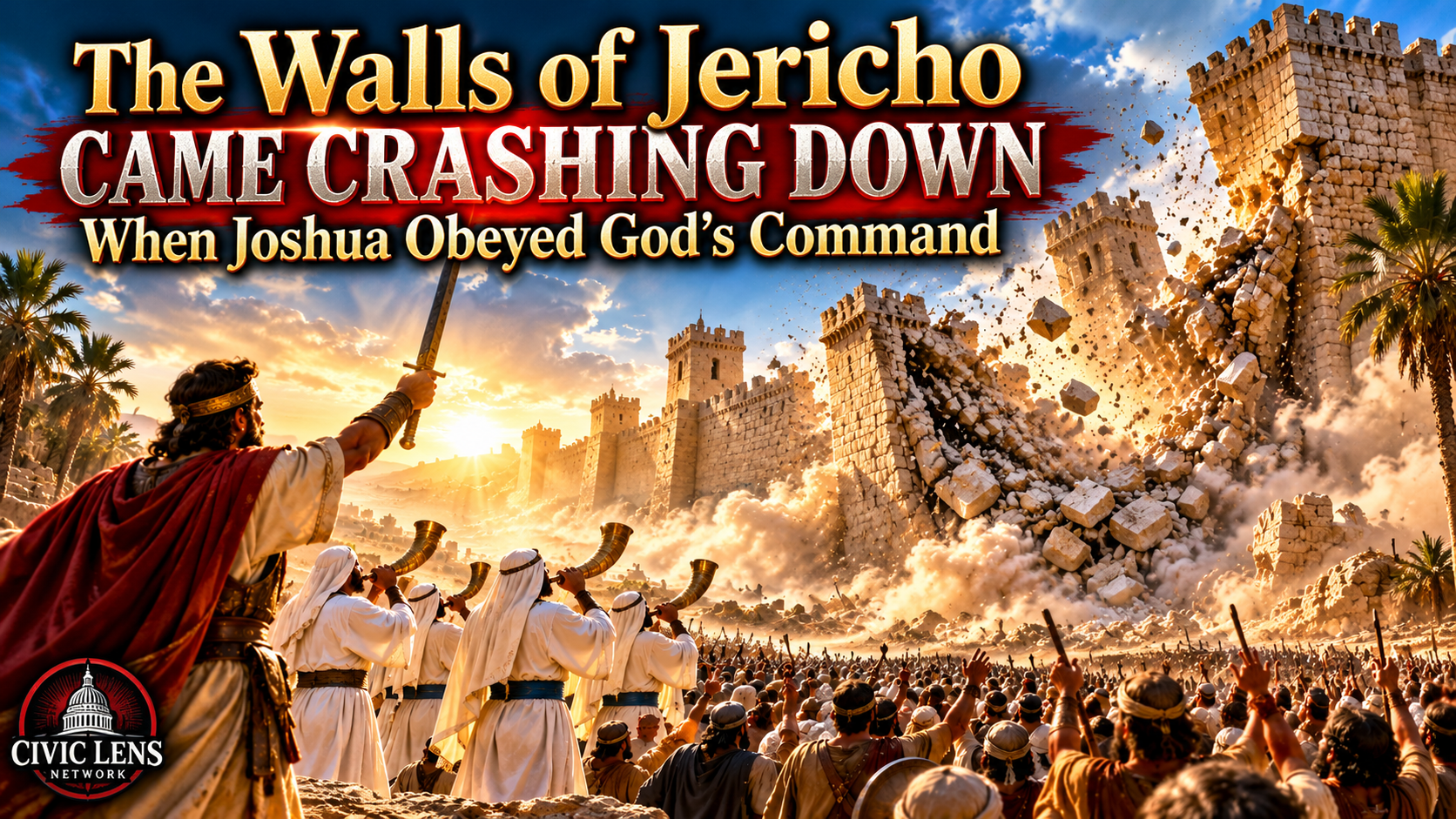
Seven priests were to carry trumpets of rams’ horns in front of the ark of the covenant of the Lord. On the seventh day the people were to march around the city seven times, the priests blowing the trumpets. When they heard the long blast, the whole army was to give a loud shout, and the wall of the city would collapse so that the army could go up, everyone straight in. These were not suggestions.
They were the clear commands of the God who had already promised to give the land. Joshua received the word and acted on it at once. He called the priests and told them to take up the ark and to have seven of their number carry the trumpets before it. He ordered the army to advance with an armed guard going ahead of the ark.
When he had spoken to the people, the procession formed. The armed men went first. The seven priests followed, blowing their rams’ horns. The ark of the covenant came after them, and the rear guard followed the ark.
The people themselves were commanded to remain silent. No war cry was raised. No challenge was shouted toward the walls. Only the sound of the trumpets marked their presence.
Joshua led them in exact obedience to what the Lord had spoken, and the people followed their leader because he followed the Lord. For six days the same pattern repeated. Each morning the procession left the camp, circled the city once, and returned. The inhabitants of Jericho watched from behind their fortifications.
They saw the ark of the covenant of the Lord carried in the midst of the Israelites. They heard the repeated blasts of the rams’ horns. They saw no scaling ladders, no battering rams, no attempt to undermine the walls. The silence of the army must have seemed strange and perhaps even mocking.
Yet day after day the circuit continued without deviation. Joshua did not alter the plan when the walls remained standing after the first day or the third or the fifth. He did not call a council of officers to devise a more conventional strategy. The command of the Lord had been clear, and Joshua’s leadership consisted in keeping the people faithful to that command until the appointed time.
On the seventh day the people rose at daybreak. The same order of march was followed, but this time they circled the city seven times. The priests continued to blow the trumpets as they went. The armed men and the rear guard maintained their places.
The ark remained in the center of the procession. After the seventh circuit, when the priests sounded the long blast on the trumpets, Joshua commanded the army, “Shout! For the Lord has given you the city! The city and all that is in it are to be devoted to the Lord.
Only Rahab the prostitute and all who are with her in her house shall be spared, because she hid the spies we sent. But keep away from the devoted things, so that you will not bring about your own destruction by taking any of them. Otherwise you will make the camp of Israel liable to destruction and bring trouble on it. All the silver and gold and the articles of bronze and iron are sacred to the Lord and must go into his treasury.”
At the sound of the trumpet the people shouted with a great shout. The wall of the city collapsed, and the army charged straight in and took the city. The barrier that had kept them out fell flat, and every man went up into the city before him. They devoted the city to the Lord and destroyed with the sword every living thing in it, men and women, young and old, cattle, sheep and donkeys.
The city was burned with fire, and the silver and gold and the vessels of bronze and iron were placed in the treasury of the house of the Lord. Joshua then pronounced a solemn oath: “Cursed before the Lord is the one who undertakes to rebuild this city, Jericho. At the cost of his firstborn son he will lay its foundations. At the cost of his youngest he will set up its gates.”
The place of the first victory was marked as a place under the Lord’s ban, not to be restored by human hands without consequence. Before the city was destroyed, the two men who had earlier spied out the land were sent to bring out Rahab and her household. Joshua said to them, “Go into the prostitute’s house and bring her out and all who belong to her, in accordance with your oath to her.”
They went in and brought out Rahab, her father and mother, her brothers and sisters, and all who belonged to her. They set them outside the camp of Israel. Rahab had lived in a house built into the wall. When the two spies came to Jericho, she had hidden them on her roof under stalks of flax and then lowered them by a rope through the window.
She had told them that the fear of the Lord had fallen on the people of the land because of what He had done to the Egyptians and to the kings east of the Jordan. She had confessed that the Lord their God was God in heaven above and on the earth beneath. The spies had sworn to preserve her and her family if she tied a scarlet cord in the window through which she let them down and gathered everyone into her house.
She did as they instructed. When the walls fell and the city was taken, the scarlet cord marked the place of her rescue. She and all who were with her were spared because she had believed the report of the Lord’s works and had acted on that belief. The text records that she lives among the Israelites to this day.
The biblical account in Joshua 6 presents these events as the direct result of the Lord’s promise and Israel’s obedience. Archaeological investigation of the site known as Tell es-Sultan has produced a range of interpretations. Some excavators have concluded that the major fortifications of the city were destroyed centuries earlier than the period traditionally associated with the Israelite conquest and that little evidence remains of a substantial Late Bronze Age occupation.
Others have argued that collapsed mud-brick material and a destruction layer can be dated in a manner consistent with an early date for the conquest and with the description of walls falling flat. The dating of pottery, the interpretation of stratigraphic layers, and the correlation with Egyptian chronology remain matters of ongoing scholarly debate. These differing readings of the physical remains do not alter the text of Scripture.
The book of Joshua records what the Lord said, what Joshua and the people did in response, and what happened when they obeyed. The narrative stands on the authority of the word of God rather than on the provisional conclusions of any excavation report. Throughout the account the emphasis rests on the certainty of God’s promise and the necessity of obedient faith. The Lord declared the city delivered before any circuit began.
Joshua led the people in the precise actions that had been commanded, even though those actions appeared inadequate by ordinary standards of warfare. The six days of marching established a pattern of patient obedience. The seven circuits on the seventh day brought the people to the moment when the long blast and the shout became the signal for God to act.
The walls collapsed not because of the strength of the shout or the skill of the soldiers, but because the Lord had spoken and His people had trusted His word. Rahab’s household was preserved for the same reason. She had heard of the Lord’s mighty acts, believed that He was the true God, and displayed the scarlet cord as the visible sign of the oath that had been given.
In both the army outside the walls and the household inside them, faith was expressed in concrete obedience to the word that had been received. Joshua’s leadership consisted in receiving the Lord’s command, communicating it clearly, and refusing to deviate from it. He did not seek additional signs after the initial promise. He did not allow the strange character of the instructions to become an excuse for delay.
He kept the people in silence during the six days so that the only voice they heard was the sound of the trumpets that God had appointed. When the moment came for the shout, he reminded them that the city had already been given. The result was that the first city of the conquest fell by the power of the Lord rather than by the ingenuity of men. The same principle runs through the entire narrative.
God’s promises are fulfilled when His people walk in the obedience of faith, and the unusual nature of the command does not lessen its authority. The walls of Jericho came crashing down because Joshua obeyed what the Lord had spoken, and the account remains a lasting testimony to the faithfulness of God and the effectiveness of trust that acts on His word.