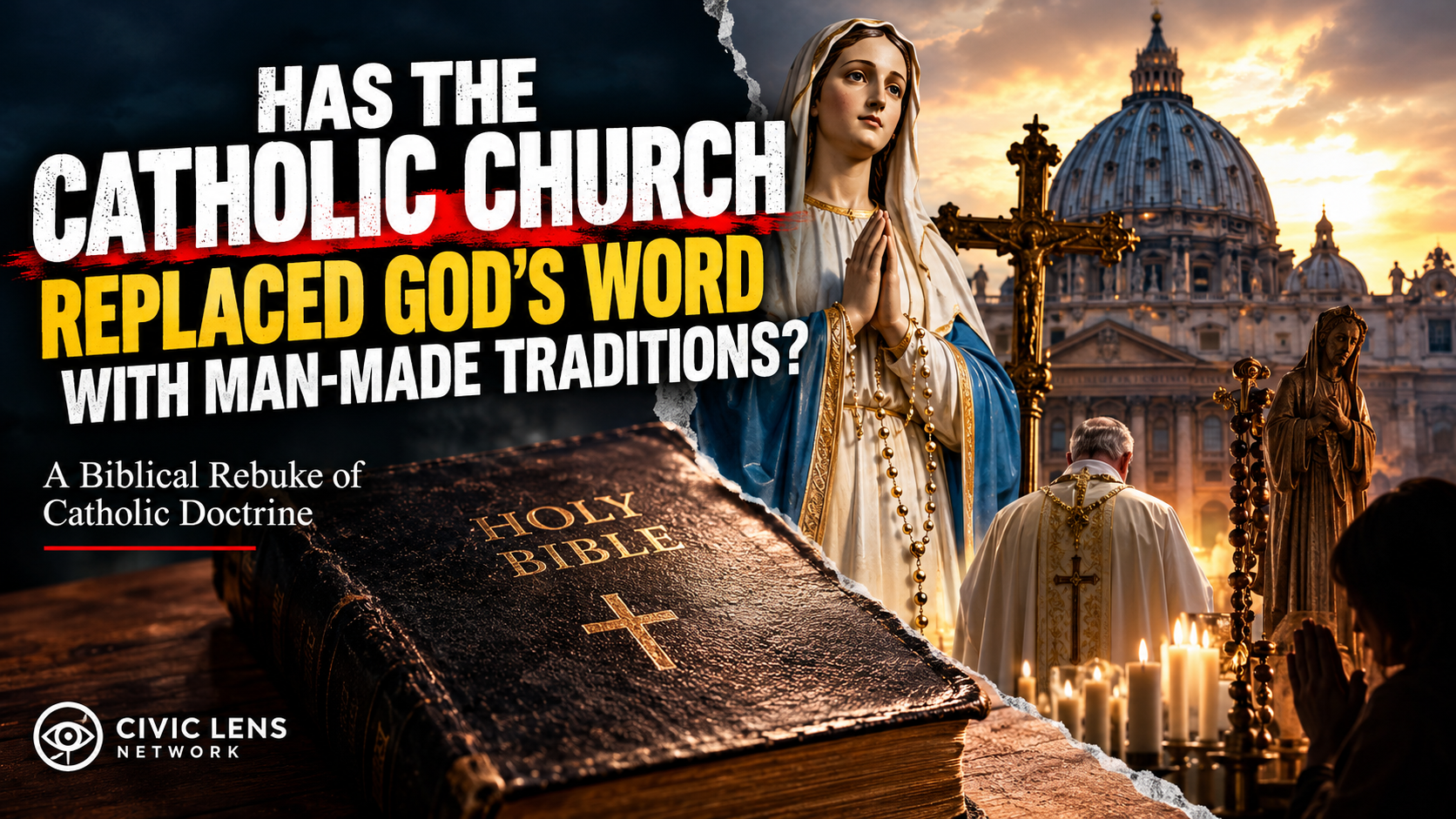
Has the Catholic Church allowed centuries of religious tradition to overshadow the teachings of Jesus Christ?
It is a question that deserves an answer, especially when some of the Church’s most recognizable practices are difficult to reconcile with a straightforward reading of Scripture.
From prayers addressed to Mary and departed saints to papal authority, purgatory, religious statues, and controversial interfaith ceremonies, the Catholic Church has developed a system of doctrines and devotions that many Bible-believing Christians reject.
This criticism is not directed at ordinary Catholics who sincerely love Jesus Christ. It is directed at religious teachings, institutional decisions, and practices that should be open to biblical examination.
Jesus warned about the danger of replacing God’s commandments with religious traditions.
Mark 7:7–8 (KJV)
“Howbeit in vain do they worship me, teaching for doctrines the commandments of men. For laying aside the commandment of God, ye hold the tradition of men.”
Those words should concern every Christian, regardless of denomination.
No church should be beyond criticism. No religious leader should be above Scripture. And no tradition should be treated as divine truth simply because it has existed for centuries.
When Religious Unity Begins to Blur Biblical Truth
In September 2024, Pope Francis sparked controversy during an interreligious meeting with young people in Singapore when he compared religions to different languages or paths toward God.
The remarks troubled Christians who believe the Gospel leaves no room for multiple equally valid paths to salvation.
The Catholic Church does not officially teach that every religion is equally true. It maintains that salvation comes through Jesus Christ while recognizing elements of truth in other religions.
Nevertheless, the Pope’s remarks raised legitimate questions about how clearly Christian leaders are communicating the exclusive claims of Christ.
John 14:6 (KJV)
“Jesus saith unto him, I am the way, the truth, and the life: no man cometh unto the Father, but by me.”
Jesus did not describe Himself as one possible route among many.
Acts 4:12 (KJV)
“Neither is there salvation in any other: for there is none other name under heaven given among men, whereby we must be saved.”
Christianity teaches that Jesus Christ is the Savior of the world. That message cannot be diluted merely to avoid offending people who follow other religions.
Christians can respect the dignity and freedom of people of different faiths without pretending that contradictory religious beliefs are equally correct.
If the Church believes Jesus is the only Savior, its leaders should proclaim that truth clearly.
The Pachamama Controversy and the Vatican
In 2019, a controversy erupted during the Amazon Synod when wooden figures associated by critics with Pachamama, an Indigenous Andean earth or fertility figure, appeared at Vatican-related events.
The figures were later displayed in a church in Rome, where protesters removed them and threw them into the Tiber River.
Vatican representatives rejected accusations of pagan worship, describing the figures in cultural and symbolic terms. Pope Francis also denied that their use involved idolatrous intent.
Still, the controversy raised an important question.
Why were religiously ambiguous figures associated with Indigenous spiritual traditions incorporated into Catholic religious gatherings?
Exodus 20:3–5 commands God’s people to have no other gods before Him and forbids bowing down to or serving idols.
Throughout the Old Testament, Israel repeatedly fell into spiritual trouble when foreign religious practices became mixed with the worship of God.
Respect for Indigenous cultures is one thing. Introducing symbols associated with other religious traditions into Christian religious settings is another.
Even without proof of actual idol worship, Church leaders should have recognized the danger of creating confusion about what was being honored.
The Church’s responsibility is to defend biblical worship, not blur its boundaries.
Why Is Mary Given Such Extraordinary Devotion?
Mary holds a unique place in the biblical account of Jesus Christ.
She was chosen to bear the Messiah, demonstrated faith, and deserves respect as a faithful servant of God.
But nowhere does the New Testament explicitly command Christians to pray to Mary.
Catholic teaching distinguishes between worship, which belongs to God alone, and the special veneration given to Mary.
Yet that distinction does not eliminate the biblical objections.
Why do Catholics address prayers to Mary?
Where did Jesus command believers to recite the Rosary?
Where does Scripture clearly teach that Mary can hear petitions offered by millions of people around the world?
Luke 1:46–47 (KJV)
“And Mary said, My soul doth magnify the Lord, And my spirit hath rejoiced in God my Saviour.”
Mary herself acknowledged God as her Savior.
At the wedding in Cana, Mary directed the servants toward Jesus.
John 2:5 (KJV)
“Whatsoever he saith unto you, do it.”
That instruction remains powerful.
Listen to Jesus.
Follow Jesus.
Place your trust in Jesus.
The Catholic doctrines of Mary’s Immaculate Conception and bodily Assumption also raise questions because neither is explicitly described as an event or doctrine in the biblical text.
Catholic theologians defend these beliefs through Scripture interpreted alongside Sacred Tradition. Protestants who regard Scripture as the final doctrinal authority reject those arguments as insufficient.
Honoring Mary as the mother of Jesus is biblical.
Establishing elaborate systems of religious devotion directed toward her is another matter.
Praying to Saints When Christ Is the Mediator
Catholics believe saints in heaven can intercede for Christians on earth.
They argue that asking a saint to pray is comparable to asking a living Christian for prayer.
But the Bible identifies one mediator between God and humanity.
1 Timothy 2:5 (KJV)
“For there is one God, and one mediator between God and men, the man Christ Jesus.”
That statement deserves careful attention.
One mediator.
Jesus Christ.
The New Testament repeatedly encourages believers to pray, to seek God’s mercy, and to intercede for one another.
But it does not explicitly instruct Christians to direct petitions to departed saints.
Hebrews 4:16 (KJV)
“Let us therefore come boldly unto the throne of grace, that we may obtain mercy, and find grace to help in time of need.”
Christians have direct access to God through Jesus Christ.
Why should believers establish devotional relationships with departed saints when Scripture invites them to approach God directly?
Catholics distinguish saintly intercession from Christ’s unique mediation. The Protestant objection is that Scripture never establishes the practice of addressing prayers to the departed.
The burden of biblical justification belongs to those who teach it.
Prayers Addressed to the Dead
This is one of the most controversial areas of Catholic practice.
Catholics maintain that saints in heaven are alive in Christ and that requesting their intercession is not the same as attempting to summon the dead.
That distinction should be acknowledged.
Nevertheless, the Bible gives serious warnings concerning attempts to consult the dead.
Deuteronomy 18:10–12 condemns necromancy and other forbidden spiritual practices.
Praying for a saint’s intercession is not identical to necromancy as Catholic theology defines it. But the larger question remains unanswered for many Protestants.
Where did Jesus or the apostles instruct believers to address petitions to people who had died?
The New Testament provides no clear example establishing such a practice for the Church.
Christians are instructed to pray to God.
Jesus taught His disciples to begin their prayers with “Our Father which art in heaven.”
He did not direct them to seek an audience with departed believers.
Statues, Religious Images, and the Danger of Idolatry
Catholic churches frequently contain statues of Mary, Jesus, angels, and saints.
Some Catholics kneel before religious images, kiss statues, light candles near them, or participate in processions involving sacred figures.
Catholic doctrine insists that these actions do not constitute worship of the physical objects.
But visible religious practices should still be examined against Scripture.
Psalm 115:4–8 warns against idols fashioned by human hands.
The Bible does not condemn every artistic representation. The Old Testament itself includes divinely commanded decorative images.
The concern is the use of images as objects or focal points of religious veneration.
When a person kneels before a statue and addresses prayers toward the figure represented, Christians have reason to ask whether the practice risks crossing the boundary between remembrance and religious devotion.
God does not require a statue to hear prayer.
Jesus does not require a carved representation to receive worship.
A believer can approach the Lord without relying on an image made by human hands.
Confession to Priests
The Catholic Church teaches that priests exercise a sacramental ministry of reconciliation, including pronouncing absolution.
Catholics appeal to passages such as John 20:23 to support this practice.
But Scripture also promises forgiveness to those who confess their sins to God.
1 John 1:9 (KJV)
“If we confess our sins, he is faithful and just to forgive us our sins, and to cleanse us from all unrighteousness.”
Christians are also encouraged to confess faults to one another and pray for each other.
However, the New Testament does not clearly establish the later Catholic system of private sacramental confession as a universal requirement for receiving ordinary reconciliation after serious sin.
Jesus Christ is the great High Priest.
A repentant believer should never be led to believe that God’s mercy is inaccessible without first entering a particular institutional process.
Purgatory and the Sufficiency of Christ
The Catholic Church teaches that some people who die in God’s grace undergo purification before entering heaven.
This doctrine is known as purgatory.
Catholics cite biblical passages and tradition in its defense, including 1 Corinthians 3:15 and 2 Maccabees 12:46.
Protestants dispute whether these passages establish the doctrine. Most Protestant traditions also reject 2 Maccabees as canonical Scripture.
Consider the repentant thief who was crucified beside Jesus.
Luke 23:43 (KJV)
“And Jesus said unto him, Verily I say unto thee, To day shalt thou be with me in paradise.”
The thief had no opportunity to complete religious rituals or undertake a lengthy process of purification.
He turned to Christ and received a promise of paradise.
The question is whether purgatory introduces a doctrine that goes beyond the biblical promises concerning salvation through Jesus Christ.
Christ’s sacrifice is sufficient.
The Gospel should never leave believers uncertain about whether additional postmortem purification is necessary to complete what Christ has accomplished.
Papal Authority and Infallibility
The Catholic Church teaches that the Pope possesses a specific form of infallibility when, under narrowly defined conditions, he definitively teaches doctrine concerning faith or morals.
This does not mean Catholics believe every papal statement or personal decision is infallible.
Even so, the doctrine presents a major biblical disagreement.
Where does the New Testament establish an ongoing papal office with this authority?
Catholics appeal to passages concerning Peter, especially Matthew 16:18–19.
Protestants dispute whether those passages establish the later institution of the papacy.
Peter himself was publicly confronted by the Apostle Paul.
Galatians 2:11 (KJV)
“But when Peter was come to Antioch, I withstood him to the face, because he was to be blamed.”
This passage does not directly disprove the narrowly defined Catholic doctrine of papal infallibility, but it demonstrates that even prominent apostolic leaders were subject to correction.
No human leader should be placed beyond biblical scrutiny.
Christ is the head of the Church.
Every pastor, bishop, priest, and pope must answer to Him.
The Mass and the Finished Sacrifice of Jesus Christ
Catholic teaching holds that bread and wine become the body and blood of Jesus Christ during the Eucharist.
This doctrine is called transubstantiation.
The Catholic Church also teaches that the Mass makes Christ’s one sacrifice sacramentally present, not that Jesus undergoes a new and separate sacrifice each time.
Protestants nevertheless question whether Scripture supports transubstantiation and the sacrificial understanding of the Mass.
Hebrews 10:12 (KJV)
“But this man, after he had offered one sacrifice for sins for ever, sat down on the right hand of God.”
Christ offered Himself once.
His sacrifice was sufficient.
The Lord’s Supper was instituted by Jesus and should be observed faithfully. But its meaning must be established from Scripture rather than doctrines developed through later theological systems.
Indulgences and the Abuse of Religious Authority
The history of indulgences remains one of the Catholic Church’s most troubling controversies.
During the period leading to the Protestant Reformation, abuses connected with indulgence preaching and fundraising helped provoke widespread opposition.
The Catholic Church condemns the sale of indulgences today.
Its official doctrine describes indulgences as remission of temporal punishment associated with sins whose guilt has already been forgiven.
But this system raises substantial questions about the biblical foundation for an institutional treasury of spiritual merits and the Church’s claimed authority to administer indulgences.
Ephesians 2:8–9 (KJV)
“For by grace are ye saved through faith; and that not of yourselves: it is the gift of God: Not of works, lest any man should boast.”
Salvation is not a commercial transaction.
God’s mercy cannot be purchased.
Religious institutions should never create confusion about the free gift of grace.
Mandatory Celibacy for Priests
The Latin Catholic Church generally requires priests to remain unmarried, although exceptions exist. Eastern Catholic traditions also include married priests.
The Bible honors those who voluntarily remain single for the sake of ministry.
But it does not establish universal priestly celibacy as a requirement for Christian leadership.
1 Timothy 3:2 describes an overseer as the husband of one wife.
1 Timothy 4:1–3 warns against false teachings that include forbidding marriage.
These passages do not condemn voluntary celibacy.
They do, however, provide grounds to question whether a broad mandatory celibacy policy is necessary or biblically justified.
Marriage is not an obstacle to serving God.
The apostles did not establish a universal requirement that Christian ministers remain unmarried.
The Sexual Abuse Scandals and Institutional Cover-Ups
Beyond disputes over doctrine, the Catholic Church must also confront its documented failures in responding to clergy sexual abuse.
Investigations in multiple countries have uncovered abuse, institutional negligence, failures to report allegations, and decisions that protected reputations rather than victims.
Some church officials transferred accused clergy or mishandled complaints, allowing further harm.
These are not minor administrative mistakes.
They are profound moral failures.
Jesus warned about the seriousness of harming children and vulnerable people.
Matthew 18:6 delivers a severe warning concerning those who cause little ones to stumble.
Any church that claims to represent Christ has an obligation to protect the innocent, expose wrongdoing, cooperate with lawful investigations, and hold offenders accountable.
Religious authority must never become a shield against justice.
Victims deserve truth and accountability, not institutional excuses.
The Central Problem: Tradition Elevated to Divine Authority
The fundamental disagreement between Catholicism and Scripture-centered Protestant Christianity concerns authority.
The Catholic Church teaches that Scripture and Sacred Tradition together transmit divine revelation, with the Church’s teaching authority responsible for authentic interpretation.
Protestants who affirm sola Scriptura believe Scripture is the final infallible standard by which all Christian doctrines must be judged.
2 Timothy 3:16–17 (KJV)
“All scripture is given by inspiration of God, and is profitable for doctrine, for reproof, for correction, for instruction in righteousness: That the man of God may be perfect, throughly furnished unto all good works.”
Church history has value.
Christian teachers have value.
Faithful traditions can have value.
But none of them should be allowed to establish doctrines that cannot withstand examination by the Word of God.
A religious practice does not become biblical simply because millions of people observe it.
A doctrine does not become true merely because a church council declares it.
And an institution does not become incapable of error because it claims divine authority.
A Final Call to Return to Jesus Christ
The Catholic Church has a responsibility to answer serious questions about its teachings, its devotional practices, and its institutional conduct.
Why are prayers addressed to Mary and departed saints when Scripture directs believers to God through Jesus Christ?
Why are doctrines such as purgatory and papal infallibility binding on Catholics when their biblical foundations remain disputed?
Why have religious images and ceremonies become such prominent features of Catholic devotion?
Why should traditions developed over centuries carry authority alongside Scripture?
And why have some leaders within an institution claiming to represent Christ failed so terribly to protect the vulnerable?
These questions deserve more than appeals to historical authority.
They deserve honest biblical answers.
The issue is not whether individual Catholics can be faithful followers of Jesus. Many sincerely seek to live according to His teachings.
The issue is whether every doctrine and practice taught in Christ’s name truly reflects His Word.
Jesus did not command His followers to build their faith around devotion to Mary.
He did not explicitly instruct them to address prayers to departed saints.
He did not establish purgatory as a clearly defined doctrine.
He did not tell Christians that their access to God’s mercy depended on the authority of a religious institution.
He called people to repent, believe the Gospel, love God, and follow Him.
John 19:30 (KJV)
“When Jesus therefore had received the vinegar, he said, It is finished: and he bowed his head, and gave up the ghost.”
Those words should remain central to Christian faith.
It is finished.
Christ’s sacrifice is complete.
His authority is supreme.
His Word deserves obedience.
And His Church must remain accountable to Him.
Every denomination, including Protestant churches, should be willing to submit its teachings to that same examination.
The ultimate question is not which institution possesses the oldest traditions or the greatest earthly influence.
The question is whether Christians are following the teachings of Jesus Christ or defending religious traditions that have accumulated in His name.
No pope, priest, pastor, denomination, or church council should ever stand above the Word of God.
Jesus Christ is the Savior. Jesus Christ is the mediator. Jesus Christ is the head of the Church. And Jesus Christ alone is worthy of worship.