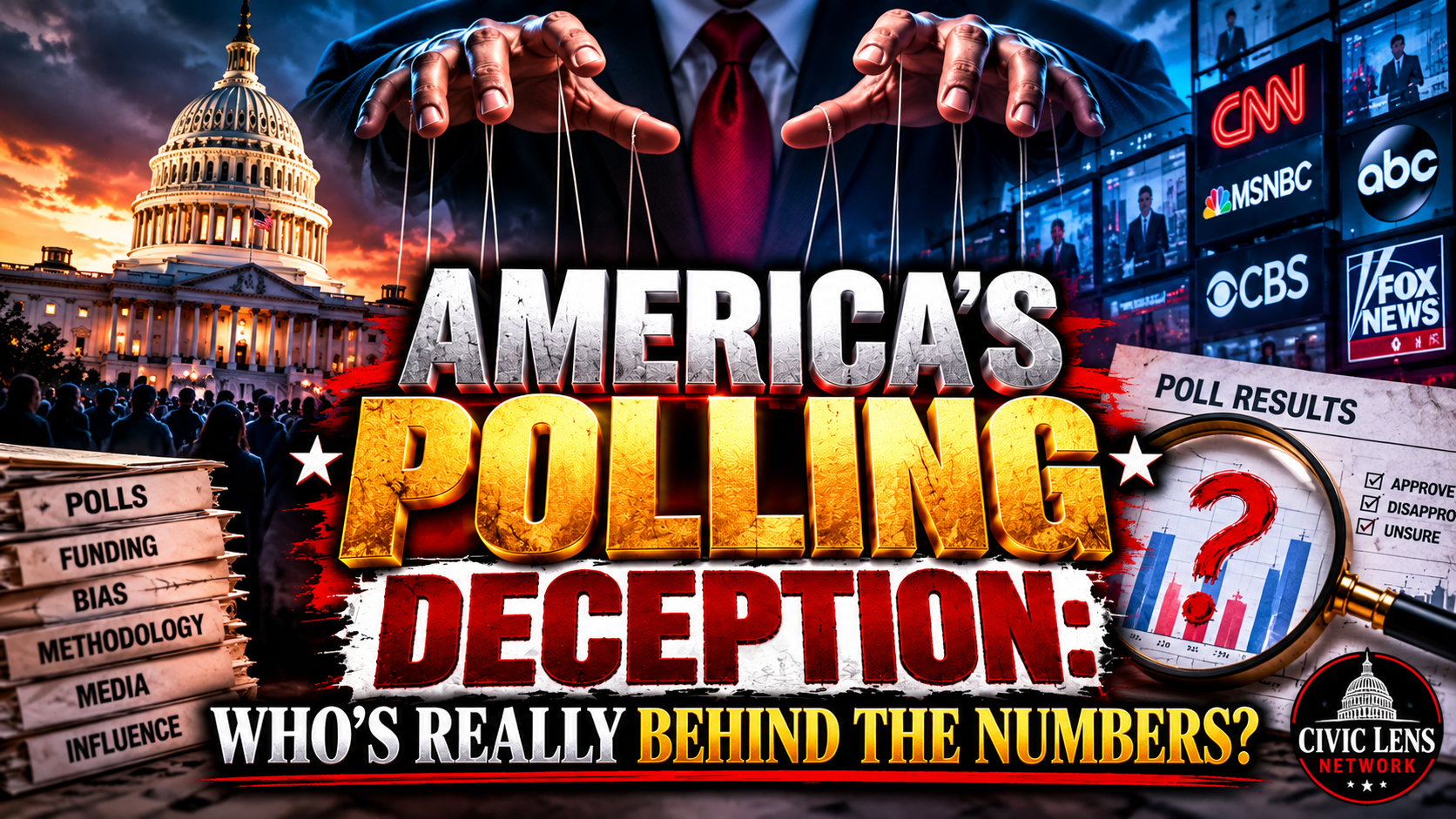
Political polls do not simply measure public opinion. In the hands of campaigns, media outlets, and partisan firms, they often manufacture the appearance of momentum, discourage opposing voters, and shape the very perceptions they claim to report. For three consecutive presidential cycles, the industry systematically underestimated Republican support, particularly for Donald Trump. In 2026, outright fabricated polls entered the midterm conversation, briefly influencing spending and coverage before being exposed.
The pattern raises a blunt question: are Americans receiving independent measurements, or carefully selected numbers designed to persuade? The American Association for Public Opinion Research’s (AAPOR) 2024 post-election task force documented the latest chapter. Across 611 polls of presidential, Senate, governor, and House races fielded in the campaign’s final two weeks, the average absolute error on the two-party margin fell to 3.3 percentage points, better than the 5.3-point miss in 2020 and 5.2 in 2016.
National presidential polls missed by about 2.6 points and state-level presidential polls by 3.0. Yet for the third straight presidential election, polls overstated Democratic margins, this time by 2.7 points across offices. The underestimation of Republican vote share was smaller than in 2020 but persistent. AAPOR noted under-representation of Republican voters in GOP-leaning areas, overstated Democratic support among some Hispanic voters, and underestimation of the Republican lean among 2020 non-voters who turned out in 2024.
This is not ancient history. In 2016, national polls were relatively close on the popular vote while state polls in key Midwest battlegrounds failed to capture Trump’s strength among non-college white voters. In 2020, both national and state polls produced some of the largest errors in decades, overstating Biden’s support. Adjustments after those cycles—more weighting on education and party or past vote—reduced but did not eliminate the directional bias.
Weighting itself is a legitimate statistical tool when response rates differ systematically by group. Pew Research Center has shown that weighting on party affiliation or recalled past vote improved accuracy by roughly 1–2 points per candidate in recent cycles because Republicans have become somewhat less likely to respond. Roughly 70 percent of national election polls in 2024 used some form of political weighting.
The practice becomes misleading, however, when targets rest on faulty assumptions about the future electorate or when firms apply aggressive weights that amplify small, unrepresentative subsets. Recalled past vote is imperfect memory, not a hard count of prior ballots. Question wording and framing produce further distortions. Leading phrasing, unbalanced response options, or priming with one side’s characterization reliably shifts results.
A well-known earlier example involved a USA Today/Suffolk question that framed the Mueller investigation in Trump’s “witch hunt” language and produced high agreement; more neutral wording in other polls yielded the opposite impression of fairness. Order effects and the selective release of results that fit a narrative compound the problem. Media outlets frequently headline a single number—“Harris leads in Iowa”—while burying sample size, margin of error, likely-voter screen, and weighting details. One high-profile illustration came days before the 2024 election.
J. Ann Selzer’s highly regarded Des Moines Register/Mediacom Iowa poll showed Harris leading Trump 47–44 among likely voters. Coverage treated the result as a potential warning for Trump despite Iowa’s solid Republican lean and other polls showing him ahead. Trump ultimately won the state by roughly 13 points.
Selzer later reviewed the miss and stepped back from election polling. Post-analysis suggested that weighting to recalled 2020 vote would have produced a Trump lead, though still short of the final margin. Funding and client relationships further color the picture. Campaigns and party committees hire partisan polling firms for internal strategy; those firms also sell public surveys that lean toward their clients.
Democratic-aligned firms such as Global Strategy Group have long worked for Democratic candidates and committees while serving corporate clients. Media organizations commission or partner with university pollsters whose results receive prominent, often less-skeptical coverage. Independent or right-leaning firms that performed well in 2024—Trafalgar Group, Rasmussen Reports, InsiderAdvantage, and Big Data Poll—formed the National Association of Independent Pollsters in July 2025 specifically to challenge what they describe as unacknowledged bias in media and academic surveys and the lack of consequences for repeated misses.
Trafalgar’s Robert Cahaly has stated that media and university sponsors carry inherent leanings yet face little accountability when results prove inaccurate. The most direct evidence of deliberate deception arrived in 2026. Two entities, Median Strategies and Wedgewood Polls, released fabricated results in contested midterm races. Wedgewood, which presented a polished resume, admitted after scrutiny from FiftyPlusOne that the numbers were invented as an “experimental project.”
Several of the fake surveys showed tighter Democratic races or better Democratic positioning than consensus polls, including in Mississippi and Michigan Senate contests. Reporting indicates the phony numbers briefly influenced campaign resource decisions. RealClearPolitics documented the episodes and noted their modest Democratic tilt relative to other surveys. FCC Chairman Brendan Carr subsequently warned broadcasters that airing entirely fake or suppression polls could implicate news distortion or broadcast hoax rules.
Democratic Commissioner Anna Gomez countered that good-faith reporting of publicly available data should not be punished when a poll later proves wrong. These episodes illustrate how selective amplification works. Outlier or favorable results receive heavy coverage that creates an impression of shifting momentum. Repeated publication of polls showing one side trailing can discourage turnout or donor activity.
Aggregators that include or exclude certain pollsters produce different narratives. Approval ratings and horse-race forecasts are routinely conflated. The industry’s self-regulatory mechanisms through AAPOR emphasize transparency but impose no meaningful external penalties for methodological failure or undisclosed conflicts. Ordinary sampling error and honest methodological disagreement exist and should not be labeled fraud.
Documented patterns, however, go beyond random noise: consistent directional underestimation of Republican support across three presidential cycles, aggressive or opaque weighting, leading question designs, selective media promotion of convenient results, partisan funding streams, and, in 2026, admitted fabrications that briefly entered the information environment. When the organizations producing and amplifying the numbers face limited consequences while campaigns and outlets continue to treat the output as authoritative, the distinction between measurement and persuasion blurs. Americans deserve polling that is transparent about methods, funding, and limitations.
Until the industry and the media that promote its work face real accountability for repeated, directionally consistent failures and for amplifying outright fakes, the numbers will continue to shape opinion more reliably than they measure it.