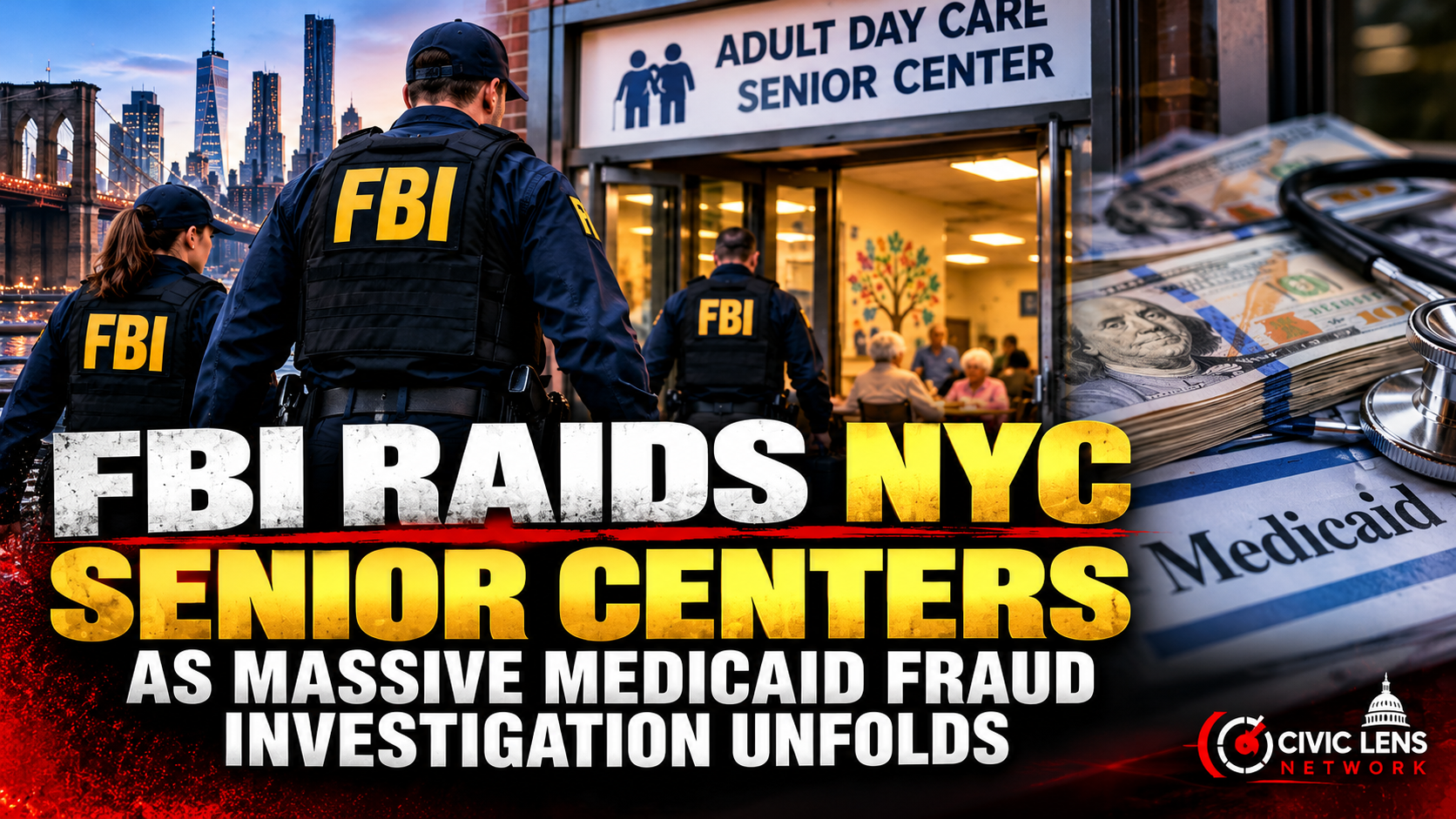
Federal agents in marked vests carried boxes of documents and computers out of storefront adult day care centers in Brooklyn, Queens, and Staten Island on October 20, 2026. At Happy Adult Day Care on Fort Hamilton Parkway in Borough Park, agents from the FBI, Homeland Security Investigations, the IRS, New York State Medicaid investigators, and the NYPD executed court-authorized searches. Similar activity unfolded at a Sunset Park location and at Hanmaum Daycare in Flushing, Queens, where agents removed multiple boxes, computers, and containers.
The actions were part of a coordinated months-long investigation targeting more than 100 Social Adult Day Care providers suspected of improper billing, money laundering, kickbacks, and inflated service records. Governor Kathy Hochul described the effort as a “massive” joint operation involving the state Department of Health, the Office of the Medicaid Inspector General, the Attorney General’s Medicaid Fraud Control Unit, HHS-OIG, the FBI, and more than a dozen other partners.
“We are targeting providers we believe who engaged in illegal activity ranging from money laundering to kickbacks to improper billing and other fraudulent activities,” she said. No charges tied directly to the October 20 searches had been publicly detailed by the following day, though reporting indicated two arrests on Staten Island and that prosecutors expected to announce charges involving a Staten Island center’s operators for billing clients who were dead or never attended. The investigation remains active.
The scale of the Social Adult Day Care program makes the stakes high. An audit covering January 2019 through October 2024 found that Managed Long-Term Care plans paid approximately $2.4 billion for these services. Statewide, more than 400 programs serve roughly 45,000 Medicaid members at an annual cost exceeding $500 million. New York has accounted for a disproportionate share of national spending on the benefit.
A CBS News analysis earlier in 2026 identified 64 facilities within a one-mile radius in Flushing, Queens the densest cluster in the country. Local Medicaid-eligible senior population growth was about 20 percent between 2018 and 2024, in line with national trends, while the number of seniors billed by those facilities nearly quintupled, rising 390 percent. Facilities in the area billed for the equivalent of more than 90 percent of local eligible seniors. Suspected methods follow patterns documented in prior prosecutions.
Operators allegedly billed for services never delivered, inflated daily attendance, paid cash kickbacks to induce enrollment, and submitted claims for recipients who were not present sometimes because they were outside the United States or deceased. Homeland Security Investigations stated plainly on social media: “Billing public programs for care, transportation or other services that were never provided is fraud, NOT a paperwork mistake.”
State Comptroller Thomas DiNapoli’s February 2026 audit flagged concrete weaknesses: more than $285 million in questionable payments to programs after they had been terminated from networks, including over $28 million to providers terminated for cause; claims totaling hundreds of thousands of dollars lacking supporting sign-in sheets; and one Flushing facility that claimed 530 people on a single day against a legal capacity of 323, generating roughly $47,000 in payments for that day alone. CMS Administrator Dr.
Mehmet Oz visited Kent Senior Care and Evergreen Adult Day Care in Flushing the same day, delivering warning letters as part of more than 80 such visits across the city. At one site he noted billing that implied near-constant full occupancy while the room appeared sparsely populated. He questioned wheelchair transportation charges when few or no wheelchairs were visible and challenged attendance logs, including entries for dates after his visit. “The bills are much higher than they should be,” Oz said.
“We know from the billing here that there’s no way this business is running in the way that they claim to be running without something being wrong.” He later described elements of the broader pattern as resembling “a clubhouse for crime.” These observations remain allegations pending investigation; the centers have not been charged. Earlier cases illustrate the same playbook.
On October 2, Brooklyn businessman Ahsan Ijaz pleaded guilty to conspiracy to commit health care fraud in a scheme prosecutors said generated approximately $65 million in false Medicaid claims for adult day care and home health services that were not provided. His businesses, including Happy Family Social Adult Day Care Center and Family Social Adult Day Care Center, allegedly paid cash kickbacks to induce enrollment and billed for recipients who were sometimes abroad. Ijaz was the tenth defendant to plead guilty in that investigation.
A related $68 million scheme involving the same centers produced earlier guilty pleas, including by owner Zakia Khan. Separately, two Queens men faced charges in an alleged $120 million Medicare and Medicaid scheme tied to adult day care and pharmacy services. No public evidence has linked these resolved or charged cases to the specific centers searched on October 20. The raided Happy Adult Day Care is a different entity from the Happy Family centers.
Oversight failures are documented. The Comptroller’s audit concluded that the Department of Health’s supervision of Managed Long-Term Care plans was inadequate, allowing non-compliance and questionable payments to continue. Payments for the benefit rose more than 141 percent from 2021 to 2023 even as some providers had been removed from networks.
Hochul’s administration has pointed to corrective steps: a moratorium on new providers beginning in July 2026, reviews of 418 programs in 2025, 387 OMIG investigations and roughly 100 referrals to the Attorney General between 2021 and 2025, and claimed Medicaid program-integrity savings and recoveries exceeding $15 billion over five years.
Hochul has said she traveled to Washington to meet with Oz on fraud and has directed further prepayment reviews, potential payment suspensions, and a full program review with options due by the end of the year. Critics note that the dramatic concentration of providers in Flushing and the sustained billing growth relative to population occurred over years before the October raids. A House committee previously raised concerns about New York’s provider risk designation practices.
As of October 21, authorities have not announced a total loss figure for the current investigation or the full number of arrests and charges stemming from the October 20 searches. The $2.4 billion paid over the audit period, the $65–68 million and $120 million figures from earlier cases, and the Flushing billing anomaly establish the potential exposure of taxpayer funds.
Legitimate centers that deliver meals, supervision, and activities to elderly New Yorkers remain essential; the risk is that fraud diverts money from those who need real services. The question is who is responsible for protecting both seniors and the public treasury. State regulators oversee the benefit through managed-care plans. Federal agencies fund a large share of Medicaid and now lead much of the enforcement.
Years of rising payments, capacity overages, and post-termination billings occurred under existing rules. The October 20 searches and Oz’s on-site challenges represent a sharper response. Whether that response produces convictions, recoveries, and lasting structural controls or simply another cycle of detection after the money has moved will determine whether taxpayers and vulnerable seniors are better protected going forward.