The valley of Elah lay quiet under the weight of fear. For forty days the armies of Israel and the Philistines had faced each other across the ravine. Each morning and evening a single figure stepped from the Philistine ranks and thundered his challenge. His name was Goliath of Gath.
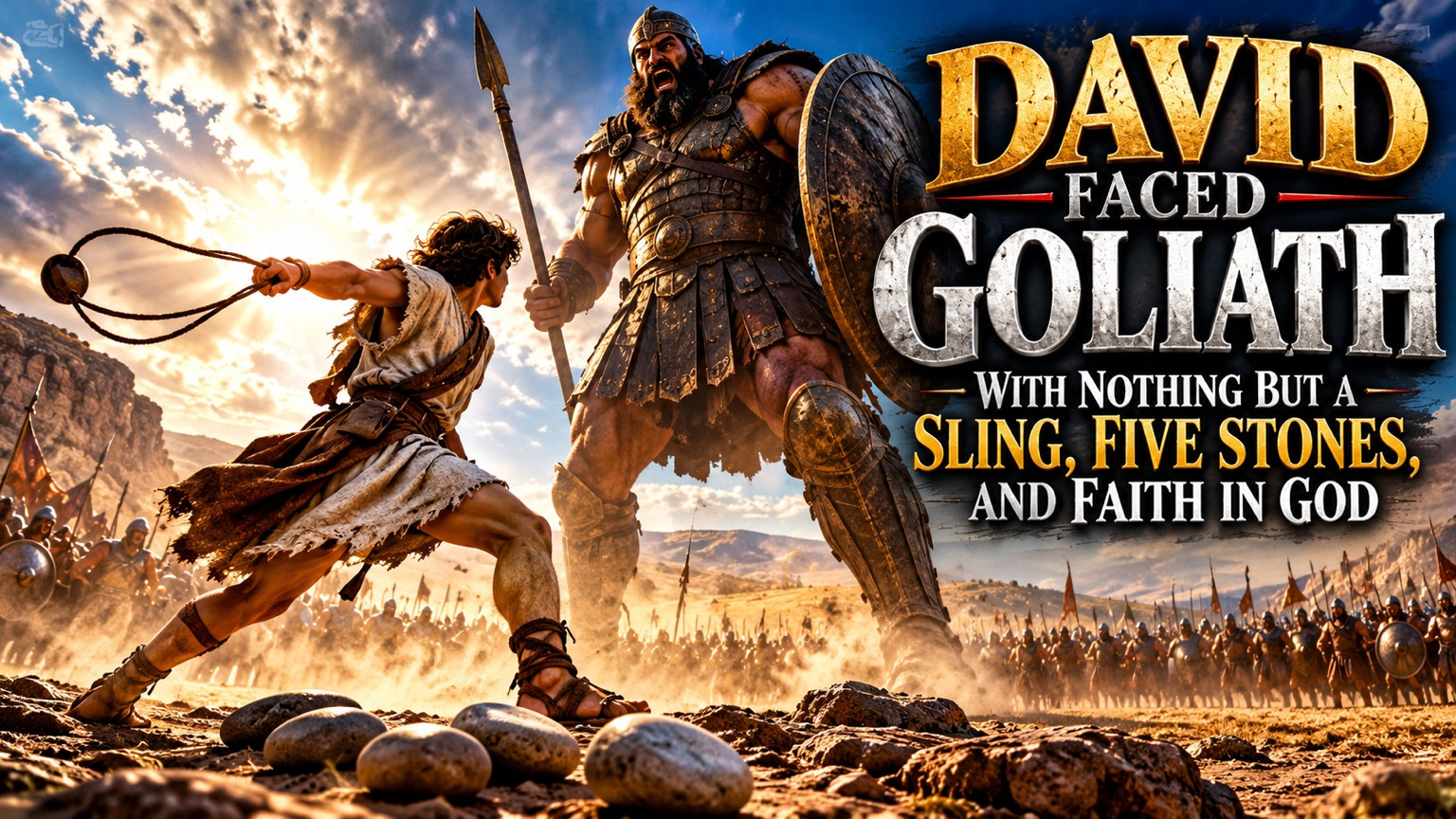
His height was six cubits and a span. He wore a helmet of brass, a coat of mail weighing five thousand shekels of brass, greaves of brass on his legs, and a target of brass between his shoulders. The staff of his spear was like a weaver’s beam, and its iron head weighed six hundred shekels. A shield-bearer walked before him.
Goliath cried to the armies of Israel: “Why are ye come out to set your battle in array? am not I a Philistine, and ye servants to Saul? choose you a man for you, and let him come down to me.” He defied the armies of Israel and demanded a champion.
When Saul and all Israel heard those words, they were dismayed and greatly afraid. Even the king who had once stood taller than any man in Israel now stood silent while the giant’s voice echoed through the valley. Into that silence walked a young shepherd from Bethlehem. David, the youngest son of Jesse, had come only to bring food to his older brothers who served in Saul’s army.
He left the sheep with a keeper, carried the parched corn and loaves and cheeses, and ran into the camp. As he greeted his brothers, the champion of Gath stepped forward again and spoke the same words. David heard them. While the men of Israel fled and were sore afraid, David asked, “What shall be done to the man that killeth this Philistine, and taketh away the reproach from Israel?
for who is this uncircumcised Philistine, that he should defy the armies of the living God?” Word of the youth’s words reached Saul. David stood before the king and said, “Let no man’s heart fail because of him; thy servant will go and fight with this Philistine.” Saul answered that David was only a youth and Goliath a man of war from his youth.
Then David told what the Lord had already done. “Thy servant kept his father’s sheep, and there came a lion, and a bear, and took a lamb out of the flock: And I went out after him, and smote him, and delivered it out of his mouth: and when he arose against me, I caught him by his beard, and smote him, and slew him.
Thy servant slew both the lion and the bear: and this uncircumcised Philistine shall be as one of them, seeing he hath defied the armies of the living God. The Lord that delivered me out of the paw of the lion, and out of the paw of the bear, he will deliver me out of the hand of this Philistine.” Saul clothed David in his own armor, a helmet of brass and a coat of mail, and girded a sword upon him.
David assayed to go, but he had not proved the armor. He said, “I cannot go with these; for I have not proved them.” He put them off. Then he took his staff, chose five smooth stones out of the brook, placed them in his shepherd’s bag, and with his sling in his hand drew near to the Philistine.
Goliath looked upon the youth, ruddy and of a fair countenance, and disdained him. He cursed David by his gods and promised to give his flesh to the fowls of the air and the beasts of the field.
David answered with words that still ring across the centuries: “Thou comest to me with a sword, and with a spear, and with a shield: but I come to thee in the name of the LORD of hosts, the God of the armies of Israel, whom thou hast defied.” He declared that the Lord would deliver the giant into his hand that day, that all the earth might know there is a God in Israel, and that the battle is the Lord’s.
When the Philistine arose and drew nigh, David hasted and ran toward the army to meet him. He put his hand in his bag, took a stone, slang it, and smote the Philistine in his forehead so that the stone sunk into his forehead and he fell upon his face to the earth. David prevailed with a sling and a stone. There was no sword in his hand.
He ran and stood upon the Philistine, drew Goliath’s own sword from its sheath, and cut off his head. When the Philistines saw their champion was dead, they fled. The men of Israel and of Judah arose, shouted, and pursued them to the valley and the gates of Ekron. They spoiled the tents of the Philistines.
David took the head of the Philistine and brought it to Jerusalem, and he put Goliath’s armor in his tent. The account in 1 Samuel 17 is not a tale of human cleverness or youthful bravado. Scripture shows a shepherd who had already learned that the living God delivers His people from lions and bears. That same God would deliver him from the giant who defied the armies of Israel.
David refused the armor of a king because he had not proved it; he trusted the weapons and the God he already knew. His courage was not the absence of danger but the presence of the name of the LORD of hosts. His humility appears in the simple tools of a shepherd and in the confession that the battle belongs to the Lord. His faith rested not on the size of the stone but on the character of the God who had already proven faithful.
These truths remain. The giants that stand against the people of God still defy the living God. They may appear in the form of fear that freezes an entire camp, of circumstances that seem impossibly large, or of voices that mock the name of the Lord. The pattern Scripture sets is not to measure our strength against the giant’s, but to remember the God who has already delivered us in smaller valleys and to go forward in His name.
The victory does not rest in the excellence of our sling or the smoothness of our stones. It rests in the Lord of hosts, the God of the armies of Israel, who still saves not with sword and spear, for the battle is the Lord’s.