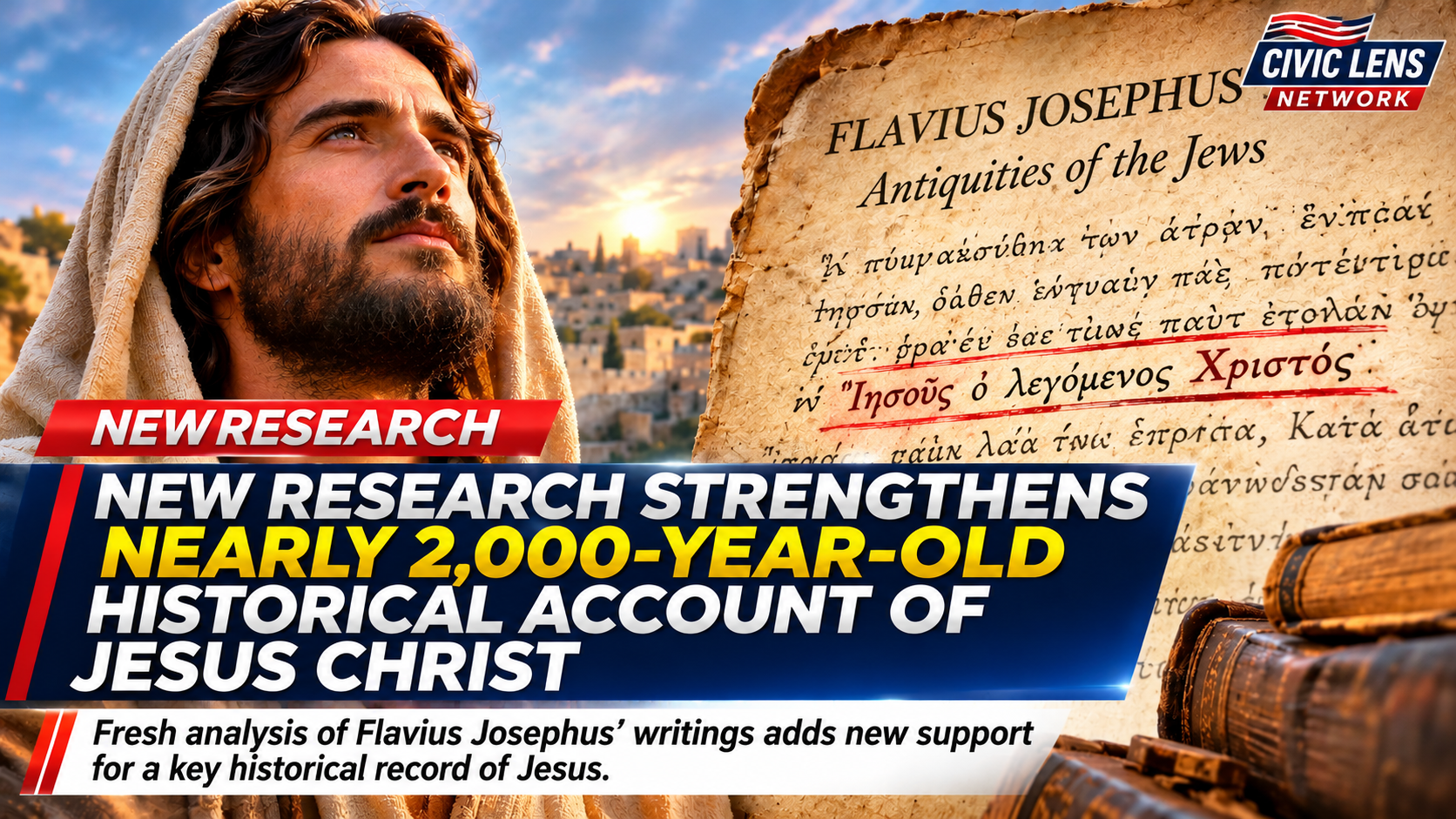
A nearly 2,000-year-old historical account of Jesus Christ is receiving renewed attention after groundbreaking research challenged centuries of skepticism surrounding one of the earliest surviving non-Christian descriptions of His life, crucifixion, and the belief that He rose from the dead.
The findings could have significant implications for historians, biblical scholars, and millions of Christians who have long maintained that the New Testament describes real events involving a real historical figure.
At the center of the research is Flavius Josephus, a first-century Jewish historian whose writings have remained among the most important surviving records of the ancient Roman world.
Josephus was not a Christian. He was a Jewish historian writing decades after the crucifixion of Jesus, making his testimony particularly significant because it originated outside the early Christian movement.
Now, new linguistic analysis and comparisons of ancient manuscripts are challenging the longstanding argument that Christian scribes substantially altered his account.
A Historical Record That Has Survived Nearly 2,000 Years
Josephus was born around A.D. 37, only a few years after the period traditionally associated with the crucifixion of Jesus Christ.
Around A.D. 93 or 94, he completed Antiquities of the Jews, a monumental historical work documenting Jewish history, religious traditions, and political events.
Within that work appears a passage known as the Testimonium Flavianum, which describes Jesus as a wise man who attracted followers and was condemned to crucifixion under the Roman governor Pontius Pilate.
The passage also discusses reports that Jesus appeared alive to His followers after His execution.
For generations, the account has been at the center of a historical controversy.
Some scholars argued that the passage contained language too favorable toward Christianity to have originated with a Jewish historian who did not personally follow Jesus.
Others maintained that Josephus originally wrote about Jesus but that Christian copyists later introduced additional religious statements.
The debate has continued for centuries.
However, recent research is reopening questions that many scholars once considered largely settled.
Researcher Challenges Longstanding Assumptions
T.C. Schmidt, an associate professor of religious studies at Fairfield University in Connecticut, has conducted an extensive investigation into the authenticity of Josephus’ account.
His research, presented in the 2025 book Josephus and Jesus: New Evidence for the One Called Christ, examines whether the disputed passage genuinely reflects the writing style and historical perspective of Josephus.
Schmidt compared ancient versions of the text preserved in Greek, Latin, Syriac, Arabic, and Armenian.
Using computer-assisted linguistic analysis alongside traditional historical research, he examined the vocabulary, sentence structures, and expressions appearing throughout the passage.
His conclusion challenges the belief that large portions of the account must have been inserted by later Christian writers.
Schmidt argues that the disputed language is consistent with expressions Josephus used elsewhere in his historical writings.
He also suggests that certain descriptions previously interpreted as unmistakably Christian may actually reflect the perspective of a non-Christian Jewish observer.
This distinction matters because it raises the possibility that the passage has preserved substantially more of Josephus’ original testimony than many researchers previously believed.
What Did Josephus Say About Jesus?
The historical passage describes several events and beliefs central to Christianity.
It identifies Jesus as a teacher who attracted followers.
It connects His execution to Pontius Pilate, the Roman governor who oversaw Judea during the period of Jesus’ ministry.
It also describes the continued existence of the Christian movement after His death.
Perhaps most striking is its reference to the belief that Jesus appeared alive again on the third day.
For Christians, this is the central event of their faith: the resurrection of Jesus Christ.
Schmidt emphasizes an important distinction in interpreting the ancient account.
His research does not establish that Josephus personally witnessed or affirmed the resurrection.
Instead, it argues that Josephus recorded the belief among Jesus’ earliest followers that He had risen from the dead.
That would make the passage an especially important historical witness to what early Christians proclaimed.
The significance lies in the possibility that a Jewish historian writing for a Roman audience preserved an account of the Christian movement’s central claims within decades of the events described in the Gospels.
Ancient Languages Offer New Clues
One of the most important aspects of the research involves comparing the surviving textual traditions.
Ancient manuscripts were copied by hand over generations, frequently translated into other languages, and sometimes altered through transcription errors or deliberate editorial changes.
Because the original manuscript of Josephus has not survived, researchers must examine later copies and translations to reconstruct what he most likely wrote.
Schmidt’s work compares the disputed passage across five ancient languages, looking for linguistic patterns that might reveal its original form.
His findings suggest that wording previously considered suspicious may fit naturally within Josephus’ broader historical writing.
Separate research has also examined Arabic and Syriac versions of the passage, particularly how they describe the resurrection.
One interpretation suggests that an earlier form may have described the resurrection as something Jesus’ followers reported rather than something Josephus declared to be established fact.
That distinction could help explain why a non-Christian historian included the account.
It also demonstrates why the manuscript debate remains active.
Not every scholar agrees with Schmidt’s conclusions. Many historians continue to believe that the surviving Greek passage contains later Christian additions, even if Josephus originally wrote about Jesus.
Nevertheless, the renewed investigation is forcing researchers to reconsider the evidence rather than simply accept longstanding assumptions.
Why the Findings Matter for Christianity
For Christians, the historical importance of Josephus extends beyond a single ancient manuscript.
The New Testament describes Jesus preaching throughout Judea and Galilee, gathering disciples, confronting religious authorities, and ultimately being crucified under Roman authority.
Josephus provides a potentially independent historical account that overlaps with several of those central details.
His writings are especially important because they were produced outside the Christian community.
If Schmidt’s interpretation is correct, the passage could strengthen the case that an ancient Jewish historian documented not only Jesus’ execution but also the extraordinary claims circulating among His followers.
It would not scientifically prove that Jesus performed miracles or rose from the dead.
Those questions extend beyond what linguistic analysis alone can establish.
But it could strengthen the historical record concerning the existence of Jesus, the circumstances surrounding His death, and the early spread of belief in His resurrection.
Another Reference to Jesus in Josephus’ Writings
The disputed passage is not the only reference associated with Jesus in the writings of Josephus.
Elsewhere in Antiquities of the Jews, Josephus describes the execution of James, identifying him as the brother of Jesus, who was called Christ.
That reference has generally attracted less skepticism than the longer passage.
Its importance lies in connecting Jesus to a named individual involved in the religious and political history of first-century Jerusalem.
Taken together, the references have long played an important role in scholarly discussions of Jesus as a historical figure.
The latest research adds another dimension by questioning whether the more detailed account has been underestimated.
A Debate That Is Far From Over
Despite the renewed attention, the research has not ended the controversy.
Historians continue to debate whether the Testimonium Flavianum is substantially authentic, partially modified, or a later addition.
Schmidt’s interpretation represents a significant challenge to the prevailing view that the passage contains substantial Christian editing, but it has not achieved universal scholarly acceptance.
There has also been confusion surrounding claims that a newly discovered 2,000-year-old manuscript proves the resurrection.
No such new manuscript is established by this research.
The development involves fresh examination of ancient writings that scholars have studied for generations.
That distinction does not diminish the importance of the investigation.
Historical discoveries do not always come from objects newly unearthed beneath the ground. Sometimes they emerge when researchers return to familiar evidence with improved analytical methods and ask questions previous generations may have overlooked.
Ancient Testimony Still Speaks to the Modern World
Nearly two millennia after Josephus recorded the history of the Jewish people under Roman rule, his writings remain central to understanding the world in which Christianity emerged.
The renewed examination of his account demonstrates that questions surrounding the historical Jesus are not confined to theology.
They also involve language, manuscript preservation, Roman history, Jewish history, and the reliability of ancient testimony.
For believers, the research offers another reason to examine the historical foundations of their faith.
For historians, it presents an opportunity to reconsider a document whose authenticity has been debated for centuries.
And for anyone interested in the origins of Christianity, it highlights an extraordinary fact: nearly 2,000 years after Jesus walked the lands of ancient Judea, scholars are still uncovering new insights from the surviving records of His time.
The debate over Josephus may continue, but the historical importance of his testimony remains undeniable.
What began as a brief account in an ancient Jewish history has become one of the most closely examined passages concerning Jesus Christ outside the Bible.