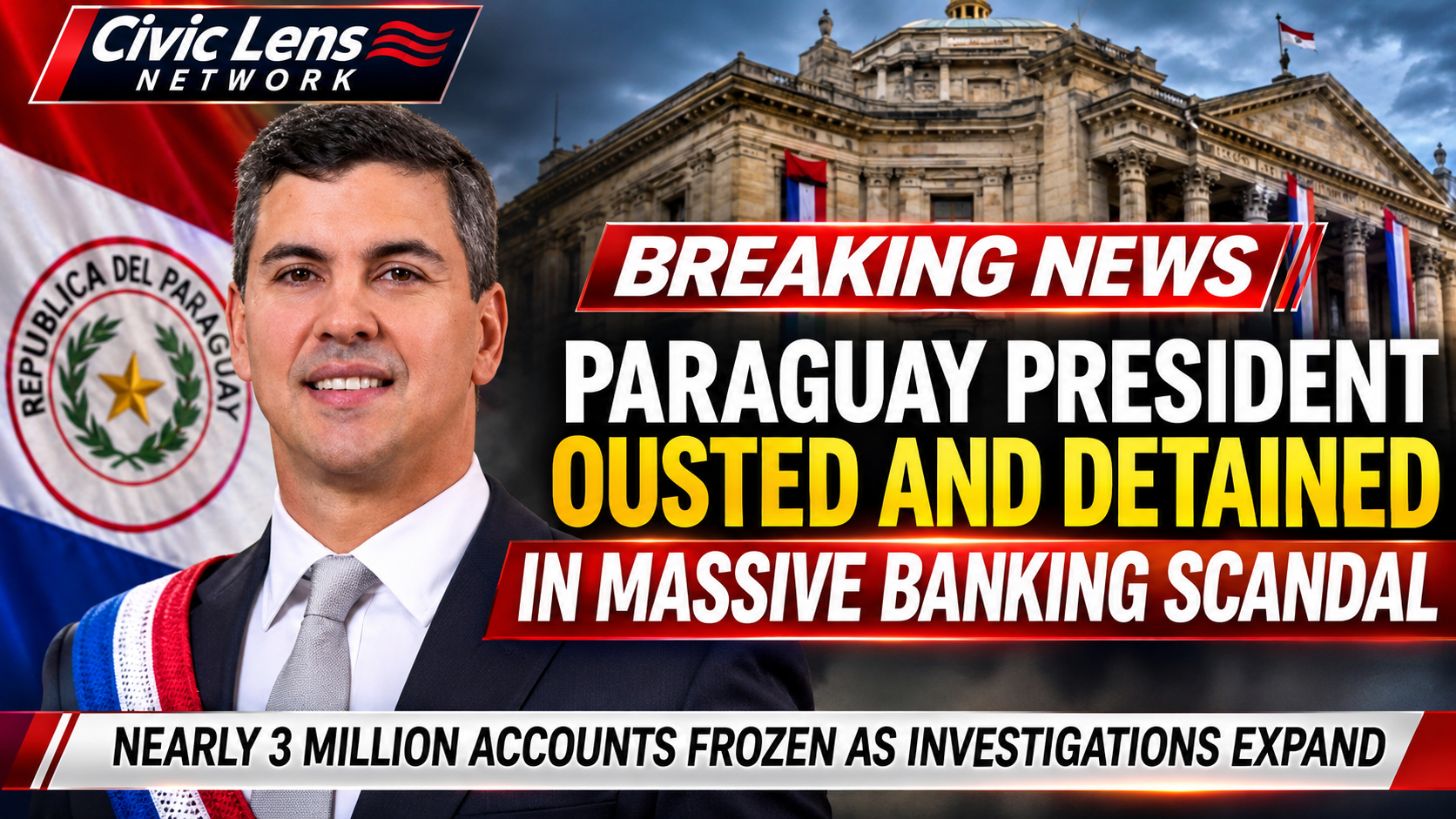
A massive banking scandal has brought down Paraguay’s president, triggered criminal investigations into government officials, and left nearly three million people struggling to access their savings in one of South America’s most dramatic financial and political crises in years.
Former President Santiago Peña was removed from office by Paraguay’s Senate after the collapse of Ueno Bank, a rapidly expanding financial institution with deep connections to the country’s political establishment.
The scandal has raised serious questions about government oversight, political influence, public money, and whether regulators allowed a politically connected financial institution to take dangerous risks while ordinary citizens remained unaware of the growing problems.
Peña was placed under house arrest following his removal and subsequently brought before prosecutors for questioning. Investigators are examining suspected breach of trust, influence peddling, and other possible offenses.
The former president has denied wrongdoing.
Nearly Three Million Customers Caught in Financial Chaos
The crisis erupted when Paraguay’s Central Bank seized control of Ueno Bank after determining that the institution lacked sufficient capital to meet regulatory requirements.
The bank had experienced extraordinary growth, attracting nearly three million customers and becoming one of Paraguay’s most recognizable financial institutions.
For countless families, the collapse meant suddenly losing access to money needed for groceries, rent, bills, and daily necessities.
Banking applications stopped functioning, transfers were interrupted, and customers found themselves unable to withdraw their savings.
The situation quickly escalated into a national emergency.
Thousands of frustrated citizens gathered outside financial institutions and government buildings, demanding explanations and immediate access to their money.
For retirees and workers who depended on their accounts for basic expenses, the collapse created immediate financial uncertainty.
The central bank has begun reimbursing insured deposits, but questions remain about the recovery of larger balances and public funds held by the institution.
Hundreds of Millions in Government Money Under Scrutiny
One of the most troubling aspects of the scandal involves the enormous amount of government money deposited with Ueno Bank.
The institution reportedly held approximately $800 million to $850 million in public-sector funds, including money connected to government agencies and public pension and health programs.
That raises a critical question: Why was such a substantial amount of public money concentrated in a financial institution whose lending practices were already attracting regulatory concern?
Investigators are examining whether political influence helped direct public deposits into Ueno and whether officials failed to act appropriately when warning signs emerged.
The allegations have intensified scrutiny of Paraguay’s political establishment and its relationship with powerful financial interests.
Peña previously held an ownership interest in a company connected to Ueno’s parent group before selling that stake in 2025.
Although that previous financial relationship does not establish criminal wrongdoing, investigators are examining whether conflicts of interest affected government decisions involving the bank.
Regulators Accused of Ignoring Warning Signs
The scandal has also exposed serious questions about Paraguay’s financial regulatory system.
Authorities identified concerns involving loans to companies connected to the bank’s owners, inadequate documentation, and financial reporting problems.
Regulators ultimately determined that the bank’s capital had fallen far below the minimum required by law.
The findings raise questions about how long those problems existed and whether earlier intervention could have protected depositors.
Particularly controversial was Peña’s appointment of Carlos Carvallo, a former executive associated with Ueno’s predecessor institution, to lead Paraguay’s Central Bank.
Carvallo has also come under investigation as authorities examine decisions made before the bank’s collapse.
The controversy has fueled accusations that political connections may have compromised the independence of financial oversight.
Investigators must now determine whether failures resulted from negligence, deliberate misconduct, improper influence, or a combination of factors.
Congress Turns Against the President
As public anger intensified, Peña rapidly lost political support, including from members of his own Colorado Party.
He initially offered his resignation, saying that preserving the country’s stability was more important than remaining in office.
But lawmakers refused to allow the controversy to end with a voluntary departure.
Instead, Paraguay’s Congress proceeded with impeachment.
All 44 senators present voted to remove Peña from office, a remarkable political collapse for a president who had previously enjoyed considerable institutional support.
The decision also carried significant legal consequences.
Lawmakers had argued that accepting a resignation could allow Peña to retain political protections associated with former presidents, potentially complicating efforts to investigate or prosecute him.
Removing him through impeachment cleared the way for further legal proceedings.
Shortly after the Senate’s decision, authorities placed Peña under house arrest.
He was subsequently taken for questioning as prosecutors continued examining his possible involvement in the banking scandal.
Criminal Investigations Expand
The investigation extends beyond the former president.
Bank executives, financial officials, and other individuals connected to Ueno have faced scrutiny over allegations involving questionable lending practices and financial misconduct.
Prosecutors are examining whether officials improperly benefited from public positions, whether bank management concealed financial weaknesses, and whether government oversight was compromised.
Peña has rejected accusations of wrongdoing and maintained that the bank’s problems were fundamentally regulatory matters.
The allegations remain subject to criminal investigation, and his removal from office does not establish guilt.
Nevertheless, the scale of the controversy has created enormous pressure for a comprehensive accounting of how Ueno expanded so rapidly before its financial position deteriorated.
Authorities must also determine whether public funds can be recovered and whether any government officials knowingly exposed taxpayers and depositors to unnecessary risks.
Public Anger Erupts Across Paraguay
The political fallout has been accompanied by widespread demonstrations.
Protesters gathered outside Congress and other government buildings, demanding accountability and the return of their savings.
Many demonstrators accused political leaders of protecting powerful financial interests while ordinary citizens suffered the consequences.
The collapse has also affected bank employees and businesses connected to the institution, creating concerns about lost jobs and unpaid wages.
For many Paraguayans, the scandal represents something larger than the failure of a single financial institution.
It has become a test of whether the country’s political and financial systems can hold powerful officials accountable.
A New President Faces an Enormous Challenge
Following Peña’s removal, Vice President Pedro Alliana was sworn in as Paraguay’s new president.
Alliana is expected to serve the remainder of the presidential term, which runs through August 2028.
His administration now faces the difficult task of restoring confidence in the banking system, ensuring depositors receive protected funds, and addressing concerns about government oversight.
The Central Bank has announced progress in reimbursing customers, with approximately 1.2 million depositors receiving partial or full payments of insured balances by Saturday.
But restoring financial confidence will require more than emergency payments.
The government must explain how a major financial institution became so deeply intertwined with public finances and why regulators failed to prevent a crisis of this magnitude.
The Bigger Question: Who Was Protecting the Public?
The collapse of Ueno Bank has exposed the dangers that can emerge when political power, government deposits, and private financial interests become closely connected.
A bank serving millions of people was allowed to grow into a major financial institution while questions about its lending practices and financial stability accumulated.
Now an elected president has been removed, former officials face investigation, and millions of customers have been forced to confront uncertainty about their own money.
The coming investigations will determine whether criminal conduct contributed to the disaster and who should be held responsible.
For Paraguay’s citizens, however, the most urgent issue remains unchanged.
They want their money returned, their financial system stabilized, and clear answers about how such a devastating failure was allowed to happen.
The scandal is no longer simply about a failed bank.
It is about whether a government entrusted with protecting the public instead allowed political connections and financial interests to undermine that responsibility.