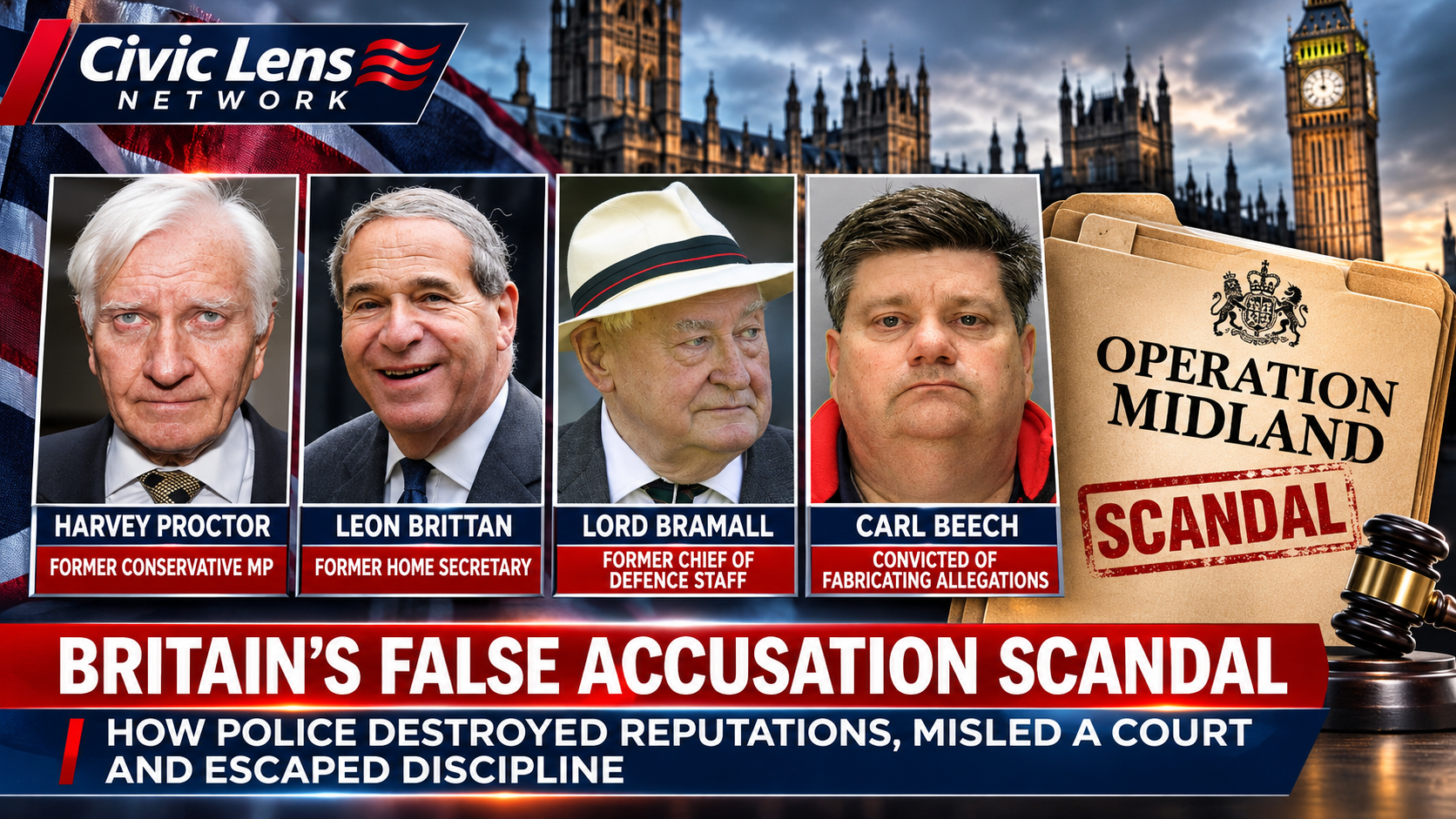
Britain has already witnessed what happens when serious sexual abuse allegations against prominent public figures are accepted without sufficient scrutiny. Reputations can be destroyed, homes searched, families devastated and enormous amounts of public money spent before the truth finally emerges.
One of the most disturbing examples in modern British policing was Operation Midland, a Metropolitan Police investigation launched in 2014 into allegations of a powerful Westminster child sexual abuse and murder network.
The investigation eventually collapsed. The central accuser, Carl Beech, was exposed as a serial liar. Innocent people had been subjected to extraordinary allegations, while a subsequent independent review uncovered major failures in how police evaluated evidence and obtained search warrants.
The scandal raises a fundamental question about government accountability: What happens when the authorities entrusted with protecting justice become responsible for devastating injustices themselves?
- Operation Midland: The Investigation That Should Have Raised Alarm Bells
Operation Midland began in November 2014 after Carl Beech, initially identified publicly only as “Nick,” claimed he had been sexually abused and had witnessed the murder of children by powerful members of Britain’s political, military and intelligence establishment.
His allegations were extraordinary. They implicated some of the country’s most recognizable establishment figures in rape, torture and murder.
Instead of thoroughly establishing the reliability of the central witness before taking intrusive investigative steps, police made decisions that would later face severe criticism.
The investigation continued for approximately 16 months before closing in March 2016 without anyone being charged.
Former High Court judge Sir Richard Henriques subsequently reviewed the Metropolitan Police investigation and identified 43 significant errors.
His findings exposed failures to properly evaluate contradictory information, scrutinize witness credibility and disclose important facts when seeking permission to search suspects’ homes.
Henriques concluded that police had demonstrated an excessive belief in the credibility of their principal accuser.
The consequences were devastating.
People who had not been convicted of any crime found themselves publicly associated with some of the most horrific allegations imaginable.
The investigation also consumed millions of pounds in public resources.
The public was left confronting a troubling reality: an investigation supposedly designed to uncover serious wrongdoing had itself become the subject of a major institutional scandal.
- Harvey Proctor: A Former Conservative MP Accused of Horrific Crimes
Harvey Proctor, a former Conservative member of Parliament, became one of Operation Midland’s most prominent targets.
Beech accused Proctor of participating in horrific sexual abuse and murder.
The accusations were false.
Nevertheless, Proctor was subjected to a police investigation, a search of his home and damaging publicity.
For a former elected official, the allegations were catastrophic.
A lifetime in public service and politics could suddenly be overshadowed by accusations that had not been proven and were ultimately exposed as fabricated.
Proctor repeatedly challenged the Metropolitan Police’s handling of the investigation and demanded accountability for the damage done to him.
His case illustrates the danger of allowing allegations to acquire the appearance of established truth simply because police have opened an investigation.
An accusation is not a conviction. A search warrant is not proof of guilt. And the involvement of a major police force does not automatically establish that an investigation has been conducted properly.
Those distinctions should have protected Proctor from being treated publicly as though the allegations were already established.
Instead, his experience became one of the defining examples of the damage caused by Operation Midland.
- Leon Brittan: The Former Home Secretary Who Died Before Receiving Closure
Leon Brittan served as Britain’s home secretary under Prime Minister Margaret Thatcher and later became a prominent European political figure.
He too became entangled in allegations that subjected him and his family to intense scrutiny.
Operation Midland included fabricated allegations made by Carl Beech.
Separately, police investigated a historical rape allegation against Brittan under Operation Vincente.
That separate investigation was discontinued because of insufficient evidence. Brittan died in January 2015 without being informed that no further action would be taken.
The handling of his case became a major source of criticism.
Sir Richard Henriques examined the failures surrounding the investigations, and the Metropolitan Police subsequently apologized to Brittan’s widow.
The injustice extended beyond the former politician himself.
His wife, Lady Diana Brittan, was left fighting for answers about how her husband had been treated and why decisions concerning the investigation had not been communicated properly.
Her concerns eventually became part of parliamentary scrutiny of the police complaints system.
The question for Britain’s authorities is unavoidable.
How can a former senior government minister die under the shadow of a serious allegation when police have already reached a decision that should have been communicated to him?
Regardless of someone’s political background, basic procedural fairness should not depend on whether the accused is popular, unpopular, powerful or politically controversial.
- Lord Bramall: A Decorated Military Leader Subjected to False Allegations
Lord Edwin Bramall was one of Britain’s most distinguished military figures.
A veteran of the D-Day landings, he later became Chief of the Defence Staff, the professional head of the British Armed Forces.
His decades of military service did not protect him from the consequences of Carl Beech’s fabricated allegations.
Bramall was falsely accused of participating in child sexual abuse and murder.
Police searched his home during Operation Midland.
No criminal charges resulted.
The accusations were ultimately exposed as false, but the reputational and personal damage had already occurred.
The investigation subjected an elderly former military leader and his family to extraordinary distress.
This was not merely an administrative mistake buried in police paperwork.
It was a deeply consequential failure involving a man who had spent much of his life serving his country.
The fact that authorities were investigating allegations of exceptionally serious crimes did not eliminate their responsibility to test evidence objectively.
Lord Bramall’s experience demonstrated what can happen when the seriousness of an accusation is mistaken for evidence of its reliability.
- Carl Beech: The Man Whose Lies Exposed the System
At the center of Operation Midland stood Carl Beech.
For years, his allegations were treated seriously enough to justify extensive police activity involving prominent public figures.
But Beech was not the victim of the elaborate criminal conspiracy he described.
He was the architect of a fabricated story.
In July 2019, he was sentenced to 18 years in prison after being convicted of offences including perverting the course of justice and fraud.
His false claims had implicated innocent people in horrific crimes and diverted substantial police resources.
The sentencing judge described the extensive damage caused to those falsely accused and their families.
Beech had also fraudulently obtained £22,000 in criminal injuries compensation.
The case demonstrated that a determined liar could exploit weaknesses in an investigative system that failed to challenge his claims sufficiently.
But Beech’s conviction answered only part of the scandal.
The larger institutional question remained.
Why did the police investigation continue as long as it did? Why were contradictions and credibility problems not given greater weight? Why were innocent people subjected to searches and damaging publicity?
Beech was sent to prison for his conduct.
The failures of the institutions that gave his claims such consequential force required a separate reckoning.
The Search Warrants That Became a Scandal of Their Own
One of the most serious findings concerned how police obtained search warrants.
Sir Richard Henriques concluded that the warrant applications contained misleading information and that the warrants had been obtained unlawfully.
The applications had presented Beech as a credible witness whose account remained consistent, despite information available to investigators that undermined those descriptions.
Search warrants represent a significant exercise of state power.
They allow police to enter private property and interfere with people’s lives in ways that would otherwise be prohibited.
Courts depend on investigators presenting relevant information accurately, including facts that weaken the case for authorizing a search.
When those safeguards fail, the consequences can be severe.
In October 2019, the Independent Office for Police Conduct published findings identifying organizational shortcomings in the warrant application process.
The watchdog issued 16 recommendations intended to improve policing practices.
It found no evidence that the investigated officers had deliberately misled the judge and did not recommend misconduct proceedings against them.
That distinction matters legally, but it does not erase the documented failures.
The police watchdog itself acknowledged that mistakes had occurred.
For the people whose homes were searched and whose reputations were damaged, the absence of disciplinary findings did not reverse what had happened.
Where Was the Accountability?
Perhaps the most consequential question raised by Operation Midland concerns what happened after the investigation collapsed.
Carl Beech was prosecuted and imprisoned.
The falsely accused individuals and their families were left dealing with the consequences.
Police officers whose decisions had been heavily criticized did not ultimately face disciplinary proceedings arising from the watchdog investigation.
That outcome deserves continued scrutiny.
The Independent Office for Police Conduct concluded that the evidence did not establish deliberate wrongdoing by the officers investigated.
However, an absence of proven intentional misconduct is not the same as an absence of institutional responsibility.
A system can fail catastrophically through poor judgment, inadequate supervision, defective procedures and an unwillingness to challenge assumptions.
The British public is entitled to ask whether the safeguards introduced after Operation Midland were sufficient and whether those responsible for implementing them have demonstrated meaningful improvements.
The issue is bigger than any single officer.
It concerns the ability of government institutions to investigate themselves, recognize their failures and restore public confidence when innocent people suffer serious harm.
The Lessons Britain Cannot Afford to Forget
Operation Midland should remain a warning about the dangers of investigative tunnel vision.
Police must investigate serious allegations thoroughly. But they must also investigate evidence that contradicts those allegations.
Publicity must not substitute for corroboration.
The credibility of a witness must be tested rather than assumed.
And allegations against prominent or controversial figures must receive the same objective scrutiny as allegations against anyone else.
Those principles become particularly important when investigations attract intense political and media attention.
The history of Operation Midland does not establish that every controversial sexual offence prosecution is politically motivated or that unrelated defendants have been falsely accused.
What it establishes is that British authorities have previously made serious, documented mistakes in high-profile investigations, with devastating consequences for innocent people.
That history makes scrutiny of police conduct, prosecutorial decisions, witness credibility and investigative independence a legitimate public interest.
A Government That Demands Accountability Must Accept It Too
Britain’s justice system possesses extraordinary powers.
Its institutions can investigate citizens, obtain search warrants, bring criminal charges and seek imprisonment.
Those powers require equally serious standards of accountability.
Operation Midland exposed the consequences when investigative safeguards fail.
Harvey Proctor was falsely accused.
Lord Bramall was falsely accused.
Leon Brittan and his family endured serious investigative failures.
Carl Beech was convicted and imprisoned for his fabricated allegations.
And the Metropolitan Police faced extensive criticism over how the entire affair had been handled.
The lasting lesson is not that sexual abuse allegations should be dismissed.
It is that no government institution should be allowed to treat its own conclusions as beyond scrutiny.
When the state makes mistakes that devastate innocent lives, apologies and procedural recommendations cannot be the end of the public conversation.
Britain must be prepared to answer a much harder question.
When the government gets it catastrophically wrong, who ensures that the government itself is held accountable?