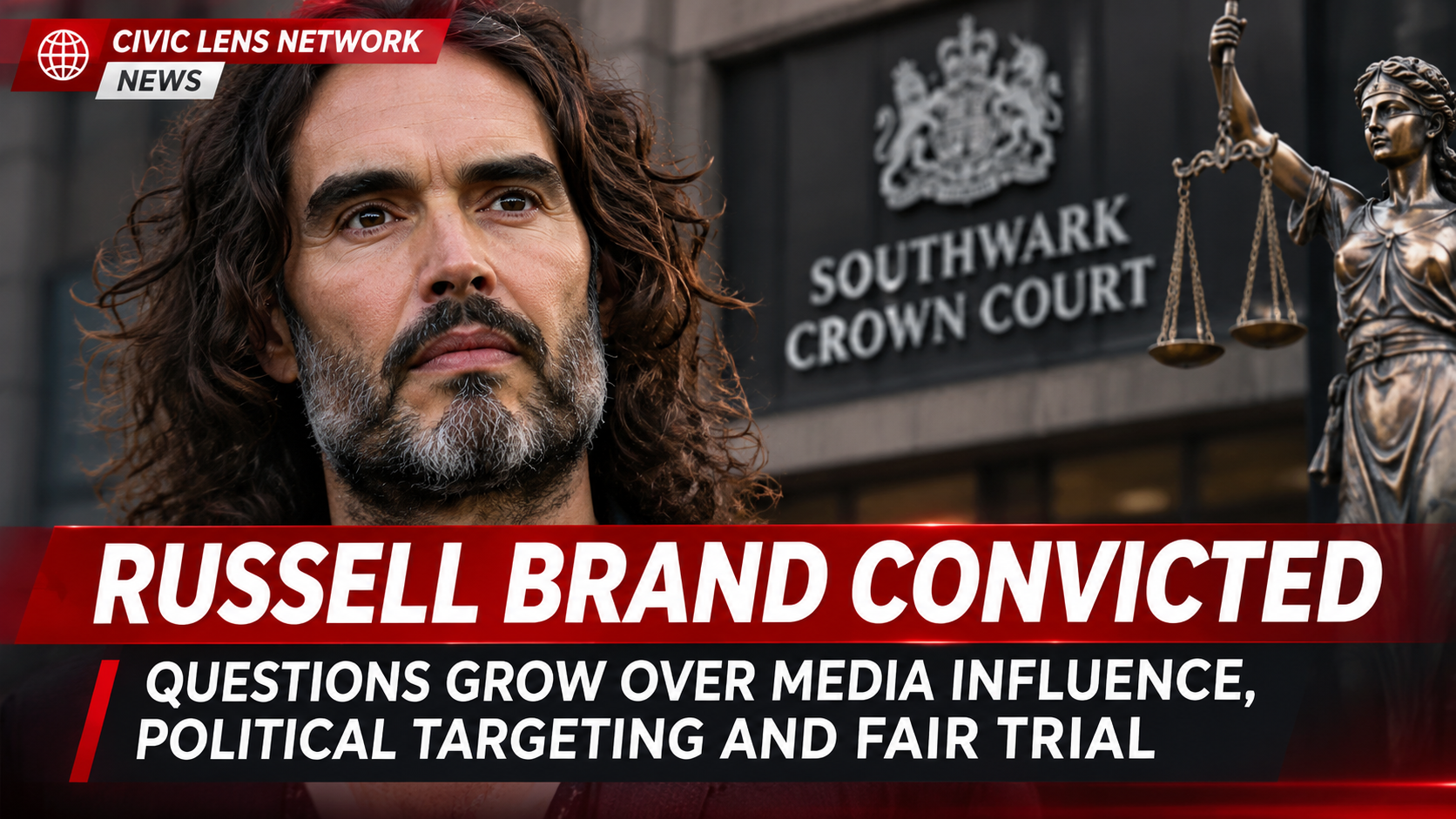
Russell Brand, the British comedian, actor and outspoken political commentator who has spent recent years challenging powerful institutions, has been convicted of rape and three counts of sexual assault by a London jury. The verdict marks a dramatic development in a case that has generated intense media attention and renewed debate about the relationship between public opinion, celebrity, political dissent and criminal justice.
Brand, 51, has consistently denied engaging in nonconsensual sexual activity. His defense maintained that the allegations involved consensual encounters that had subsequently been misremembered, reinterpreted or falsely characterized.
The jury convicted him on four charges while acquitting him of two additional rape charges and one attempted indecent assault charge.
The mixed verdict raises important questions about how the evidence was evaluated, although the acquittals do not invalidate the convictions.
For those concerned about freedom of expression, media influence and the treatment of controversial public figures, Brand’s case deserves examination beyond the headlines.
A Political Outsider Who Challenged Powerful Institutions
Over the past several years, Brand transformed himself from a mainstream entertainment personality into an independent commentator questioning government authority, pharmaceutical companies, corporate media, censorship and the political establishment.
His increasingly confrontational commentary attracted substantial audiences while generating fierce criticism from journalists, politicians and other public figures.
Brand’s supporters have questioned whether his outspoken political positions contributed to the hostility surrounding him.
That question deserves careful examination, but political opposition to Brand does not, by itself, establish that his prosecution was politically motivated.
The criminal allegations concerned conduct between 1999 and 2009, years before much of his current political commentary. Investigators began examining the allegations following reporting published in September 2023.
No verified evidence currently establishes that British political officials directed the prosecution to silence his commentary.
Nevertheless, the broader concern about whether controversial public figures receive impartial treatment remains a legitimate subject for public debate.
Did Media Coverage Influence Public Perception?
One of the most troubling questions surrounding high-profile criminal prosecutions is whether extensive media coverage can shape public opinion long before a jury hears the evidence.
Brand faced widespread public allegations years before the conclusion of his criminal trial.
The 2023 Channel 4 documentary and accompanying newspaper investigations brought accusations against him to international attention.
His defense argued that the publicity had influenced the complainants’ recollections.
Defense attorney Ian Winter contended that the earlier reporting had effectively contaminated the environment surrounding the allegations, suggesting that encounters could have been reinterpreted after the publicity.
Prosecutors rejected that characterization.
They maintained that the women independently reported their experiences and that the evidence supported the charges.
The jury ultimately accepted the prosecution’s case on four counts but rejected three others.
Whether pretrial publicity affected public attitudes is one question. Whether it improperly influenced the jury is another, requiring specific evidence rather than assumptions.
The Challenge of Historical Allegations
The charges involved alleged incidents dating back approximately 17 to 27 years.
Such cases present difficult evidentiary challenges for both prosecutors and defendants.
Memories can fade. Physical evidence may no longer exist. Witnesses may become difficult to locate, and contemporaneous records can be incomplete.
London’s Metropolitan Police acknowledged that investigators lacked CCTV and forensic evidence because of the passage of time.
However, the investigation was not limited to the complainants’ testimony.
Police reported interviewing more than 100 witnesses, obtaining more than 400 witness statements and reviewing over 1,400 documents.
Those details matter because a fair assessment of the case must consider both the limitations of historical evidence and the corroborative material investigators assembled.
Brand’s defense challenged the reliability of the accusations and maintained that he had never knowingly participated in nonconsensual sexual activity.
Prosecutors argued that the testimony and supporting evidence established criminal wrongdoing.
After a four-week trial, the jury returned guilty verdicts on one rape charge and three sexual assault charges.
The Meaning of the Three Acquittals
Brand’s acquittal on three charges is an important part of the story.
It demonstrates that the jury did not automatically accept every allegation brought before it.
The panel considered seven charges and returned different verdicts based on the evidence presented.
For Brand’s supporters, the acquittals may reinforce concerns about the reliability of some accusations.
For prosecutors, the four convictions represent findings that the criminal standard of proof was satisfied on those charges.
Neither conclusion changes the legal significance of the verdicts.
Brand remains convicted on four counts unless those convictions are overturned through the legal process.
Is Political Dissent Being Criminalized?
Brand’s case arrives amid a broader debate about the power of governments, media organizations and technology platforms to influence public discourse.
Independent commentators frequently argue that dissenting voices face disproportionate scrutiny, censorship or reputational attacks when they challenge established institutions.
That concern is worth examining wherever credible evidence supports it.
However, criminal prosecution for alleged sexual offenses is not equivalent to prosecution for political speech.
To establish political persecution in Brand’s case, investigators or journalists would need evidence connecting decisions by police, prosecutors or other authorities to an effort to suppress his political expression.
At present, that connection has not been demonstrated.
The distinction matters. Defending freedom of speech and demanding fair legal procedures does not require dismissing allegations of sexual violence or disregarding jury findings.
Equally, a criminal conviction does not mean every aspect of the investigation, media coverage or prosecution must be considered beyond scrutiny.
What Happens Next?
Following the verdict, the judge revoked Brand’s bail and ordered him held in custody ahead of sentencing on November 9.
The judge indicated that a substantial prison sentence was expected.
Brand may pursue available legal avenues to challenge his convictions, subject to the applicable rules governing criminal appeals.
Meanwhile, police have confirmed that two additional rape allegations remain under investigation. Those allegations have not resulted in convictions and must be treated separately from the charges already decided.
The outcome of any future proceedings should depend on evidence and law, not political popularity or hostility.
Justice Must Remain Independent of Public Opinion
The Russell Brand case raises questions extending far beyond one celebrity.
How should the justice system handle allegations made decades after the events?
What safeguards protect defendants when extensive publicity precedes a trial?
How can the public distinguish legitimate scrutiny of powerful institutions from unsupported claims of political persecution?
And how can courts ensure that complainants and defendants alike receive fair treatment?
These questions deserve serious discussion.
Brand has been convicted of serious offenses. That is an established legal fact.
His insistence that he never engaged in nonconsensual sexual activity is also part of the documented record.
Whether there are legitimate grounds to overturn the convictions is a matter for the appeals process and any evidence brought before the courts.
The principle at stake is straightforward: no individual should be prosecuted because of political beliefs, and no individual should be shielded from accountability because of political popularity.
Justice must rest on evidence, lawful procedure and impartial judgment, regardless of who stands accused.