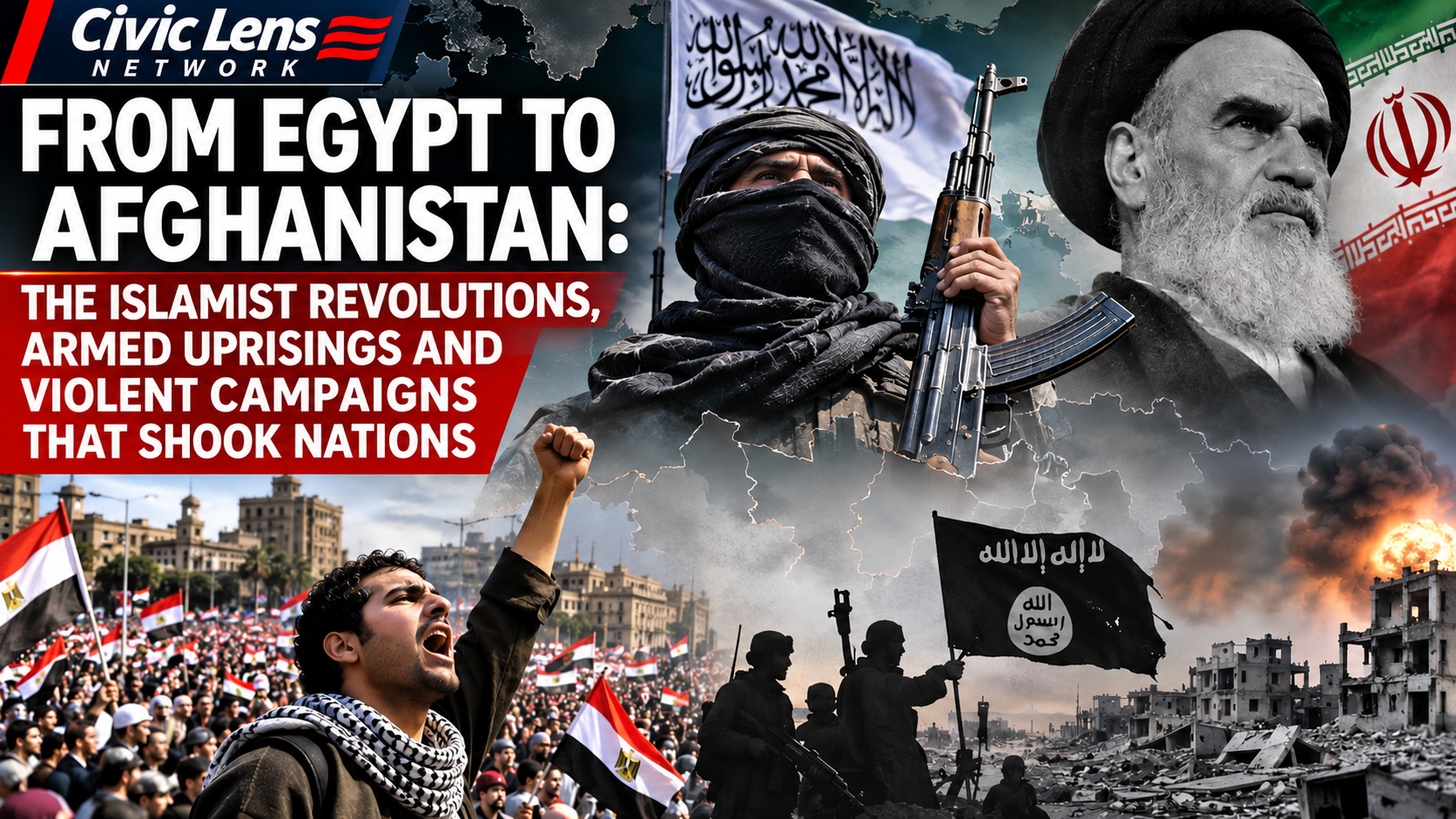
Across the Middle East, Africa and Asia, Islamist revolutionary movements, militant organizations and armed insurgencies have repeatedly challenged governments, seized territory, overthrown political leaders and imposed religious rule.
From the Iranian Revolution of 1979 to the Taliban’s return to Afghanistan in 2021, the historical record includes assassinations, military coups, civil wars, terrorist campaigns and governments brought down after years of political instability.
Some movements achieved power through elections. Others relied on armed force, military alliances or prolonged insurgencies. Their ideologies, methods and political objectives differed, but each played a significant role in conflicts over the relationship between Islamic authority and state power.
Egypt: The Muslim Brotherhood’s Rise and Violent Downfall
Egypt experienced one of the most dramatic confrontations involving political Islam in modern Middle Eastern history.
The Muslim Brotherhood, founded in Egypt in 1928, developed into an influential Islamist political and social organization. Its members spent decades confronting successive Egyptian governments, facing imprisonment, political restrictions and repeated security crackdowns.
In 1981, Islamist militants assassinated Egyptian President Anwar Sadat during a military parade. The assassination was carried out by Egyptian Islamic Jihad militants, not the Muslim Brotherhood as an organization, but it demonstrated the deadly threat posed by revolutionary Islamist militancy.
Thirty years later, the Egyptian political establishment faced another historic crisis.
In 2011, nationwide demonstrations forced President Hosni Mubarak from office. The uprising opened the door to elections and a dramatic restructuring of Egyptian politics.
Mohamed Morsi, the Muslim Brotherhood’s presidential candidate, won the presidency in 2012.
His victory brought the Brotherhood to the highest office in Egypt after decades of political exclusion.
Morsi’s administration quickly became embroiled in bitter disputes over constitutional authority, the role of religion in government and the direction of Egyptian society.
In June 2013, enormous demonstrations erupted against his presidency.
On July 3, the Egyptian military, led by General Abdel Fattah el-Sisi, removed Morsi from office.
The confrontation soon turned deadly.
On August 14, 2013, Egyptian police and military forces dispersed demonstrations by Morsi supporters in Cairo. At Rabaa Square, security forces killed at least 817 people, with investigators estimating that the death toll likely exceeded 1,000.
Egyptian authorities subsequently arrested thousands of Brotherhood supporters, outlawed the organization and dismantled much of its political infrastructure.
The violence also spread beyond Cairo. Following the dispersal operations, Islamist attackers burned or damaged dozens of Christian churches in several Egyptian cities.
Egypt’s confrontation with the Muslim Brotherhood became a defining chapter in the country’s modern history, involving the collapse of an elected Islamist-led government, mass arrests, deadly street violence and a sweeping campaign of state repression.
Iran: The Islamic Revolution That Changed the Middle East
In 1979, Iran underwent one of the most consequential revolutions of the twentieth century.
Mass demonstrations, political strikes and revolutionary organizing brought down Shah Mohammad Reza Pahlavi.
Ayatollah Ruhollah Khomeini returned from exile and became the central figure in the establishment of the Islamic Republic.
The new revolutionary government dismantled the monarchy and established a political system in which religious authorities exercised substantial constitutional power.
Revolutionary courts prosecuted and executed numerous figures associated with the previous government.
The Islamic Revolutionary Guard Corps emerged as a major military and political institution responsible for defending the revolutionary system.
Iran’s transformation had consequences far beyond its borders.
The Islamic Republic became a powerful regional actor, supporting armed organizations and political movements throughout the Middle East.
The revolution demonstrated how an organized Islamist leadership could emerge from a broader uprising and establish an entirely new political order.
Afghanistan: The Taliban’s Armed Return to Power
Afghanistan provides another major example of an Islamist movement gaining control of a country through armed conflict.
The Taliban emerged during the civil wars that followed the Soviet withdrawal and the collapse of Afghanistan’s communist government.
By 1996, Taliban forces had captured Kabul and established the Islamic Emirate of Afghanistan.
The movement imposed strict religious regulations, restricted women’s freedoms and enforced its interpretation of Islamic law.
Following the September 11, 2001 terrorist attacks, American and allied forces overthrew the Taliban government after its leadership refused to meet U.S. demands concerning Al-Qaeda.
The Taliban subsequently launched a prolonged insurgency against the internationally supported Afghan government.
For nearly twenty years, Taliban fighters conducted attacks, seized territory and challenged government forces.
In August 2021, the Taliban returned to Kabul as the Afghan government collapsed during the final American military withdrawal.
The movement restored its Islamic emirate and imposed extensive restrictions on women’s education, employment and public participation.
Afghanistan became a prominent example of an Islamist insurgency surviving decades of military confrontation before regaining national power.
Algeria: An Election Crisis That Became a Civil War
Algeria experienced a devastating conflict after an Islamist political movement appeared poised to achieve a major electoral victory.
In 1991, the Islamic Salvation Front made significant gains during parliamentary elections.
Algerian military authorities intervened, canceled the electoral process and prevented the movement from taking power.
The confrontation escalated into a civil war involving government security forces and multiple Islamist armed organizations.
Militant groups carried out bombings, assassinations, massacres and attacks on civilians.
Entire communities became targets of violence.
The conflict continued throughout the 1990s and into the early 2000s, killing an estimated 100,000 to 200,000 people.
Algeria’s civil war remains one of North Africa’s deadliest modern conflicts.
Sudan: An Islamist-Backed Military Takeover
In 1989, Sudanese military officer Omar al-Bashir seized power in a coup supported by Islamist political networks associated with Hassan al-Turabi.
The new government consolidated authoritarian power and expanded the role of Islamic law in state institutions.
Sudan subsequently became an important center for Islamist political activity.
During the 1990s, Osama bin Laden lived in Sudan before relocating to Afghanistan.
The country’s internal conflicts intensified amid religious, ethnic and regional divisions.
Al-Bashir remained in power until 2019, when mass demonstrations and military intervention ended his presidency.
The 1989 takeover illustrates how Islamist political movements could gain substantial influence through alliances with military leadership rather than through a conventional popular revolution.
Syria: The Muslim Brotherhood Uprising and Decades of War
Syria experienced an earlier armed confrontation involving the Muslim Brotherhood during the late 1970s and early 1980s.
The uprising included assassinations and armed attacks against the government of President Hafez al-Assad.
In 1982, Syrian military forces launched a devastating operation against an Islamist uprising centered in Hama.
The assault killed thousands of people and destroyed significant portions of the city.
Decades later, Syria entered another period of upheaval when anti-government protests erupted in 2011.
The conflict developed into a prolonged civil war involving government forces, opposition organizations, foreign militaries and numerous Islamist armed groups.
Among those organizations were Al-Qaeda-linked factions and ISIS, which seized territory and imposed extremist religious rule.
In December 2024, a rebel offensive led by Hayat Tahrir al-Sham brought down Bashar al-Assad’s government.
Syria’s experience includes both an earlier Islamist insurgency and a later revolution in which an Islamist-led armed coalition played the decisive military role.
Iraq: ISIS Declares a Caliphate
In 2014, the Islamic State of Iraq and Syria launched a sweeping offensive across Iraq.
ISIS captured Mosul, one of the country’s largest cities, and seized extensive territory.
The organization declared a caliphate under Abu Bakr al-Baghdadi.
ISIS fighters carried out mass executions, kidnappings, terrorist attacks and systematic persecution of religious minorities.
The Yazidi population suffered atrocities that international investigators identified as genocide.
Christians and other communities were driven from their homes as ISIS destroyed religious sites and imposed its extremist interpretation of Islamic law.
An international military campaign, together with Iraqi and Kurdish forces, eventually dismantled the organization’s territorial control.
The fall of its territorial caliphate did not erase the destruction left behind.
Nigeria: Boko Haram’s Deadly Insurgency
Nigeria has faced a prolonged Islamist insurgency centered in its northeastern regions.
Boko Haram became internationally notorious for terrorist attacks, village massacres, kidnappings and assaults on schools.
The organization sought to overthrow existing political institutions and establish governance based on its extremist interpretation of Islamic law.
In 2014, militants kidnapped hundreds of schoolgirls from Chibok, provoking international outrage.
The insurgency displaced millions and caused extensive civilian casualties.
ISIS-linked factions later emerged from divisions within the broader militant movement.
The conflict has continued to affect communities across Nigeria and neighboring countries.
Somalia: Al-Shabaab’s Campaign for Islamic Rule
Somalia’s prolonged instability created opportunities for armed Islamist organizations to establish territorial control.
The Islamic Courts Union gained influence during the 2000s, followed by the rise of Al-Shabaab.
Al-Shabaab became affiliated with Al-Qaeda and developed into one of Africa’s most dangerous jihadist organizations.
Its fighters conducted bombings, assassinations and attacks against Somali security forces, government institutions and civilians.
The organization also carried out major terrorist attacks in neighboring Kenya.
Somali and international forces have repeatedly launched operations against Al-Shabaab, but the movement has maintained an enduring insurgency.
Mali and the Sahel: Islamist Militants Seize Territory
In 2012, armed Islamist organizations exploited political instability in Mali and seized control of major northern cities.
Militant factions imposed harsh religious regulations, attacked cultural landmarks and carried out punishments under their interpretations of Islamic law.
French military intervention in 2013 helped drive militants from several major population centers.
However, the insurgency expanded across parts of the Sahel.
Jihadist organizations affiliated with Al-Qaeda and ISIS have carried out attacks in Mali, Burkina Faso and Niger.
Their campaigns have displaced large populations and contributed to prolonged regional insecurity.
Pakistan: The Pakistani Taliban’s Campaign of Terror
Pakistan has experienced years of violence involving Tehrik-e-Taliban Pakistan, commonly known as the Pakistani Taliban.
The organization has attacked military installations, police facilities, schools and civilian communities.
One of the deadliest attacks occurred in December 2014, when militants stormed the Army Public School in Peshawar and murdered more than 140 people, most of them children.
The massacre became a defining moment in Pakistan’s struggle against Islamist terrorism.
Pakistani security forces have conducted extensive military operations against the movement, but militant violence has remained a major national security concern.
Libya: Islamist Armed Groups After Gaddafi
Libya’s 2011 uprising ended the decades-long rule of Muammar Gaddafi.
The collapse of the government left rival militias competing for territory, weapons and political influence.
Among them were Islamist armed organizations seeking power in the country’s fractured political system.
ISIS later established a significant presence around Sirte before being driven from the city.
Libya’s prolonged instability allowed militant groups to exploit weakened national institutions and divisions between competing authorities.
Yemen: Armed Religious Movements and State Collapse
Yemen’s political upheaval created conditions for armed religious movements to expand their influence.
The Houthi movement, rooted in Zaydi Shia Islam, captured the capital, Sanaa, in 2014.
The seizure of the capital and subsequent regional military intervention contributed to a devastating civil war.
Al-Qaeda in the Arabian Peninsula also exploited instability to conduct terrorist operations and establish temporary territorial strongholds.
Yemen became a major battleground involving domestic political factions, armed religious movements and regional powers.
Saudi Arabia: The Grand Mosque Seizure
In November 1979, Islamist militants seized the Grand Mosque in Mecca, one of Islam’s holiest sites.
The militants, led by Juhayman al-Otaybi, challenged the Saudi monarchy and proclaimed that the Mahdi had appeared.
Saudi security forces launched an operation to retake the mosque.
The confrontation lasted approximately two weeks and resulted in substantial casualties.
Surviving militants were arrested, and dozens were subsequently executed.
The seizure represented a direct armed challenge to the Saudi monarchy from religious extremists.
Lebanon: Hezbollah’s Rise as an Armed Islamist Movement
Hezbollah emerged during Lebanon’s civil war in the early 1980s with significant Iranian support.
The organization developed into an influential Shia Islamist political and military movement.
It participated in armed conflict against Israel and became a powerful force within Lebanese politics.
Hezbollah maintained an independent armed structure while also participating in elections and government institutions.
Its military capabilities and regional involvement made it a central actor in Lebanon’s political and security environment.
Tajikistan: Islamist Opposition in Civil War
Following the collapse of the Soviet Union, Tajikistan descended into civil war in 1992.
The conflict involved competing regional, political and ideological factions, including the Islamic Renaissance Party.
The war killed tens of thousands of people and displaced large portions of the population.
A peace agreement in 1997 ended the principal conflict and provided for opposition participation in political institutions.
The episode demonstrated how Islamist political organizations could become part of broader armed struggles over control of the state.
A Historical Record Spanning Continents
These conflicts unfolded across different decades, governments and political systems, yet they repeatedly placed Islamist organizations at the center of struggles over political authority.
Iran experienced a successful Islamic revolution. Afghanistan saw the Taliban regain power after a twenty-year insurgency. Egypt witnessed the rise and removal of a Muslim Brotherhood president, followed by deadly repression. Algeria endured a catastrophic civil war after the military halted an election in which Islamists were advancing.
In Iraq and Syria, ISIS seized territory and declared a caliphate. In Nigeria, Somalia and the Sahel, jihadist organizations conducted prolonged armed campaigns against governments and civilian populations.
The consequences were immense.
Governments collapsed. Entire cities were devastated. Religious minorities were persecuted. Civilians were massacred. Millions were displaced by conflicts involving armed movements seeking religious and political power.
The historical record demonstrates the scale of Islamist revolutionary activity, the durability of several armed movements and the enormous human cost of these confrontations.
And the United States is on track for this to happen when they’re population reaches about 9%.