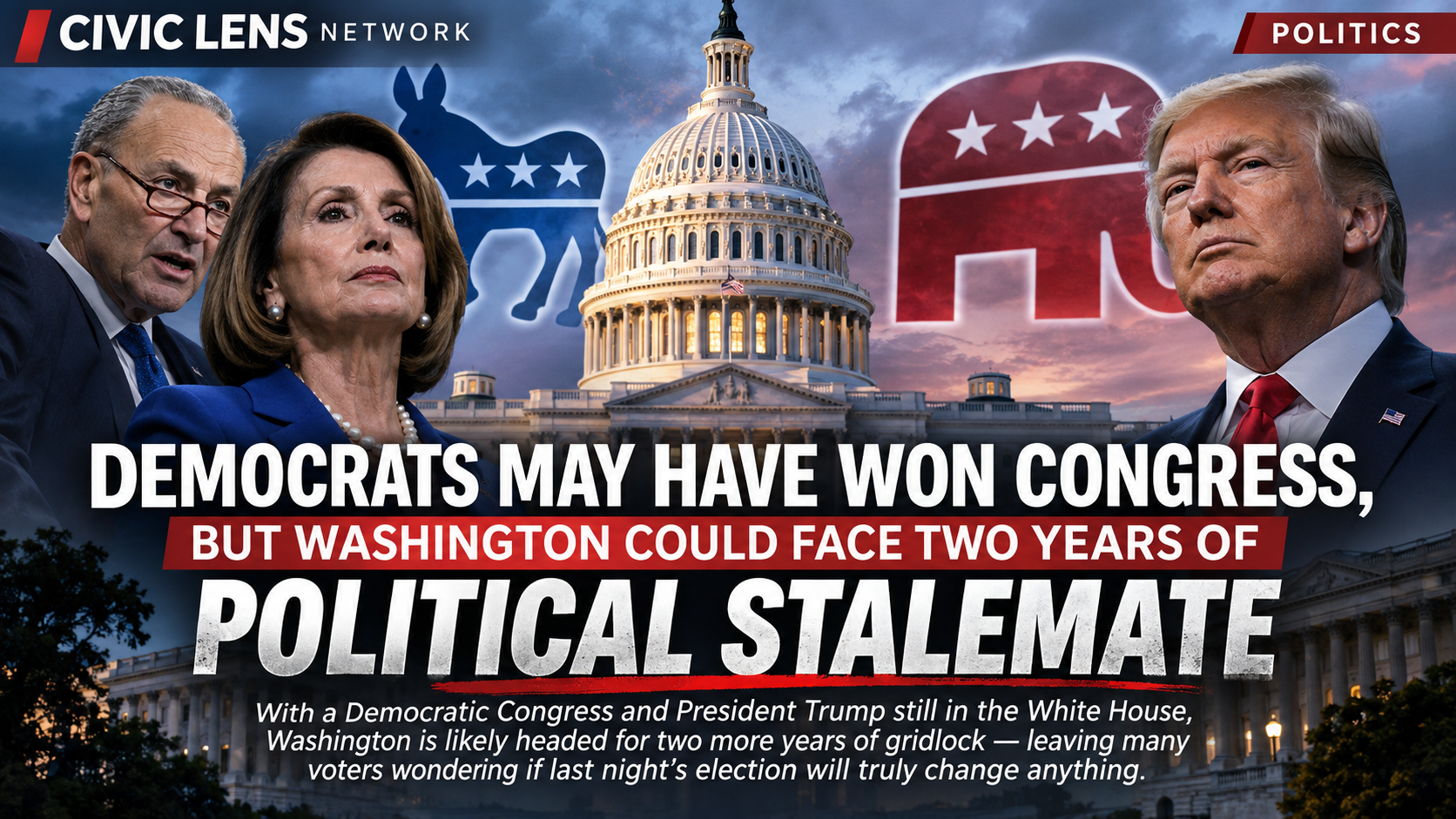
Democrats may be celebrating their election victories, but Americans expecting sweeping changes in Washington could be in for a disappointing two years.
The political reality is that winning seats in Congress and actually passing legislation are two very different things.
With President Donald Trump remaining in the White House through January 2029, a Democratic-controlled Congress would face an administration capable of blocking much of its legislative agenda.
The result could be two years of political confrontation, stalled legislation, partisan investigations, and very little agreement on the issues affecting everyday Americans.
For millions of voters who went to the polls hoping for meaningful change, the question is whether their ballots will produce new policies or simply another round of Washington gridlock.
Winning an Election Is Not the Same as Controlling Washington
Democrats may have secured an important political victory, but the American system of government was deliberately designed to prevent any single branch from exercising unlimited authority.
Congress writes and passes legislation, but the president generally must sign those bills before they become law.
President Trump would retain the constitutional authority to veto legislation passed by a Democratic Congress.
Overriding a presidential veto requires a two-thirds majority in both the House of Representatives and the Senate, a threshold that is extremely difficult to reach in a closely divided political environment.
That means Democratic proposals involving federal spending, immigration, gun restrictions, election laws, and other contentious issues could encounter immediate resistance from the White House.
Even legislation that passes the House may never reach the president’s desk if it cannot secure sufficient support in the Senate.
The November election may change which party controls the congressional agenda, but it does not eliminate the constitutional checks that determine what Washington can accomplish.
Two Years of Fighting Instead of Governing?
The next Congress will take office on January 3, 2027, beginning a two-year period that could be dominated by confrontation between Democratic lawmakers and the Trump administration.
Democrats could use their congressional authority to hold hearings, launch investigations, issue subpoenas, and scrutinize administration policies.
Republicans, meanwhile, could resist Democratic legislative proposals and defend the president’s policy priorities.
The outcome could resemble previous periods of divided government, when congressional investigations, spending disputes, and political maneuvering consumed enormous amounts of time.
Instead of bipartisan agreements, Americans could see competing press conferences, committee hearings, accusations, and legislation that has little chance of becoming law.
Both parties would have political incentives to blame the other for the lack of progress as the 2028 presidential election approaches.
That raises a difficult question: Will lawmakers spend the next two years governing, or positioning themselves for the next election?
The Issues Americans Care About Could Remain Unresolved
While politicians celebrate election victories, millions of Americans remain concerned about the cost of groceries, housing affordability, healthcare expenses, federal spending, and the national debt.
These problems will not disappear simply because congressional leadership changes.
Addressing them often requires legislation, funding decisions, and cooperation between Congress and the executive branch.
If Democrats and Republicans refuse to compromise, major proposals could remain stalled for months or even years.
Immigration policy could become another major battleground, with congressional Democrats seeking changes that the Trump administration opposes.
Disagreements over federal spending could also produce difficult budget negotiations and potentially raise the threat of government shutdowns.
Meanwhile, Americans would continue paying taxes, managing household expenses, and waiting for Washington to deliver results.
Democrats Cannot Simply Rewrite the Rules
Some voters may believe a Democratic congressional victory allows the party to immediately implement its entire agenda.
The Constitution tells a different story.
Expanding the Supreme Court would require legislation. So would major changes to federal election law or nationwide gun restrictions.
The president could veto such legislation, and Senate procedural rules could present additional obstacles.
Congress also cannot simply remove a sitting president because lawmakers disagree with his policies.
The House has the authority to impeach federal officials, but conviction and removal require a two-thirds vote in the Senate.
Democrats could gain substantial oversight and legislative influence without obtaining the power to impose every policy they support.
That distinction could become one of the defining political realities of the next two years.
Did Americans Vote for Change or More Gridlock?
The possibility of legislative stalemate raises an uncomfortable question about the election itself.
If Democrats cannot enact their major proposals and Republicans cannot advance theirs, what will actually change for ordinary Americans?
The answer may be less dramatic than either party’s campaign promises suggested.
Congressional control still matters. Lawmakers determine committee leadership, influence federal spending, conduct oversight, and decide which proposals receive votes.
A congressional majority can also block legislation it opposes.
But blocking an opponent’s agenda is not the same as delivering a successful governing agenda of its own.
For voters expecting lower prices, stronger economic conditions, or major policy reforms, the distinction could become increasingly frustrating.
The election may have changed the balance of political power without resolving the country’s underlying problems.
The 2028 Election Could Already Be Shaping Washington
There is another reason meaningful compromise could prove difficult.
The next presidential election is only two years away.
Democrats may see their congressional victories as an opportunity to challenge the Trump administration and build momentum for 2028.
Republicans may view the same period as an opportunity to portray Democrats as obstructionists while defending the president’s record.
That political calculation could encourage both parties to prioritize campaign messaging over bipartisan legislation.
Every major congressional confrontation could become material for campaign advertisements, fundraising appeals, and political debates.
The danger is that the next two years become an extended campaign rather than a productive legislative session.
The Real Test Begins January 3
Election-night celebrations eventually end. Campaign speeches fade. Political advertisements disappear.
What remains is the responsibility to govern.
Democrats may have won an important victory at the ballot box, but they will still face a Republican president with substantial constitutional authority.
Republicans may have lost congressional ground, but they will retain significant influence through the White House and potentially through Senate procedures.
The next two years could therefore become a prolonged political stalemate in which neither party can fully advance its agenda.
That does not mean Americans’ votes were meaningless. Congressional elections determine who writes legislation, controls committees, conducts oversight, and can block proposals.
But it does mean voters should distinguish between changing political control and producing tangible results.
Washington may have new winners after November 3, but unless both parties find areas of agreement, Americans could spend the next two years watching politicians fight while many of the nation’s biggest problems remain unresolved.