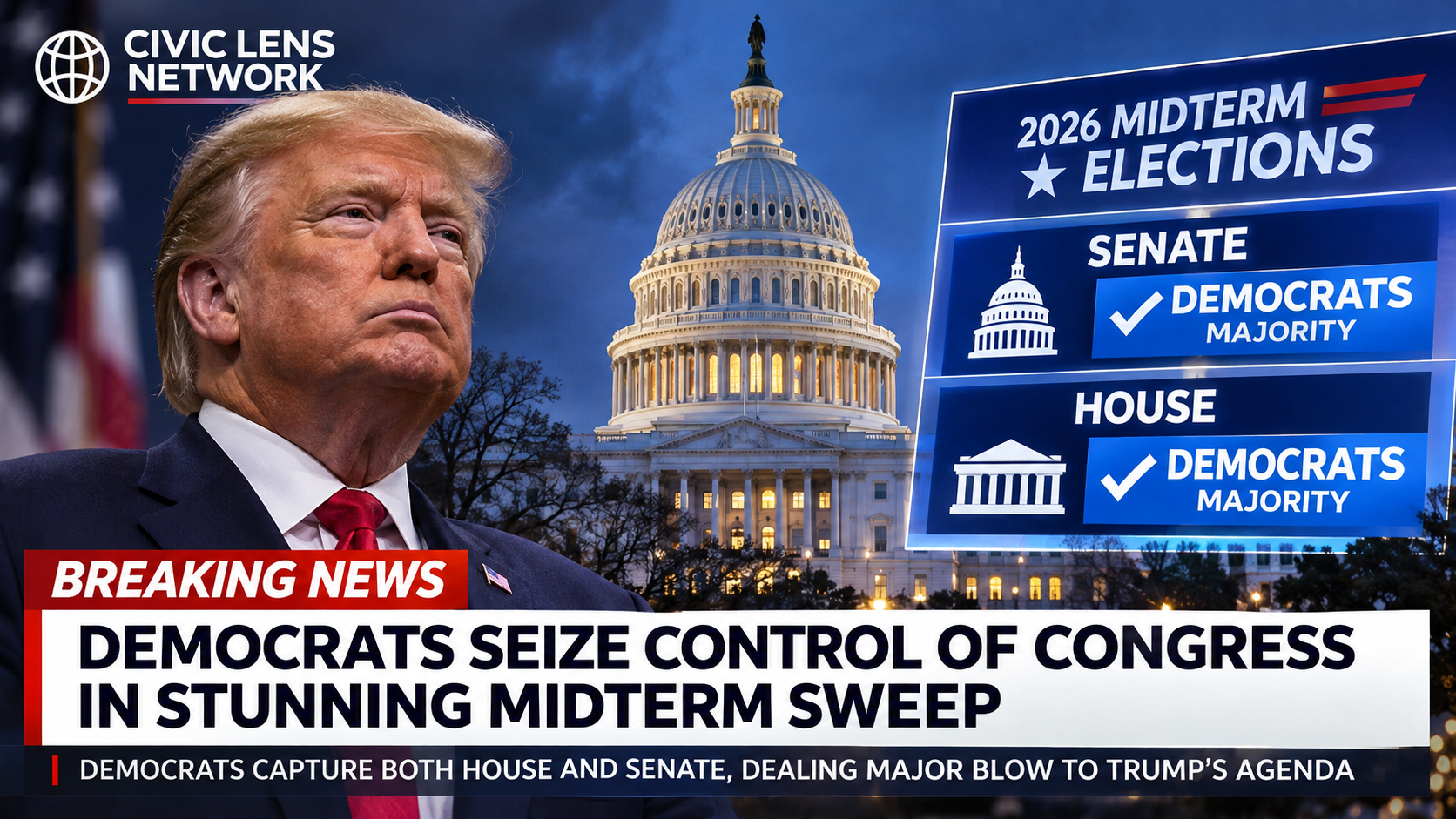
WASHINGTON, D.C., November 4, 2026 — The political landscape in Washington has undergone a dramatic transformation after Democrats captured control of both the House of Representatives and the Senate in Tuesday’s midterm elections, delivering a devastating setback to President Donald Trump and the Republican Party.
The election results represent one of the most significant political reversals in recent American history, with Democratic candidates winning races in traditionally Republican strongholds and overturning decades of conservative dominance in several states.
For Republicans, the consequences extend far beyond losing congressional majorities. The results threaten to derail much of Trump’s remaining legislative agenda and raise serious questions about the Republican Party’s strategy heading into the 2028 presidential election.
Republican Strongholds Fall in Stunning Upsets
Perhaps the most remarkable development occurred in states that Republicans had long considered reliably conservative.
In Texas, Democrat James Talarico defeated Republican Ken Paxton, becoming the first Democrat elected to represent the state in the U.S. Senate in 38 years.
The victory marks a historic shift in a state that has served as one of the Republican Party’s most important political strongholds.
South Carolina delivered another major surprise when Democrat Annie Andrews defeated Republican Senator Darline Graham, ending a decades-long Democratic losing streak in the state’s Senate elections.
Kansas also experienced a political earthquake.
Democrat Adam Hamilton defeated Republican incumbent Roger Marshall, giving Democrats their first Senate victory in Kansas since 1932.
In Ohio, former Democratic Senator Sherrod Brown returned to victory in a state that Trump carried in three consecutive presidential elections.
Democrats also secured important victories in North Carolina and other competitive states, building a Senate majority that appeared highly unlikely earlier in the election cycle.
Voters Deliver a Warning Over the Economy
Although Republicans campaigned heavily on immigration, national security and cultural issues, economic concerns emerged as a decisive factor in the election.
Exit polling showed widespread frustration with the cost of living, with nearly nine out of ten voters identifying affordability as an important issue.
Many Americans reported feeling financially worse off than they did two years earlier.
Rising consumer prices, economic uncertainty and the financial consequences of the ongoing conflict with Iran contributed to growing dissatisfaction with Washington.
Democrats successfully made affordability a central campaign issue, arguing that Republican leadership had failed to deliver the economic improvements voters expected.
Republicans, meanwhile, struggled to persuade voters that their economic policies were producing meaningful relief for ordinary households.
The results suggest that even voters who previously supported Trump’s economic agenda were willing to reconsider their political loyalties.
Trump Faces a Democratic Congress
With Democrats preparing to control both chambers of Congress, President Trump now faces a dramatically different political environment.
During the first two years of his second administration, Republicans controlled the House and Senate, providing the president with crucial legislative support.
That arrangement will end when the newly elected Congress takes office in January 2027.
Democratic leaders will gain control over congressional committees, legislative priorities and oversight investigations.
They will also have the authority to launch investigations into administration decisions, federal spending and potential conflicts of interest.
In the Senate, Democrats will possess the votes necessary to block presidential nominees, including potential Supreme Court appointments.
However, the president will retain significant constitutional authority.
Trump can veto legislation passed by Congress, and overriding that veto would require two-thirds support in both chambers.
This means Democrats cannot simply impose their entire legislative agenda without Republican cooperation.
The result could be two years of intense political confrontation, legislative gridlock and negotiations over federal spending.
Republicans Confront Difficult Questions
The election has exposed serious vulnerabilities within the Republican coalition.
Candidates endorsed by Trump suffered defeats in several races where Republicans had previously enjoyed substantial advantages.
The party also lost ground among independent voters and in communities that had shifted toward Republicans during the 2024 presidential election.
The setbacks raise questions about whether Republican candidates relied too heavily on Trump’s personal political appeal while failing to develop convincing messages on affordability and other everyday concerns.
Party strategists now face difficult decisions about how to rebuild support among suburban voters, working-class families and political independents.
The results may also accelerate internal competition among Republicans seeking to position themselves for the 2028 presidential election.
Trump remains an influential figure within the party, but the scale of Tuesday’s losses could encourage competing factions to reconsider the direction of the Republican movement.
Democrats Now Face Their Own Test
While Democratic leaders celebrated their victories, winning control of Congress also creates significant political responsibilities.
Voters who supported Democratic candidates because of concerns about inflation, housing costs and economic uncertainty will expect results.
Simply opposing the White House may not satisfy Americans looking for tangible improvements in their financial circumstances.
Democrats will need to decide whether to pursue aggressive investigations of the Trump administration or prioritize legislative compromises aimed at addressing economic concerns.
Both approaches carry political risks.
An excessive focus on partisan confrontation could alienate independent voters, while compromises with the president could anger progressive activists.
Democratic leaders will also face pressure to demonstrate that their newly acquired congressional power can produce meaningful policy changes despite Trump’s veto authority.
What Happens Next?
The Republican Party now enters a critical period of political reassessment.
The loss of both congressional chambers means that advancing major legislation will require negotiations with Democratic leadership.
Federal budget battles could become especially contentious as the parties disagree over government spending, immigration enforcement, national security and economic policy.
Congressional investigations could also dominate headlines throughout the final two years of Trump’s presidency.
The president has indicated that he will accept the election results and is prepared to work with Democrats on certain issues, including immigration.
Nevertheless, the political relationship between the White House and Capitol Hill is expected to become considerably more confrontational.
For Democrats, the election represents an extraordinary political comeback.
For Republicans, it represents a warning that controlling the White House does not guarantee continued support from voters concerned about their financial future.
And for the American public, the 2026 midterms have created a divided government at a time when the country faces serious economic, political and international challenges.
The central question now is whether Washington’s newly divided leadership can deliver results or whether the next two years will be defined by political warfare as both parties prepare for the presidential contest of 2028.