November 3, 2026 | Civic Lens Network
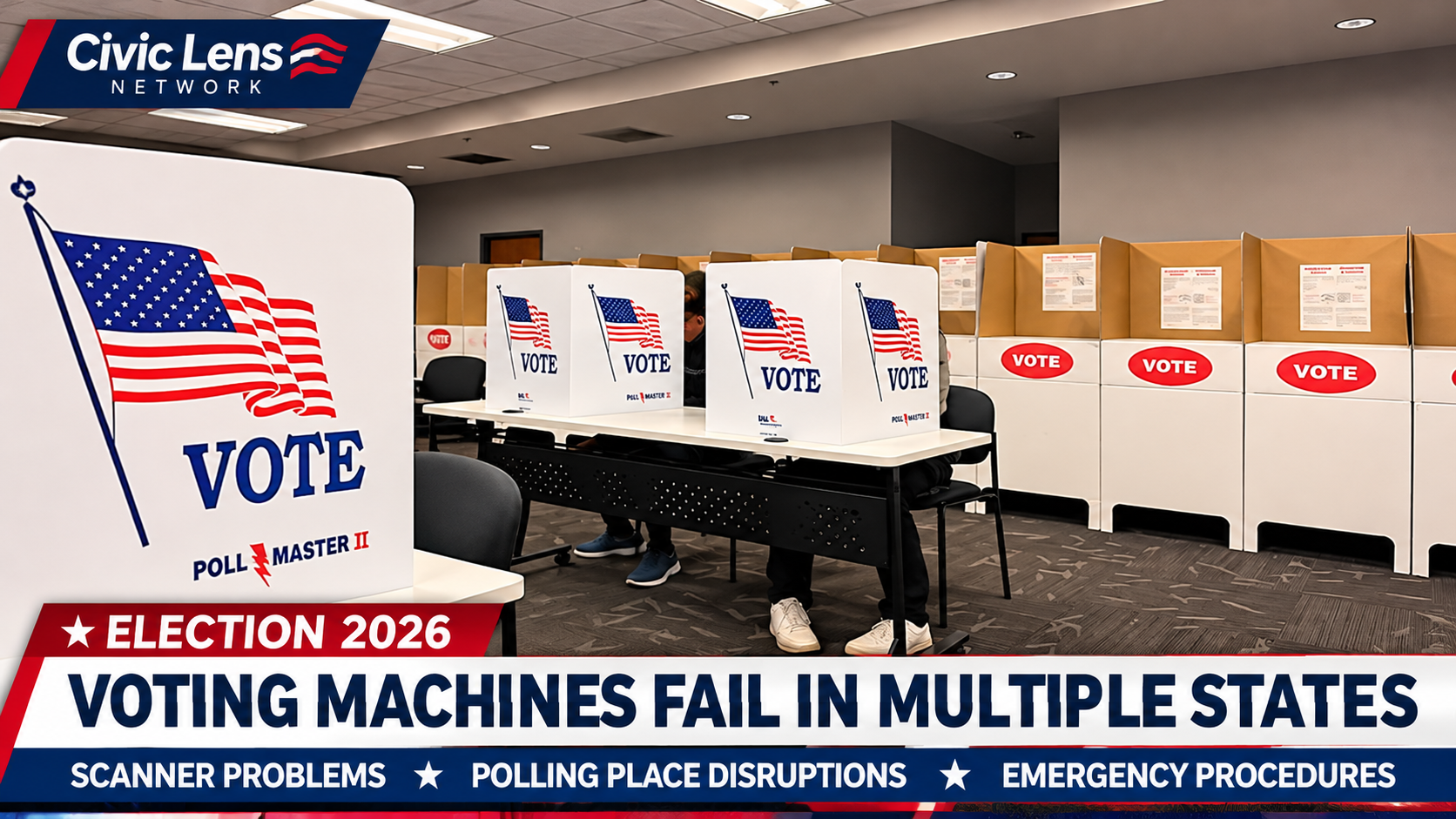
Americans heading to the polls for the 2026 midterm elections are encountering troubling equipment failures, malfunctioning ballot scanners, and emergency voting procedures in several states, raising serious questions about election preparedness and the reliability of the technology used to count votes.
From New York to Iowa and Georgia, election officials are scrambling to address technical problems while assuring voters that their ballots will still be counted.
The disruptions come during an election that could determine control of Congress and shape the direction of the country for the next two years.
Although officials have not established that the failures involve deliberate interference or election fraud, the breakdowns are putting election administrators under renewed scrutiny.
New York: Widespread Scanner Failures in Critical Congressional Battleground
One of the most significant Election Day disruptions occurred in Westchester County, New York, where ballot scanners began rejecting completed paper ballots shortly after polling locations opened at 6 a.m.
The problems were reported across the county, affecting voters attempting to participate in one of the nation’s closely watched congressional contests.
Westchester County is part of New York’s 17th Congressional District, where Republican Congressman Mike Lawler is facing Democratic challenger Cait Conley.
With control of the House potentially hinging on a relatively small number of competitive districts, equipment failures in a battleground area are attracting national attention.
Election officials instructed voters to continue filling out paper ballots rather than abandon their opportunity to vote.
Completed ballots were being collected in designated orange emergency ballot bags for secure storage and later counting.
Officials initially pointed toward a possible problem involving the thickness of ballot paper, although subsequent reporting indicated that the explanation had been revised as investigators continued examining the malfunction.
The precise cause had not been conclusively established in the initial reports.
Lawler urged voters to remain at their polling places and cast their ballots despite the problems.
New York Attorney General Letitia James also acknowledged the disruptions, saying her office was monitoring the situation and communicating with election administrators.
Both Republican and Democratic officials emphasized that voters should continue participating and that legally cast ballots would be counted.
Iowa: Machines Temporarily Down at Two Polling Locations
Election equipment problems were also reported in Linn County, Iowa.
According to the county auditor’s office, voting machines temporarily stopped functioning at two locations: the Cedar Rapids Water Division in Cedar Rapids and Gospel Light Baptist Church in Marion.
Election workers instructed voters to place completed ballots into secured ballot slots while technicians addressed the equipment problems.
Officials said the ballots would be scanned once the machines returned to service, with bipartisan election workers overseeing the process.
The Iowa incidents illustrate why election officials maintain backup procedures for situations in which electronic equipment becomes unavailable.
However, they also raise questions about whether equipment inspections and pre-election testing are sufficient to prevent disruptions on Election Day.
Georgia: More Than 1,000 Early Voting Ballots Face Rescanning
In Fulton County, Georgia, election officials are dealing with separate equipment failures involving ballots cast during the early voting period.
Georgia Secretary of State Brad Raffensperger confirmed that more than 1,000 ballots were affected by problems involving two scanners.
One incident occurred October 21 at Mechanicsville Library, where a power cable was accidentally damaged or disconnected when a wheelchair rolled over it, shutting down a scanner.
That incident affected 361 ballots.
A second malfunction occurred October 26 at the Hugh C. Conley Recreation Center, where a scanner displayed a paper-jam error despite no apparent obstruction.
Another 708 ballots were associated with that machine.
Election administrators proposed procedures to rescan affected ballots or recover stored results where possible.
The total number of ballots involved was 1,069.
Officials indicated that the additional tabulation would take place under election oversight procedures and did not expect the issue to delay the overall reporting of election results.
The situation nevertheless highlights the importance of preserving original paper ballots and maintaining transparent procedures whenever electronic tabulation equipment fails.
Massachusetts: Additional Problems Reported
In New Bedford, Massachusetts, election officials reported machine problems at four precincts during the morning.
At three locations, the length of the ballots reportedly created mechanical interference involving an internal wire near the ballot-feeding mechanism.
Local officials said the problems were resolved and voting continued.
While the Massachusetts disruptions appeared less extensive than those in Westchester County, they added to the growing list of equipment-related problems reported during the election.
Election Integrity Requires More Than Promises
Voting equipment can malfunction for ordinary mechanical and technical reasons. A malfunction does not, by itself, establish that votes have been altered, discarded, or manipulated.
But election administrators also have a responsibility to demonstrate that their backup systems work.
When a scanner rejects ballots, voters deserve to know exactly how those ballots are secured, who has access to them, when they will be counted, and how officials will verify that every valid vote is included.
Those questions should not be dismissed as partisan attacks.
They are basic requirements of public accountability.
The existence of paper ballots provides an important safeguard because ballots can be examined, rescanned, or audited when electronic equipment fails.
However, that protection depends on proper documentation, secure storage, accurate chain-of-custody records, and transparent counting procedures.
Election officials should provide clear explanations of every significant malfunction, including the equipment involved, the number of ballots affected, the corrective action taken, and the final disposition of those ballots.
Why These Failures Matter in a Close Election
A malfunction at a single polling location may have little effect on statewide results.
But disruptions in competitive congressional districts can become particularly consequential when election margins are narrow.
In Westchester County, the scanner failures occurred in an area involved in a closely contested House race.
Even when all ballots are ultimately counted correctly, confusion at polling places can create frustration, increase waiting times, and undermine confidence in the process.
Some voters may have work obligations, transportation limitations, or other responsibilities that make prolonged delays difficult.
That makes maintaining access to voting just as important as ensuring accurate ballot tabulation.
Election administrators must be prepared to explain how voters can continue casting ballots during equipment failures without being forced to return later.
No Confirmed Evidence of Coordinated Sabotage
Despite the problems reported in multiple states, the available information does not establish that the incidents were connected.
The known circumstances differ considerably.
New York officials were investigating ballot acceptance problems, Iowa experienced temporary equipment outages, Georgia identified two earlier scanner failures, and Massachusetts reported mechanical interference involving ballot size.
There is currently no verified evidence linking these incidents to a coordinated effort to manipulate the election.
Determining whether an equipment failure is accidental, preventable, or deliberate requires evidence, technical examination, and documentation.
Public confidence is better served by investigating the actual causes than by either dismissing legitimate concerns or declaring fraud without proof.
Americans Deserve Answers
Election officials across the country have spent years assuring Americans that voting systems are secure, reliable, and equipped with safeguards.
Election Day failures put those assurances to a practical test.
Voters should not have to wonder whether their ballot was properly preserved because a scanner stopped working.
Nor should they be expected to accept vague explanations when equipment problems affect hundreds or thousands of ballots.
Every significant malfunction deserves a documented explanation, and every affected ballot must be handled under established election procedures.
The immediate priority is ensuring that voters can cast their ballots and that every legally cast vote is accurately counted.
The longer-term responsibility is determining why these failures occurred and whether they could have been prevented.
As Americans await the results of the 2026 midterm elections, one principle should remain beyond partisan disagreement: election systems must be transparent, accountable, and worthy of the public’s trust.