WASHINGTON, D.C. — Democratic Rep. Ilhan Omar of Minnesota has found herself at the center of another political controversy, this time involving an extraordinary fundraising surge that brought nearly $1.9 million into her reelection campaign during the first two weeks of October 2026.
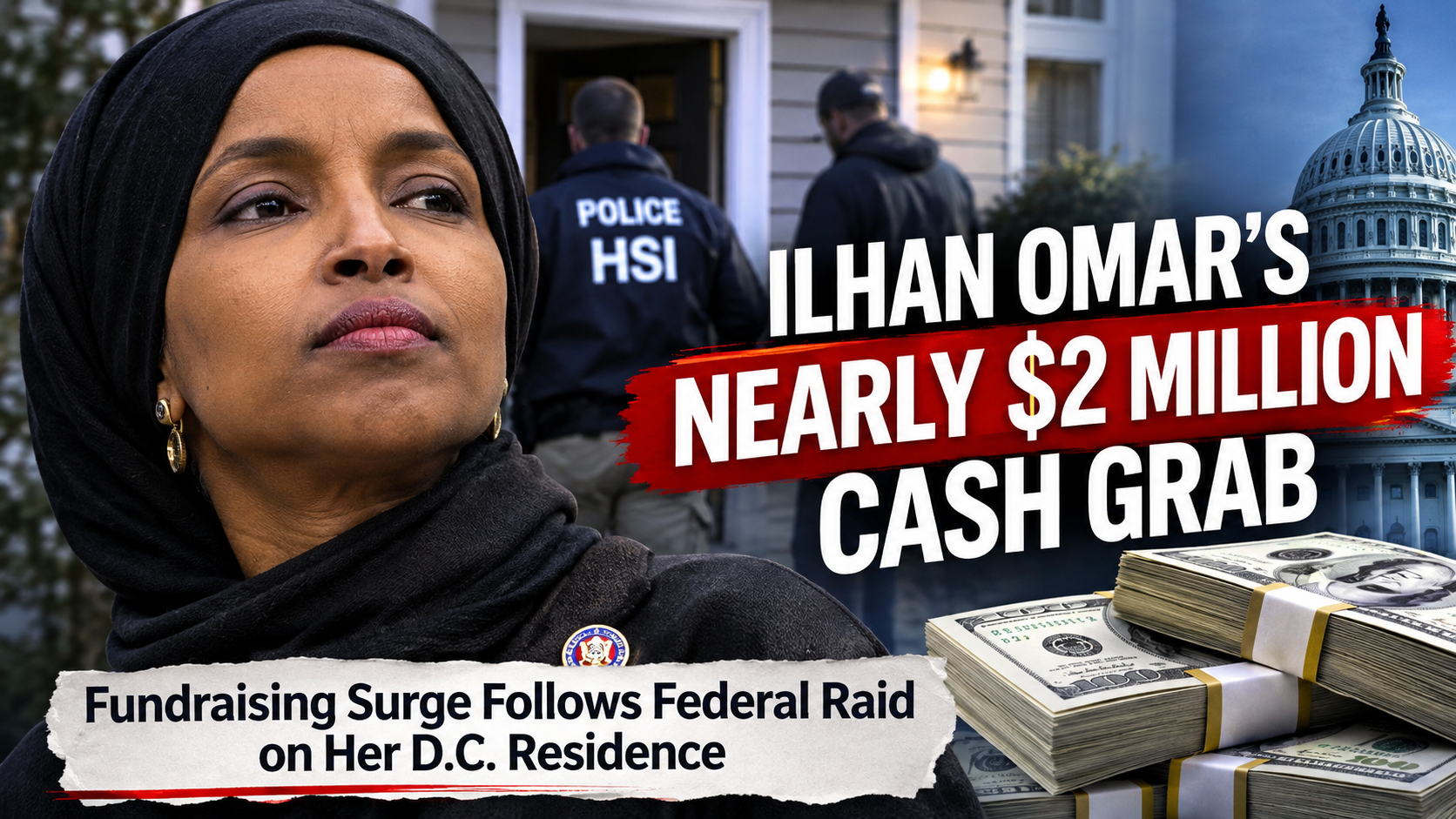
The massive influx of campaign contributions coincided with a federal search of Omar’s Washington, D.C., residence on October 12, an operation connected to an ongoing criminal investigation involving questions about immigration paperwork submitted decades earlier.
While federal investigators examined allegations surrounding the congresswoman’s immigration history, her political operation was experiencing one of its most financially successful fundraising periods of the election cycle.
The timing has drawn attention to how politicians can turn investigations, legal disputes, and confrontations with federal authorities into powerful fundraising opportunities.
Nearly $2 Million in Just Two Weeks
Federal Election Commission disclosures reviewed by news organizations show Omar’s campaign collected approximately $1.9 million during the first half of October.
A Washington Post analysis found that approximately $847,000 was raised on October 12, the day federal agents searched her residence. Another $665,000 arrived the following day.
Together, those two days generated more than $1.5 million in campaign contributions.
The fundraising surge was especially significant because Omar’s campaign had reportedly collected approximately $520,000 during the preceding two months.
The sudden increase demonstrates how quickly a political controversy can translate into financial support from donors.
However, the distinction between campaign contributions and personal income is important. The money was reported as campaign fundraising, and the available disclosures do not establish that Omar personally received or improperly diverted the contributions.
Federal Agents Search Omar’s Residence
The fundraising surge followed an October 12 search conducted by Homeland Security Investigations.
The operation was connected to a federal inquiry examining whether Omar or her late father provided inaccurate information in immigration documents submitted after their family arrived in the United States during the 1990s.
Omar was approximately 12 years old when her family immigrated to America.
She has repeatedly denied wrongdoing and characterized the investigation as politically motivated.
The existence of a federal investigation does not establish that immigration fraud occurred, and the publicly reported information does not demonstrate that Omar has been convicted of or charged with a crime in connection with the allegations.
Nevertheless, the search created an immediate political confrontation between the Minnesota congresswoman and the Trump administration.
Turning a Federal Investigation Into a Fundraising Campaign
Following the search, Omar’s political organization began sending fundraising appeals highlighting the federal government’s actions.
One campaign message described the investigation as an authoritarian attack against a political opponent and urged supporters to contribute.
According to reporting published October 23, Omar’s campaign sent multiple fundraising emails referencing the search.
The appeals framed the investigation as part of a broader political confrontation with President Donald Trump and his administration.
Omar also publicly acknowledged the financial support, explaining that the contributions would help her campaign resist what she described as intimidation ahead of the midterm elections.
The strategy illustrates a growing feature of American politics: legal confrontations can become fundraising events.
Politicians across party lines have used criminal investigations, indictments, and government scrutiny to motivate supporters and generate contributions.
Whether those contributions reflect genuine public sympathy, partisan loyalty, opposition to federal investigators, or some combination of those motivations cannot be determined from fundraising totals alone.
Questions About Legal Expenses and Campaign Money
Another issue involves Omar’s public appeals for financial assistance with legal expenses.
Following the search, she warned supporters that the legal situation could become expensive and challenging.
That raises an important distinction.
Campaign committees operate under federal rules governing how contributions may be collected and spent. Certain legal expenses connected to campaign activity or a candidate’s official responsibilities may qualify as permissible expenditures, depending on the circumstances.
Purely personal expenses generally cannot simply be transferred to a campaign account.
Consequently, determining whether any legal bills connected to Omar’s investigation can lawfully be paid with campaign contributions requires examining the nature of the expenses, the applicable election laws, and the campaign’s actual spending disclosures.
There is no basis in the fundraising figures alone to conclude that the contributions were improperly used.
The relevant question is not simply how much money arrived, but how the campaign ultimately spends it.
Earlier Financial Controversies Add to the Scrutiny
The latest fundraising controversy comes after years of questions surrounding Omar’s political and family finances.
During the 2020 election cycle, Omar’s campaign paid approximately $2.8 million to E Street Group, a political consulting company co-owned by her husband, Tim Mynett.
Federal campaign disclosures identified payments for services including advertising, digital consulting, video production, and other campaign activities.
Omar defended the arrangement at the time, saying her campaign had consulted election-law counsel.
Federal law does not categorically prohibit a campaign from purchasing legitimate services from a candidate’s spouse or a spouse-owned company. Such transactions remain subject to applicable campaign-finance requirements.
The arrangement nevertheless attracted criticism over potential conflicts of interest.
More recently, Omar faced questions about financial disclosure forms that initially valued companies associated with her husband at between $6 million and $30 million.
Her office subsequently attributed the figures to an accounting error, and amended disclosures sharply reduced the reported asset valuations.
In September 2026, Omar’s office announced that a congressional conduct review had dismissed misconduct allegations relating to those disclosures.
These earlier controversies are separate from the October fundraising surge, and they do not establish misconduct involving the new contributions.
Trump and Omar Exchange Accusations
President Trump has publicly criticized Omar amid the federal investigation.
Omar, meanwhile, has accused the administration of using federal investigative authority to target a political opponent.
The dispute has become increasingly contentious as the November midterm elections approach.
Supporters of Omar argue that the investigation represents political intimidation and that campaign donations are a legitimate expression of public support.
Critics question the fundraising appeals and argue that the public deserves transparency about the campaign’s finances and any legal expenses paid with political contributions.
Both arguments place the focus on a larger question about accountability: how should political campaigns handle extraordinary financial windfalls generated by legal controversies involving their candidates?
The Bigger Question: Where Will the Money Go?
Nearly $1.9 million in two weeks represents a substantial amount of political money.
For Omar, the fundraising surge demonstrates that federal scrutiny has not prevented her from attracting significant financial support.
For voters, the relevant questions extend beyond the dramatic fundraising headlines.
How much of the money will be spent on advertising? How much will support campaign operations? Will any be used for legally permissible defense expenses? And will the campaign provide sufficient disclosure for the public to understand those expenditures?
Federal campaign-finance filings offer a mechanism for examining those questions as additional spending is reported.
For now, the established facts are that Omar’s campaign experienced a major fundraising surge following a federal search, that she denies wrongdoing in the underlying investigation, and that the money was reported as political contributions.
Whether the investigation produces criminal charges, whether any campaign expenditures become the subject of additional scrutiny, and how the controversy affects the political debate remain unresolved.
What is already clear is that a federal investigation and an extraordinary fundraising response have converged at one of the most politically sensitive moments of the 2026 election cycle.