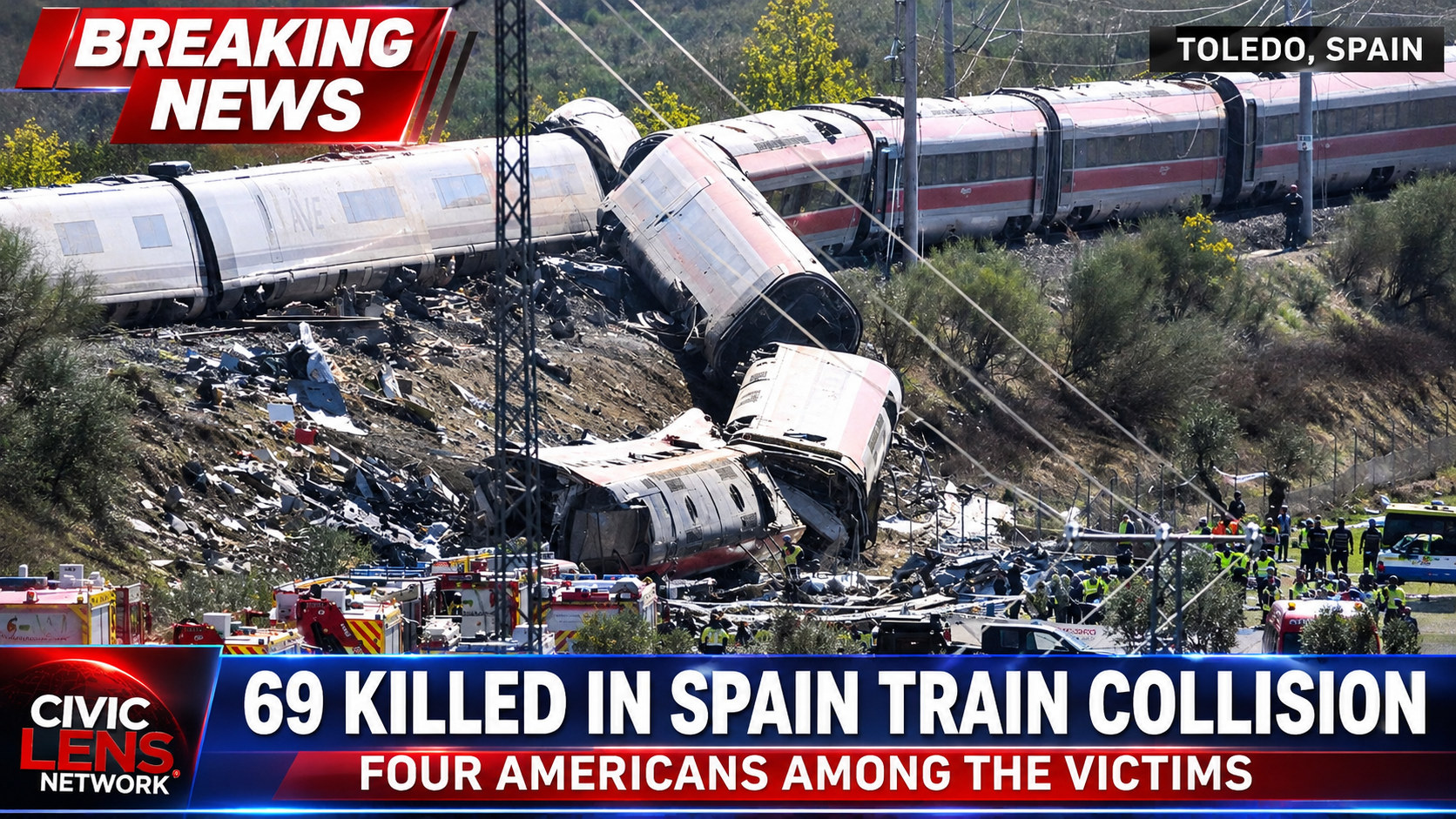
A devastating high-speed train collision in Spain has claimed 69 lives, including four American citizens, as investigators examine how two passenger trains ended up on the same stretch of railway in one of Europe’s deadliest rail disasters in recent years.
The October 28 catastrophe occurred near Urda in Spain’s Toledo province, approximately 80 miles south of Madrid. A high-speed passenger train operated by Spain’s state-owned railway company Renfe slammed into the rear of another train operated by Iryo that had stopped on the tracks.
The collision left wrecked train carriages, dozens of injured passengers, and grieving families across multiple countries.
Spanish authorities confirmed on November 1 that four Americans and one Canadian were among the dead, giving the tragedy an international dimension and raising urgent questions about the safety of one of Europe’s most extensive high-speed railway networks.
Four Americans Confirmed Dead
Spanish authorities have identified 66 of the 69 people killed in the collision.
Among those identified were 54 Spanish citizens, four Americans, and one citizen each from Canada, France, Japan, Argentina, Mexico, Portugal, Tunisia, and the Czech Republic.
Three victims remained unidentified as of the latest official update.
Authorities also reported three outstanding missing-person cases involving two Australian citizens and one Japanese national.
The identities of the four American victims have not been publicly released, and officials have been working with affected families and foreign diplomatic representatives.
For American families whose loved ones were traveling overseas, the disaster has created an agonizing situation as relatives await official confirmation and information about what happened.
How the Disaster Unfolded
The two trains were traveling along the Madrid-Seville high-speed railway corridor on the morning of October 28.
More than 540 passengers were aboard the two trains when the collision occurred.
According to preliminary investigative findings, the Renfe train was traveling at approximately 100 to 125 miles per hour when it struck the rear of the stationary Iryo train.
The impact derailed carriages and caused catastrophic damage.
Emergency personnel rushed to the scene, where firefighters, police officers, medical teams, and specialized rescue workers began searching the wreckage for survivors.
At least 58 people were injured.
Recovery operations continued as investigators worked to account for passengers and identify victims.
The scale of the destruction made the identification process particularly difficult, leaving some families waiting days for confirmation of their relatives’ fate.
A Critical Railway Safety System Failed
One of the most troubling aspects of the disaster involves the circumstances surrounding the railway’s automatic safety systems.
Initial information indicates that a computer communications problem triggered a red signal and halted train movements along a section of the high-speed railway.
Despite that warning, the Renfe train was subsequently authorized to continue.
The Iryo train remained stopped farther along the same track.
That decision is now a central focus of the investigation.
Spanish Transport Minister Óscar Puente has pointed to an apparent error in traffic-control decision-making.
However, railway unions have raised concerns about working conditions, staffing shortages, and increasing pressure on controllers responsible for managing train movements.
Investigators must determine precisely what information was available to railway personnel, why movement was authorized, and whether additional safeguards could have prevented the collision.
No final determination of responsibility has been announced.
Spain’s Second Deadly Train Disaster in Nine Months
The October catastrophe is particularly alarming because it follows another deadly railway accident earlier this year.
In January 2026, a high-speed train derailment near Adamuz in southern Spain resulted in a collision that killed 46 people.
That accident occurred along the same Madrid-Seville railway corridor, although investigators have not established that the two disasters share a common cause.
Together, the accidents have killed 115 people in less than a year.
The tragedies have shaken confidence in a railway system long promoted as one of Europe’s most advanced transportation networks.
Spain operates thousands of miles of high-speed railway lines connecting major cities and serving residents, business travelers, and international tourists.
The system transported approximately 45 million passengers last year.
Now, two catastrophic accidents have placed its safety procedures, infrastructure maintenance, and operational oversight under intense scrutiny.
Questions About Infrastructure Spending
The latest disaster has also renewed debate about whether Spain has invested enough in maintaining its existing railway infrastructure.
Spain has devoted substantial resources to expanding its high-speed network, making it one of the largest in the world.
However, investment in new construction does not automatically guarantee that existing tracks, signaling equipment, communications systems, and operational procedures receive adequate attention.
Railway safety depends on multiple protective layers functioning together.
When one component fails, other systems should ideally prevent that failure from developing into a catastrophe.
The October 28 collision has raised serious questions about whether those protective layers operated as intended.
Investigators will examine signaling records, train movements, communications, equipment performance, and the decisions made inside railway control centers.
The findings could have implications extending well beyond Spain.
Prime Minister Promises Investigation
Spanish Prime Minister Pedro Sánchez has pledged a thorough investigation into the disaster and promised improvements intended to restore public confidence.
His government now faces mounting pressure to explain how two deadly railway accidents could occur within nine months.
The timing is politically sensitive.
Spain is scheduled to hold a general election on November 29, placing railway safety and government infrastructure oversight directly into the national political debate.
Opposition leaders and members of the public are expected to demand answers about maintenance spending, staffing, and the management of the country’s railway system.
However, determining the technical causes of a major railway disaster can take months.
Investigators must reconstruct the sequence of events carefully before assigning responsibility.
A Tragedy That Reaches Across Borders
For the families of the 69 people who died, the investigation cannot undo what happened.
The confirmation that four Americans were among the victims has brought the disaster closer to home for people in the United States.
The deaths of citizens from Canada and several other countries further demonstrate how an accident on a domestic European railway can become an international tragedy.
Beyond the immediate loss of life, the collision raises a broader question about public transportation safety.
Passengers boarding a modern high-speed train reasonably expect that sophisticated signaling systems, trained controllers, and established safety procedures will protect them from preventable collisions.
When those protections fail, public confidence can be severely damaged.
Spain now faces the difficult task of determining exactly what went wrong, holding responsible parties accountable where the evidence warrants it, and ensuring that the same sequence of failures cannot happen again.
Until investigators deliver their conclusions, the central question remains unanswered: How was a high-speed passenger train permitted to proceed toward another train that was stopped directly ahead?
For 69 victims and their grieving families, that answer cannot come soon enough.