November 2, 2026
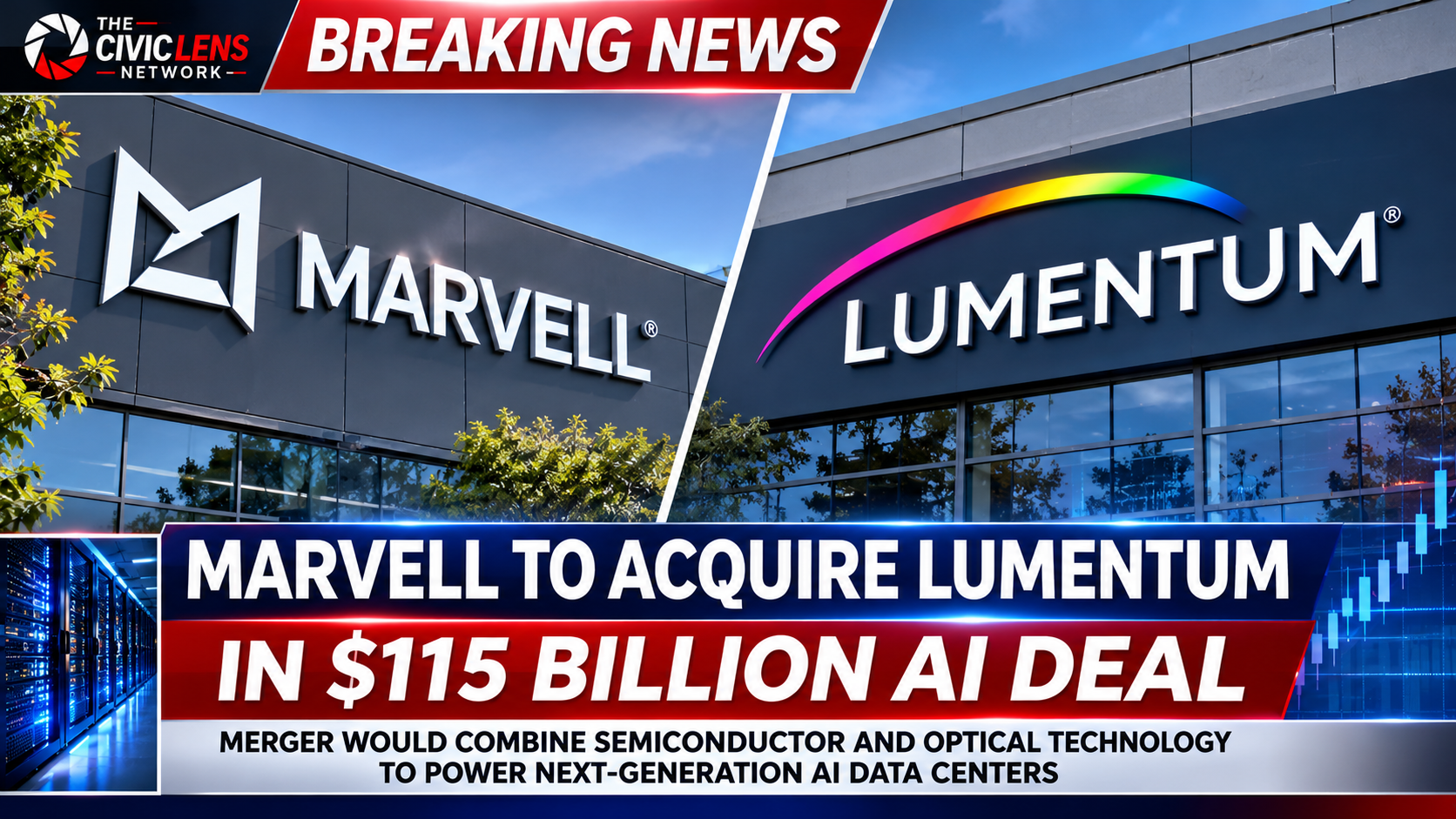
A massive $115 billion acquisition announced Monday is sending shockwaves through the technology industry as semiconductor giant Marvell Technology moves to acquire Lumentum Holdings, a leading manufacturer of optical components essential to the rapidly expanding artificial intelligence industry.
The proposed all-stock transaction represents one of the largest technology acquisitions ever announced and signals just how much money major corporations are willing to commit to controlling the infrastructure behind artificial intelligence.
The agreement would bring together two companies responsible for critical technologies that allow enormous quantities of information to move between processors, servers, and data centers.
But the staggering price tag raises another question: Is the artificial intelligence boom creating the foundation for the next generation of computing, or are corporations making increasingly enormous bets on a market whose long-term profitability remains uncertain?
A $115 Billion Bet on the Future of Artificial Intelligence
Marvell Technology announced November 2 that it had reached a definitive agreement to purchase Lumentum Holdings in an all-stock transaction carrying an implied enterprise value of approximately $115 billion, including debt.
Under the agreement, Lumentum shareholders would receive 4.5 shares of Marvell common stock for every Lumentum share they own.
Based on the companies’ unaffected stock prices on October 28, the agreement implied a value of approximately $1,132 per Lumentum share, representing a premium of roughly 23.9%.
Because the transaction involves shares rather than a fixed cash payment, the actual value received by Lumentum investors will fluctuate with Marvell’s stock price.
If completed, existing Marvell shareholders would control approximately 67% of the combined company, while Lumentum shareholders would own the remaining 33%.
Both companies’ boards of directors have unanimously approved the agreement.
However, the acquisition is not final. Shareholders and regulators must still approve the transaction, and the companies currently expect the deal to close during the first half of 2028.
Why Marvell Wants Lumentum
To understand the significance of the acquisition, it is important to understand what is happening inside modern artificial intelligence data centers.
AI systems require enormous computing power, but powerful processors alone are not enough.
Thousands of specialized chips must communicate rapidly, often across vast networks of servers.
As AI models become more complex, moving information between those processors becomes increasingly difficult.
Traditional copper-based connections face limitations involving bandwidth, power consumption, and distance.
Optical technology offers an alternative by transmitting information using light.
Lumentum specializes in lasers, optical transceivers, optical switching equipment, and other components that help make those connections possible.
Marvell develops advanced semiconductors, networking technology, and custom processors used in data infrastructure.
Combining those capabilities could allow the company to develop more tightly integrated systems that move information faster while reducing energy consumption.
Marvell believes this technological transition represents a major business opportunity.
A Once-in-a-Generation Opportunity, According to Marvell
Marvell Chairman and CEO Matt Murphy described the industry’s transition toward optical connectivity as a once-in-a-generation opportunity.
The company argues that future AI infrastructure will require closer integration between traditional semiconductor technology and optical components.
Rather than relying on separate products designed by different suppliers, manufacturers increasingly want systems developed together to improve performance and efficiency.
The proposed merger would allow Marvell to offer a broader range of technologies, including custom AI chips, networking components, lasers, and optical connections.
Marvell also estimates that the combined company’s total addressable market could reach approximately $550 billion.
That figure represents the company’s estimate of the market opportunity available to its products, not guaranteed revenue or a confirmed forecast of future sales.
The distinction matters because the acquisition’s success will depend on how much of that market Marvell can actually capture.
The AI Spending Explosion Is Reshaping Corporate America
The acquisition comes during a period of extraordinary investment in artificial intelligence.
Technology companies are spending enormous sums building data centers, purchasing advanced processors, expanding electrical infrastructure, and developing increasingly sophisticated AI models.
These investments are creating demand for specialized components that were once relatively obscure outside the semiconductor industry.
Optical networking has become particularly important because the speed of communication between chips can determine how efficiently an AI system operates.
As data centers expand, the ability to move information quickly becomes just as important as the processing power of individual chips.
Companies capable of supplying those technologies are becoming increasingly valuable.
That helps explain why Marvell is willing to pursue an acquisition with a valuation exceeding $100 billion.
The company is betting that the need for advanced connectivity will continue growing as artificial intelligence becomes more widely adopted.
A Direct Challenge to Semiconductor Rivals
The proposed acquisition could also intensify competition among some of the world’s most powerful semiconductor companies.
Marvell competes in markets that include custom AI processors, networking chips, and advanced data center infrastructure.
Broadcom is among its major competitors in several of those areas.
By acquiring Lumentum, Marvell would gain additional expertise in optical technologies that could become increasingly important to future AI systems.
The combined company could potentially offer customers a more complete collection of products, reducing the need to obtain certain components from multiple suppliers.
That strategy could strengthen Marvell’s competitive position.
However, larger product portfolios do not automatically guarantee market dominance.
Competitors will continue developing their own technologies, and customers may resist becoming overly dependent on a single supplier.
The merger could therefore reshape competition without necessarily eliminating it.
Wall Street Is Not Completely Convinced
Despite the enormous scale of the announcement, investors did not respond with universal enthusiasm.
Shares of both Marvell and Lumentum declined following the announcement, according to market reporting Monday.
That reaction highlights the uncertainty surrounding massive corporate investments tied to artificial intelligence.
Investors must consider whether the acquisition price is justified by future revenue, profitability, and potential cost savings.
Marvell expects the combination to generate more than $1 billion in annual run-rate cost synergies.
Those savings would come primarily from improvements in the cost of goods sold and other efficiencies.
The company also expects the acquisition to improve its non-GAAP earnings per share during the first year following completion.
But these are management projections, not established financial results.
Integrating two large technology companies can be expensive and complicated.
Manufacturing operations, research teams, supply chains, and corporate systems must be combined without disrupting existing customers.
Even well-planned acquisitions can struggle to deliver the financial benefits originally promised.
The Bigger Question: Is Artificial Intelligence Becoming Too Expensive?
The Marvell-Lumentum agreement arrives as investors increasingly examine the extraordinary sums being committed to artificial intelligence.
Building AI infrastructure requires specialized processors, advanced cooling systems, enormous electrical capacity, and increasingly sophisticated networking equipment.
Those costs can accumulate long before the companies financing them generate sufficient revenue to recover their investments.
Supporters of the current AI expansion believe the technology will fundamentally reshape business operations, scientific research, manufacturing, and consumer services.
They argue that today’s infrastructure spending is necessary to support future demand.
Skeptics question whether the industry can generate enough sustainable profit to justify its rapidly rising valuations.
The proposed $115 billion acquisition brings those competing expectations into sharp focus.
Marvell is not simply purchasing another technology manufacturer.
It is making an enormous financial commitment to the belief that the AI infrastructure market will continue expanding for years.
If that prediction proves correct, optical connectivity could become one of the most important segments of the technology industry.
If growth slows or customers reduce spending, the economics of the acquisition could become considerably more challenging.
Regulatory Scrutiny Could Become a Major Obstacle
The transaction will also face regulatory review.
A merger of this magnitude involving strategically important semiconductor and optical technologies is likely to attract attention from competition authorities.
Regulators may examine whether the combined company could restrict competition, raise prices, or limit access to essential technologies.
They may also consider the transaction’s implications for international supply chains and the semiconductor industry’s strategic importance.
The companies have not announced that regulatory approval is guaranteed.
The expected closing date in 2028 reflects the time required to obtain necessary approvals and complete other conditions.
Until then, Marvell and Lumentum remain separate publicly traded companies.
The agreement establishes the terms of a proposed acquisition, but it does not mean the merger has already occurred.
What Happens to Lumentum?
For Lumentum, the acquisition would represent a major transformation.
The company has developed technologies used in optical communications and other advanced applications.
Its products have become increasingly relevant as demand for AI-related networking equipment grows.
Under the proposed arrangement, Lumentum shareholders would become significant owners of the combined company.
Marvell CEO Matt Murphy would continue serving as chairman and chief executive.
Three members of Lumentum’s board, including CEO Michael Hurlston, would join Marvell’s board of directors.
The companies say the combination would allow their engineering teams to collaborate more closely on next-generation technologies.
Whether that collaboration produces the expected financial and technological benefits will become clearer only after the transaction is completed and integration begins.
A Turning Point for the Technology Industry
The proposed acquisition demonstrates how dramatically artificial intelligence is changing the priorities of major technology corporations.
For years, the industry’s attention centered heavily on the companies designing the most powerful processors.
Now, the equipment responsible for connecting those processors is becoming an increasingly important part of the conversation.
The race to build faster AI systems is creating demand not only for computing power but also for the infrastructure that allows those systems to function efficiently.
Marvell believes acquiring Lumentum will position it to capitalize on that transformation.
The company is willing to pursue a $115 billion transaction to make that happen.
But the enormous valuation also illustrates the risks associated with an industry experiencing extraordinary investment and heightened expectations.
Shareholders must decide whether the proposed combination offers sufficient long-term value.
Regulators must determine whether it satisfies applicable competition requirements.
And the broader technology industry must eventually demonstrate that the hundreds of billions being invested in artificial intelligence can produce sustainable economic returns.
For now, one fact is clear.
The race to control the infrastructure behind artificial intelligence has entered a new phase, and the companies competing for that future are prepared to spend extraordinary sums to secure their positions.