November 2, 2026
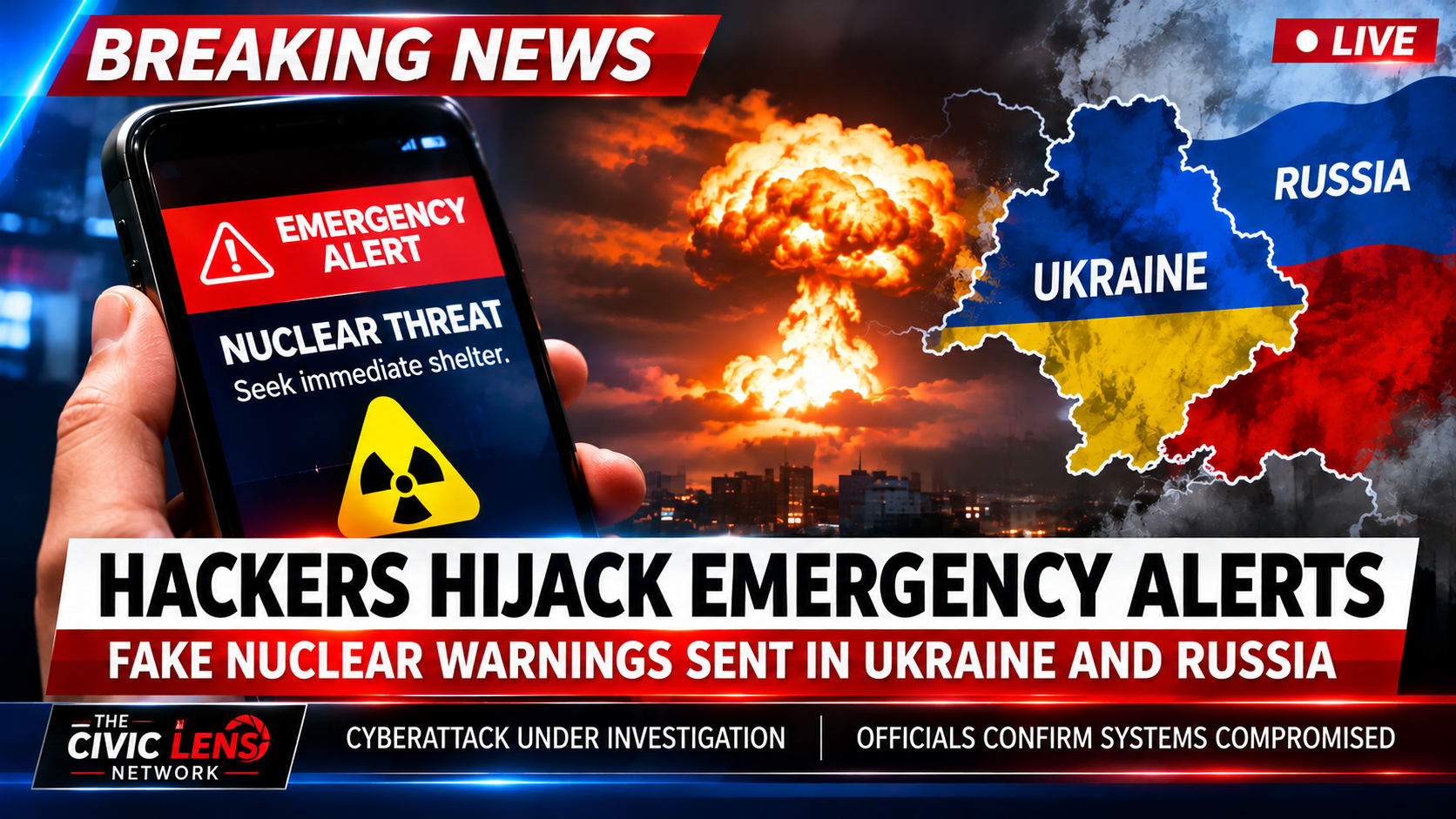
Hackers have breached emergency warning applications in both Ukraine and Russia, sending fabricated nuclear attack alerts directly to civilians and exposing a disturbing vulnerability in the technology millions depend on for their safety.
The cyberattacks unfolded overnight Sunday into Monday, November 1 and 2, as residents received frightening notifications warning of nuclear radiation, chemical weapons, incoming missiles, and even street fighting.
But the threats were not real.
The emergency messages had been manipulated by unauthorized parties, according to authorities in both countries.
The incidents raise serious questions about the security of government warning systems and the consequences of allowing hackers to control information that could determine whether civilians seek shelter, evacuate, or remain in their homes.
Even more concerning, the attacks occurred in two countries already engaged in a devastating war, where the threat of actual missile strikes remains a daily reality.
Ukraine’s Emergency Warning System Suddenly Announces Nuclear Danger
Shortly before 11 p.m. Sunday, residents of Kyiv and other Ukrainian regions began receiving alarming messages through the country’s public Air Alert application.
The system, designed to warn civilians about approaching Russian missiles, drones, and other threats, began reporting conditions that authorities quickly determined were false.
Some notifications warned of dangerous nuclear radiation levels.
Others claimed that chemical attacks were imminent or that armed fighting could erupt in city streets.
One particularly disturbing message claimed that Russia had launched an Oreshnik missile toward Ukraine.
The Oreshnik is a Russian ballistic missile system capable of carrying nuclear warheads.
In a country where millions of civilians have spent years responding to genuine air raid warnings, the possibility of a nuclear-capable missile approaching their homes carries enormous psychological weight.
However, Ukraine’s military quickly intervened.
The Ukrainian Air Force announced that the application appeared to have been compromised and reassured the public that the radiation warning was false.
Officials urged residents to remain calm and obtain updates through verified government communication channels.
Ukraine’s Center for Countering Disinformation also warned that the application’s threat information could not be trusted while the breach was being investigated.
The compromised service was temporarily suspended as technical teams worked to restore its operation.
Authorities emphasized that alternative warning systems, including physical air raid sirens and separate official communications, remained available.
Russia’s Emergency Ministry Reports Its Own Cyberattack
Just hours after the Ukrainian incident, Russia reported a similar breach involving the mobile application operated by its Ministry of Emergency Situations.
Russian officials said hackers had accessed the application and distributed fabricated emergency warnings.
According to the ministry, false notifications were transmitted across 33 Russian regions at approximately 2:45 a.m. Moscow time.
One message claimed that nuclear warheads had been launched against regions throughout Russia.
The warning instructed recipients to stockpile food and seek shelter.
The messages were not legitimate government announcements.
Russia’s emergency ministry confirmed that its application had been compromised and said specialists were working to restore normal operation.
Officials also stressed that the affected mobile application was a supplementary warning service rather than the country’s primary emergency notification infrastructure.
Other systems, including text messages, television and radio broadcasts, public sirens, and municipal loudspeakers, remained operational.
The Russian government urged citizens to rely on official emergency communications rather than the compromised application.
The fact that emergency applications in both countries were targeted within hours of one another immediately raised questions about whether the incidents were connected.
Investigators have not established such a connection.
Who Was Behind the Attacks?
Responsibility for the breaches remains unresolved.
Ukrainian officials suggested Russian involvement in the attack on their warning application, pointing in part to the Russian-language content of some fabricated messages.
However, the use of Russian does not independently establish who carried out the intrusion.
A Russian Telegram channel reported that a hacking group called Hitcore had claimed responsibility for the Ukrainian breach.
That claim has not been independently verified.
Russian authorities have not publicly identified the attackers responsible for compromising their own emergency ministry’s application.
The possibility that different groups carried out separate attacks remains open.
So does the possibility of coordinated activity.
Without confirmed technical evidence connecting the incidents, neither explanation can be treated as established fact.
What authorities have confirmed is that unauthorized individuals interfered with systems designed to deliver public safety warnings.
That alone represents a serious cybersecurity failure.
A Dangerous New Front in Psychological Warfare
The most troubling aspect of the attacks may not be the temporary disruption of two mobile applications.
It is the deliberate manipulation of fear.
Emergency warning systems operate on public trust.
When an official application warns that a missile is approaching, civilians are expected to act immediately.
They may abandon their homes, wake sleeping family members, rush into underground shelters, or interrupt essential activities.
Those decisions can be matters of life and death.
A hacker who gains access to such a system can exploit that trust.
By fabricating a nuclear warning, an attacker can potentially frighten thousands of people without launching a single weapon.
By repeatedly sending false messages, attackers may also weaken confidence in future alerts.
That creates an even more dangerous possibility.
If people begin dismissing official notifications because previous warnings were fraudulent, they may hesitate when a genuine attack occurs.
Cybersecurity specialists describe this broader problem as a threat to the integrity and reliability of critical communications.
The damage is not limited to stolen information or temporary technical inconvenience.
It can affect how people respond during emergencies.
Why the Timing Matters
The cyberattacks occurred against the backdrop of continuing hostilities between Russia and Ukraine.
The false alerts coincided with the expiration of a six-day localized ceasefire in the Kherson region of southern Ukraine.
The temporary arrangement had allowed humanitarian activity and civilian evacuations in an area heavily affected by fighting.
The expiration of that ceasefire heightened concerns about renewed military operations.
It also meant that warnings about incoming missiles and other threats could have appeared especially credible to civilians expecting further attacks.
However, the timing alone does not establish that the cyberattacks were coordinated with military operations.
No verified evidence has demonstrated that the hackers acted under orders from either country’s military or intelligence services.
The incidents nevertheless illustrate how digital attacks can intensify uncertainty during an active conflict.
Why Some Civilians Recognized the Warnings Were Fake
Despite the alarming content, reports from Kyiv indicated that many residents quickly suspected something was wrong.
Some of the fabricated messages contained spelling mistakes, unusual wording, and combinations of languages that did not resemble standard government communications.
Others included claims that appeared inconsistent with normal emergency procedures.
Several residents reportedly dismissed the notifications as an obvious hacking incident.
Others experienced brief fear before authorities clarified the situation.
That reaction may have limited the immediate consequences.
But relying on citizens to recognize suspicious wording is not an adequate security strategy.
A more sophisticated attacker could potentially imitate official language, formatting, and procedures more convincingly.
And in a real emergency, civilians may have only seconds or minutes to decide whether a warning is genuine.
Military Defense Systems Were Not Reportedly Compromised
An important distinction emerged as Ukrainian officials addressed the incident.
Ukraine’s Air Force said the compromised public application was separate from military command and defense systems.
Air Force spokesman Yurii Ihnat indicated that military operations were not disrupted by the breach.
Ukraine continued communicating genuine threats through independent channels.
Russian officials similarly maintained that their broader public warning infrastructure remained functional.
These statements indicate that the confirmed intrusions affected civilian-facing notification applications rather than establishing that hackers had penetrated nuclear command systems, military launch controls, or strategic defense networks.
There is no verified evidence that nuclear weapons were launched as a result of these incidents.
There is also no confirmed evidence that attackers gained control of nuclear weapons or military targeting systems.
The threat involved the unauthorized distribution of false warnings.
That distinction is essential to understanding both the seriousness and the limits of the incidents.
Could Emergency Warning Systems in America Be Targeted?
The events in Ukraine and Russia should concern governments far beyond Eastern Europe.
The United States relies on an extensive network of emergency communication systems to warn residents about severe weather, natural disasters, missing persons, public safety threats, and national emergencies.
Americans receive warnings through wireless emergency alerts, television and radio broadcasts, weather radios, government websites, and mobile applications.
These systems are not identical to the applications compromised in Ukraine and Russia.
The European incidents do not establish that American national emergency warning infrastructure has been breached.
However, they demonstrate why authentication, restricted access, independent backup systems, and rapid incident response are essential.
A successful attack on any trusted emergency notification platform could spread misinformation during a moment when accurate information is critical.
The consequences could be especially serious during a hurricane, wildfire, chemical spill, terrorist attack, or military emergency.
Even a brief period of uncertainty could interfere with public safety decisions.
The challenge for governments is ensuring that warning systems remain both accessible and secure.
The Growing Threat to Critical Public Infrastructure
Cyberattacks are increasingly capable of affecting systems that ordinary people depend on every day.
Hospitals, electrical utilities, transportation networks, water treatment facilities, and emergency communications all rely on digital technology.
Many systems offer remote access, automated monitoring, and centralized control.
Those capabilities improve efficiency, but they also create potential points of intrusion if security measures fail.
The Ukraine and Russia incidents show that attackers do not necessarily need to destroy infrastructure to disrupt its purpose.
They may simply need to manipulate the information it provides.
An emergency application that delivers fabricated warnings can become a tool for spreading confusion instead of protecting the public.
And because people are accustomed to treating government emergency alerts as authoritative, the potential for abuse is significant.
The solution requires more than restoring compromised applications after an incident.
Governments and technology providers must protect the systems that generate warnings, verify the authenticity of messages, monitor unauthorized activity, and maintain independent channels when digital services become unreliable.
A Warning That Cannot Be Ignored
The attacks have exposed a troubling reality of modern warfare and digital dependence.
A warning system does not have to be physically destroyed to become dangerous.
It can be compromised, manipulated, and used to distribute false information directly to the people it was designed to protect.
In Ukraine, hackers turned an air raid application into a source of fabricated nuclear and chemical warnings.
In Russia, an emergency ministry application distributed false claims of nuclear attacks across dozens of regions.
Authorities restored or began restoring the affected services, and other warning channels remained operational.
But the broader security questions remain unanswered.
Who carried out the attacks?
Were the incidents connected?
And how many other emergency communication systems could be vulnerable to similar interference?
The most serious danger may emerge long after the false notifications disappear.
When hackers can make an official emergency warning system lie, they threaten more than a computer network. They threaten the public’s ability to distinguish a real emergency from a manufactured one.