BOSTON, MASSACHUSETTS — November 2, 2026
For five years, renowned scientist Dr. David Sabatini watched his professional reputation collapse after allegations of sexual misconduct cost him his prestigious research positions and threatened a career devoted to understanding cancer, aging, and human biology.
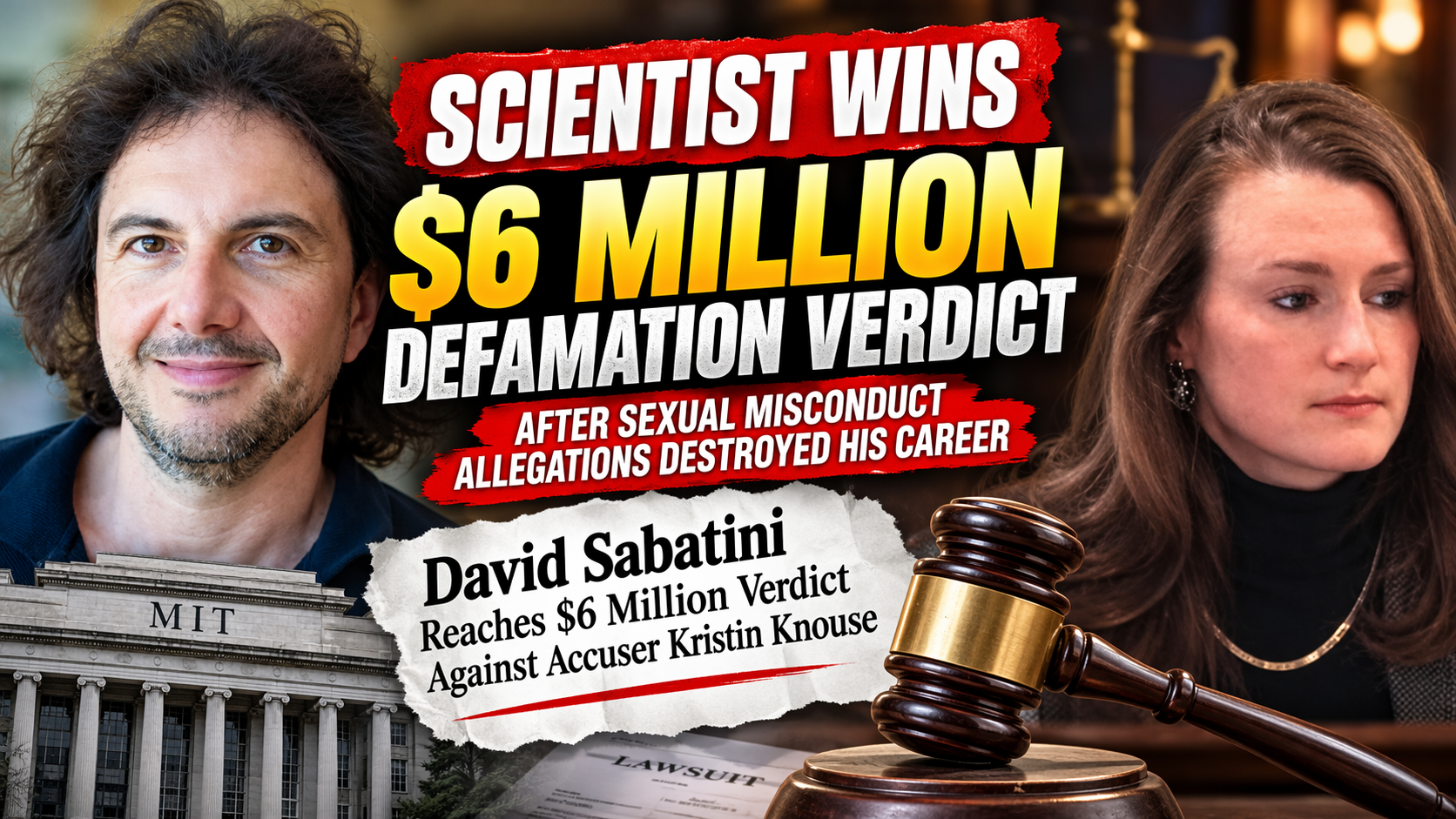
Now, in a stunning courtroom reversal, the former Massachusetts Institute of Technology professor has won a $6 million defamation verdict against the woman whose allegations helped bring down his career.
On October 16, 2026, a Suffolk County Superior Court jury in Boston found that scientist Kristin Knouse had defamed Sabatini and improperly interfered with his professional relationships.
The jury awarded Sabatini $6 million in damages, plus interest, while rejecting Knouse’s claims of sexual harassment and retaliation.
The decision represents a major legal victory for a scientist who spent years insisting that the accusations against him misrepresented a consensual relationship.
But the case raises a much larger question about the consequences of allegations that can destroy a person’s livelihood long before a courtroom reaches a verdict.
A Brilliant Scientific Career Comes Crashing Down
Before the controversy, David Sabatini was considered one of the most influential researchers in modern cellular biology.
His groundbreaking work helped identify and explain the mammalian target of rapamycin, commonly known as mTOR, a central regulator of cell growth and metabolism.
That discovery contributed to scientific advances involving cancer, diabetes, aging, and other serious medical conditions.
Sabatini led a prominent laboratory at the Whitehead Institute for Biomedical Research in Cambridge, Massachusetts, for approximately 24 years.
His research attracted international attention, substantial funding, and recognition throughout the scientific community.
For decades, he appeared to be on a path toward even greater scientific achievements.
Then, in 2021, everything changed.
An investigation into allegations involving a younger colleague, Kristin Knouse, resulted in findings that Sabatini had violated workplace policies governing relationships and professional conduct.
Sabatini resigned from the Whitehead Institute. MIT placed him on leave, and the Howard Hughes Medical Institute terminated his employment.
His once-promising career was thrown into turmoil.
The Relationship at the Center of the Controversy
The allegations centered on a sexual relationship between Sabatini and Knouse, a scientist who had worked in his research environment.
Knouse maintained that Sabatini used his professional influence to pressure her into a relationship and created an inappropriate workplace atmosphere.
She described the relationship as coercive, arguing that the difference in professional authority made it difficult for her to exercise meaningful independence.
Sabatini disputed that account.
He acknowledged that the two had been involved in a sexual relationship beginning in 2018 but maintained that it was consensual.
He argued that Knouse’s accusations followed the deterioration of their relationship and his decision to pursue another woman.
The competing accounts became central to years of litigation.
Sabatini maintained that his reputation had been unfairly destroyed by accusations he considered false.
Knouse continued to defend her allegations.
Ultimately, the dispute reached a Massachusetts courtroom, where jurors heard evidence and testimony from both sides.
Jury Delivers a $6 Million Verdict
On October 16, a jury of seven women and six men reached a verdict in Sabatini’s favor.
The jurors found that Knouse had defamed him and interfered with his professional relationships.
They awarded him $6 million in damages, plus interest.
The jury also rejected Knouse’s counterclaims involving sexual harassment and retaliation.
For Sabatini, the decision marked the culmination of a legal battle that began when he lost his research positions in 2021.
His attorney, Lisa Arrowood, celebrated the outcome as vindication for a man whose professional standing had been severely damaged.
Sabatini described the experience as overwhelming after years of uncertainty about his reputation, finances, and future.
The verdict is significant because it establishes that jurors found sufficient evidence to hold Knouse financially responsible for defamation and interference with Sabatini’s work.
However, the decision does not automatically invalidate every finding made during the earlier institutional investigations. Those proceedings involved separate workplace policies and standards.
Knouse’s attorney has also announced plans to appeal.
Nevertheless, the $6 million award represents a decisive victory for Sabatini at the trial-court level.
The Cost of an Accusation Before a Trial
One of the most troubling aspects of the case is the speed with which Sabatini’s professional opportunities disappeared.
Long before the civil jury issued its verdict, his research career had already suffered substantial damage.
He lost his laboratory leadership position, his MIT affiliation was disrupted, and his employment with a major scientific organization ended.
In 2022, a potential appointment at New York University’s Grossman School of Medicine generated fierce opposition.
Approximately 200 students, faculty members, and alumni participated in a walkout after learning that Sabatini might receive a position there.
The appointment never materialized.
For critics of the way institutions respond to misconduct allegations, Sabatini’s experience illustrates the enormous reputational consequences that can follow accusations before a civil court evaluates the underlying dispute.
That concern does not mean universities should ignore allegations of misconduct.
Institutions have a responsibility to investigate complaints, protect employees, and enforce workplace standards.
But they also have an obligation to provide fair procedures, examine conflicting evidence, and avoid allowing public pressure to substitute for careful judgment.
The Sabatini case demonstrates why those responsibilities must be taken seriously.
When Public Accusations Become Professional Punishment
Modern accusations of sexual misconduct can carry consequences extending far beyond the workplace.
A person’s reputation can be damaged through news coverage, social media, institutional announcements, and public campaigns.
Professional opportunities may disappear before litigation concludes.
Even a favorable court verdict cannot automatically restore years of lost research, damaged relationships, or career advancement.
That is particularly significant in scientific research, where laboratories depend on long-term funding, institutional support, specialized equipment, and teams of researchers.
When a laboratory leader is removed, ongoing projects may be disrupted, and rebuilding those resources can take years.
Sabatini’s experience raises a difficult question.
What happens when a person loses nearly everything professionally, only to later win a substantial defamation judgment against an accuser?
Financial damages may compensate for some losses, but they cannot simply return the years that have passed.
The Scientific Work That Nearly Disappeared
Sabatini’s scientific contributions make the consequences of his professional downfall especially notable.
His research into mTOR helped researchers understand how cells respond to nutrients, regulate growth, and control essential biological processes.
The findings contributed to a field with implications for cancer treatment, metabolic disorders, and aging research.
After leaving his American research positions, Sabatini eventually resumed scientific work through the Institute of Organic Chemistry and Biochemistry in Prague.
In 2023, billionaire investor Bill Ackman and an anonymous donor pledged approximately $25 million over five years to support his return to research.
That backing provided an opportunity to rebuild his scientific career despite the controversy.
Ackman publicly supported Sabatini following the jury’s verdict.
Still, private financial support could not erase the professional consequences of the preceding years.
Accuser Plans to Appeal
Although Sabatini prevailed before the jury, the legal dispute may not be finished.
Knouse’s attorney, Ellen Zucker, expressed disappointment with the verdict and announced plans to challenge the outcome.
Zucker maintained that her client had truthfully described her experiences and argued that testimony from other women about the laboratory environment deserved greater weight.
Knouse remains a faculty member at MIT.
Her legal team has emphasized that the case involved serious concerns about professional power and workplace conduct.
The jury nevertheless rejected her civil claims and found in favor of Sabatini on defamation and interference.
An appeal could lead to further judicial review of the proceedings and legal issues surrounding the verdict.
Until that process is resolved, the $6 million award remains subject to potential legal challenges.
A Warning About Due Process
The broader significance of this case extends beyond one scientist and one accuser.
It raises fundamental questions about fairness, evidence, institutional accountability, and the ability of individuals to defend themselves against allegations that threaten their livelihoods.
Sexual harassment and workplace coercion are serious matters that deserve credible investigations and appropriate consequences when established.
False and defamatory accusations are also serious, particularly when they can destroy professional reputations and careers.
Both realities must be acknowledged.
The principle of due process exists precisely because accusations and evidence are not the same thing.
An institution’s obligation to investigate a complaint should never eliminate its obligation to evaluate facts fairly.
And public opinion should not become a substitute for the legal process.
Sabatini’s victory demonstrates that an individual who suffers reputational harm may still have legal remedies, even after years of professional setbacks.
But it also illustrates the limitations of those remedies.
A multimillion-dollar verdict cannot guarantee that lost opportunities will return.
Can a $6 Million Verdict Restore Five Lost Years?
David Sabatini entered the controversy as an internationally recognized scientist whose work had helped transform understanding of cellular biology.
He emerged from five years of legal battles with a $6 million jury verdict in his favor.
The decision offers him a measure of legal vindication and an opportunity to rebuild his reputation.
But the question remains whether any financial award can truly compensate for the damage inflicted on a career during years of public controversy.
The case should prompt universities, research institutions, and employers across America to examine how they investigate allegations and make career-altering decisions.
Accountability matters.
So does fairness.
And when an accusation threatens to destroy someone’s professional future, the evidence must matter more than public pressure.
David Sabatini has won a $6 million verdict. Whether he can ever fully recover the career and reputation he once enjoyed is another question entirely.