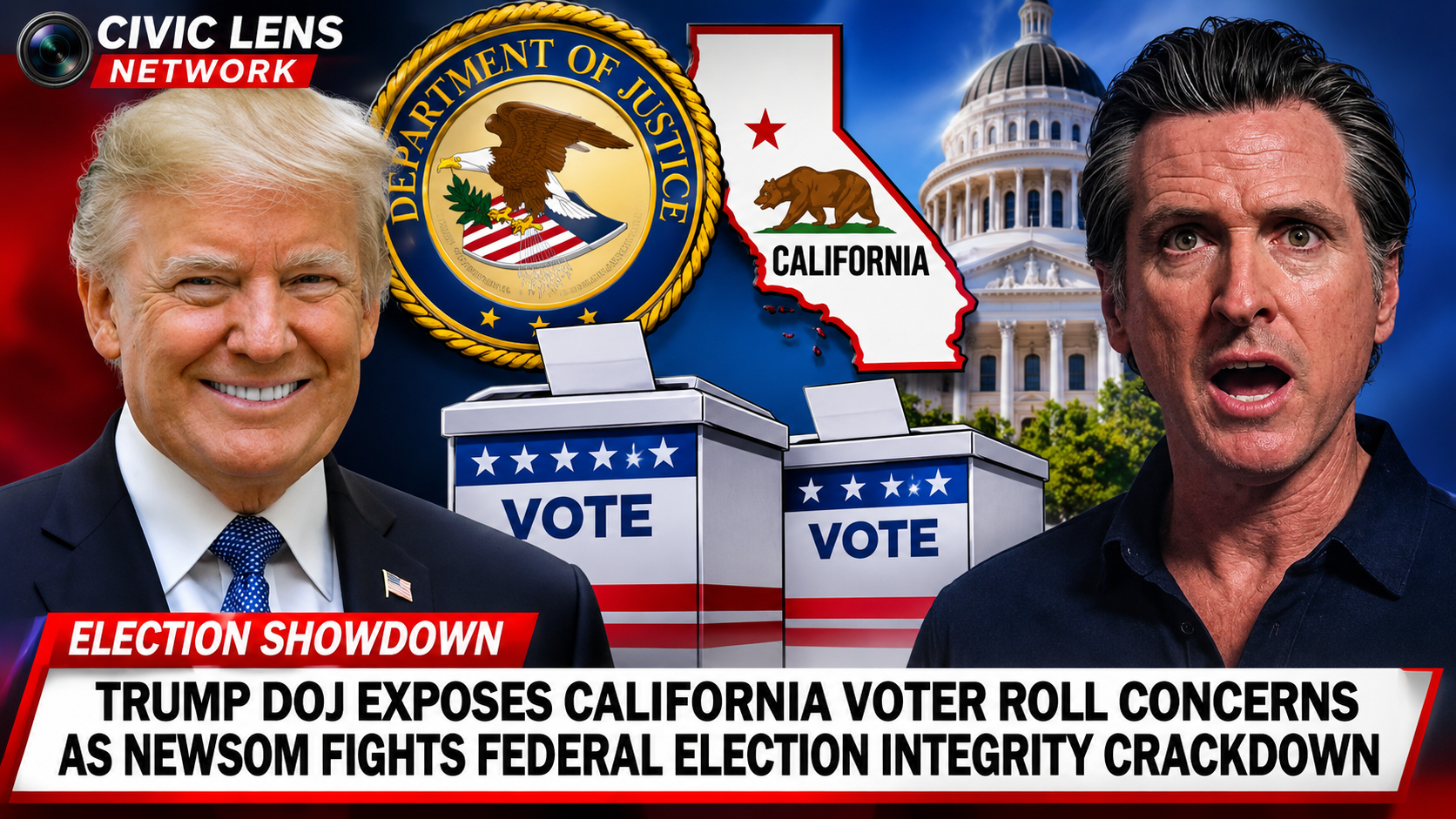
President Donald Trump’s Department of Justice is taking an aggressive stand against suspected illegal voting in California, setting off a major confrontation with Democratic Governor Gavin Newsom just days before the November 3 midterm elections.
Federal investigators say they have identified more than 20,000 registered California voters who may not be United States citizens. The Justice Department has filed a lawsuit demanding that state officials examine those registrations and prevent potentially unlawful ballots from being counted until voter eligibility can be established.
But instead of cooperating with the federal government’s requested review, California officials have challenged the investigation, questioned the reliability of the evidence, and fought the administration in federal court.
The dispute raises a fundamental question: If federal authorities identify thousands of potentially ineligible voter registrations, shouldn’t state election officials be willing to investigate them?
For the Trump administration, the answer is clear. Federal election laws exist for a reason, and protecting the votes of American citizens is a responsibility that cannot simply be ignored.
Federal Investigators Uncover Thousands of Questionable Registrations
On October 15, the Justice Department announced a lawsuit against California after federal investigators identified more than 20,000 individuals they believe are likely noncitizens registered to vote.
The investigation involved the Department of Justice, Department of Homeland Security, and Homeland Security Investigations.
According to federal officials, investigators examined publicly available voter registration information and compared it with immigration records and other data sources.
The resulting list raised questions about whether California’s election system had allowed people who were not eligible to vote in federal elections to remain registered.
The federal government provided the information to California election officials and requested that they examine the records.
The administration also sought to have ballots associated with the disputed registrations temporarily separated until citizenship could be verified.
Federal officials argued that the request was intended to protect lawful voters rather than cancel legitimate ballots.
That distinction matters.
The Justice Department was not asking California to automatically throw out every ballot connected to the disputed list. It sought verification before those ballots were counted.
California officials rejected the requested process, arguing that the information was unreliable and that complying would disrupt an election already underway.
The federal government’s allegations have not established that all 20,000 individuals are noncitizens or that they cast illegal ballots.
Nevertheless, the administration maintains that the information warrants further investigation.
Federal Crackdown Produces 28 Criminal Defendants
The administration’s concerns were not limited to questionable computer records.
On October 19, federal prosecutors announced criminal charges against 28 foreign nationals in California as part of an election enforcement operation.
Authorities accused the defendants of offenses involving unlawful voter registration, illegal voting, or related false statements.
Federal officials said the individuals appeared on the government’s larger list of suspected noncitizen registrants.
According to prosecutors, 23 of the defendants were accused of casting ballots in elections dating back to 2020.
The arrests provided the administration with concrete criminal cases to support its argument that suspected noncitizen voting deserves investigation.
Criminal charges, however, are allegations until proven in court. The prosecutions do not establish that every person on the broader list is ineligible to vote.
Still, the cases demonstrate why federal investigators believe the issue cannot simply be dismissed.
The administration argues that election integrity depends on enforcing existing citizenship requirements, identifying unlawful registrations, and prosecuting violations when sufficient evidence exists.
Why Is California Resisting Federal Verification?
California officials insist they are defending the rights of eligible voters.
The state’s attorneys argue that federal investigators relied on questionable data and that some individuals identified by the government may actually be American citizens.
Los Angeles County officials also reported that a sample of the federal list included inactive or canceled registrations.
Those findings deserve examination. An outdated registration record should not be treated as proof of a crime.
But the discovery of errors in a database does not automatically eliminate the need to investigate records that raise legitimate eligibility questions.
The Trump administration’s position is that the state should work with federal agencies to determine which records are accurate.
The larger issue is accountability.
If a state maintains voter registration records, it should be able to explain how eligibility is verified, how mistakes are corrected, and what safeguards prevent ineligible individuals from voting.
Americans should not have to choose between protecting legitimate voters and enforcing citizenship requirements.
Both obligations are essential.
California has every right to challenge inaccurate federal information. But federal authorities also have a legitimate interest in investigating credible evidence of violations of federal election law.
The public deserves a transparent accounting of the disputed registrations rather than an endless political confrontation.
Federal Judge Blocks Justice Department Request
On October 28, U.S. District Judge David O. Carter rejected the administration’s emergency request to separate ballots connected to the disputed registrations.
The judge concluded that the proposed intervention threatened established constitutional principles governing state election administration and could result in eligible voters being improperly excluded.
California officials celebrated the decision as a victory against federal interference.
For the Justice Department, however, the ruling represented a serious obstacle to its effort to verify the disputed registrations before ballots were counted.
Federal prosecutors argued that counting an unlawful ballot could diminish the influence of a lawful vote.
Their concern centers on a straightforward principle: Federal elections must be decided by people legally entitled to participate.
At the same time, the court’s decision reflects another constitutional principle. States have primary responsibility for administering elections, and federal officials must demonstrate sufficient legal grounds before courts will order extraordinary intervention.
The administration cannot simply bypass those requirements.
But a judicial rejection of an emergency ballot procedure does not, by itself, resolve every underlying question about the registrations.
The legal dispute concerns both the evidence and the remedy the federal government is seeking.
Those are separate issues, and both deserve public scrutiny.
Newsom Escalates Confrontation With Washington
As the legal fight intensified, Governor Gavin Newsom warned about the possibility of federal authorities seeking to seize election materials.
California officials also announced additional legal protections and monitoring measures ahead of Election Day.
Newsom has portrayed the administration’s actions as a threat to California’s election process.
The Trump administration presents its investigation very differently.
Federal officials maintain that their objective is to enforce existing laws and prevent ineligible ballots from influencing federal elections.
No federal seizure of California’s 2026 ballots had been confirmed as of November 1.
Newsom’s warning therefore concerns a potential future development, not an established action already carried out by the Justice Department.
The political rhetoric surrounding the confrontation has become increasingly heated.
But the central issue should not be lost in competing accusations.
The federal government has identified registrations it believes deserve investigation. California disputes the reliability of that information. The courts are determining how far federal authorities may go during an election already in progress.
Rather than treating every federal investigative effort as an attack on democracy, officials should address the underlying evidence.
If the federal government’s information is accurate, appropriate corrective action should follow.
If it is inaccurate, investigators should correct the records and explain the errors.
Either outcome would provide more public confidence than political accusations alone.
The Federal Government Has a Duty to Enforce Election Laws
Federal law generally prohibits noncitizens from voting in elections for president and Congress.
That prohibition is not optional.
It is a fundamental eligibility requirement established by Congress.
The Department of Justice has authority to investigate suspected violations of federal law, including certain election offenses.
The administration’s position is that states cannot expect federal authorities to overlook potential violations simply because an investigation creates political controversy.
That argument deserves serious consideration.
A federal government unwilling to investigate credible allegations of illegal voting would fail to enforce laws Congress has enacted.
However, enforcement must be supported by reliable evidence, lawful procedures, and respect for constitutional protections.
The government must establish the facts rather than assume every flagged individual is guilty of wrongdoing.
Strong election enforcement and protection of eligible voters are not competing objectives.
They are two parts of the same responsibility.
Every Illegal Vote Matters
One argument frequently raised during election integrity debates is that documented cases of noncitizen voting represent a small percentage of the overall electorate.
Even when violations are rare, however, their rarity does not make them lawful.
A single illegal ballot is still a violation of federal election law.
The government has a legitimate responsibility to investigate such violations and prosecute cases supported by sufficient evidence.
That does not mean a small number of alleged offenses proves widespread fraud or establishes that an election result was changed.
There is currently no verified finding that the disputed California registrations affected the outcome of the 2026 election, which has not yet taken place.
But Americans should not have to wait for evidence that an election result was altered before expecting existing election laws to be enforced.
Preventing violations is part of protecting the process.
The same standard must apply to errors that could prevent eligible American citizens from voting.
A reliable election system must be capable of detecting both.
California’s Congressional Stakes Raise the Pressure
California holds 52 seats in the United States House of Representatives, making it a critical state in the battle for control of Congress.
Although Democrats dominate statewide politics, several California congressional districts remain competitive.
With the November 3 midterm elections approaching, both parties recognize the importance of every contested race.
The dispute over voter eligibility is therefore unfolding at an especially sensitive moment.
The administration argues that lawful voters deserve protection before election results are finalized.
California officials contend that the government’s requested procedures could disrupt ballot processing and wrongfully exclude citizens.
Those competing claims now sit at the center of a legal confrontation with potential consequences beyond California.
If the Supreme Court ultimately considers the dispute, its ruling could influence how federal authorities and state governments handle similar conflicts in future elections.
A National Debate Over Election Security
The California case is part of a broader effort by the Trump administration to examine voter registration records and enforce federal election laws.
Federal authorities have pursued election-related records and investigations in other states as well.
Supporters of stronger federal enforcement argue that citizenship verification, accurate voter rolls, and meaningful penalties for unlawful voting are necessary to maintain confidence in election results.
Opponents argue that aggressive federal intervention can threaten state authority and create a risk of disenfranchising legitimate voters.
But the existence of political disagreement does not eliminate the government’s enforcement responsibilities.
The most constructive outcome would be a transparent system in which federal and state officials cooperate to identify genuine violations while correcting inaccurate information.
That requires reliable data, meaningful oversight, and accountability from every level of government.
What Happens Next?
The Justice Department has continued pursuing legal options after its initial courtroom defeat.
Further appeals could determine whether federal authorities receive additional relief before Election Day.
Meanwhile, California election officials are proceeding under existing procedures unless a court orders otherwise.
Federal prosecutors can also continue pursuing individual criminal cases supported by evidence.
The administration’s broader allegations involving more than 20,000 registrations remain contested, and no court has established that all of those individuals are noncitizens.
But the 28 criminal defendants already charged demonstrate that federal investigators have identified specific cases they believe warrant prosecution.
The ultimate outcome will depend on evidence, judicial decisions, and the lawful authority of both federal and state officials.
Protecting American Elections Should Never Be Controversial
The Trump administration has made election integrity a major federal enforcement priority.
Its investigation in California reflects a determination to examine suspected unlawful registrations rather than simply accept assurances that existing systems are working.
That is a legitimate responsibility of the federal government.
California officials have a responsibility of their own: maintaining accurate voter records, protecting eligible voters, and addressing credible evidence of unlawful participation.
Neither responsibility should be sacrificed for political advantage.
If investigators uncover illegal voting, the offenders should face the consequences established by law.
If eligible American citizens have been incorrectly identified as noncitizens, their records and voting rights must be protected.
The standard should be the same regardless of which political party benefits.
Only lawful votes should determine the outcome of federal elections, and every eligible citizen should have the opportunity to participate.
The Justice Department’s investigation has raised questions that deserve answers.
California should provide those answers through transparent verification and lawful cooperation, while federal authorities should be prepared to demonstrate that their evidence is accurate.
Americans deserve nothing less than elections conducted under the law, with accountability for violations and protections for every legitimate voter.
The battle between Washington and Sacramento may continue in court, but the principle at stake is larger than either President Trump or Governor Newsom.
American elections belong to the American people, and enforcing the laws that protect them is a responsibility no government should take lightly.