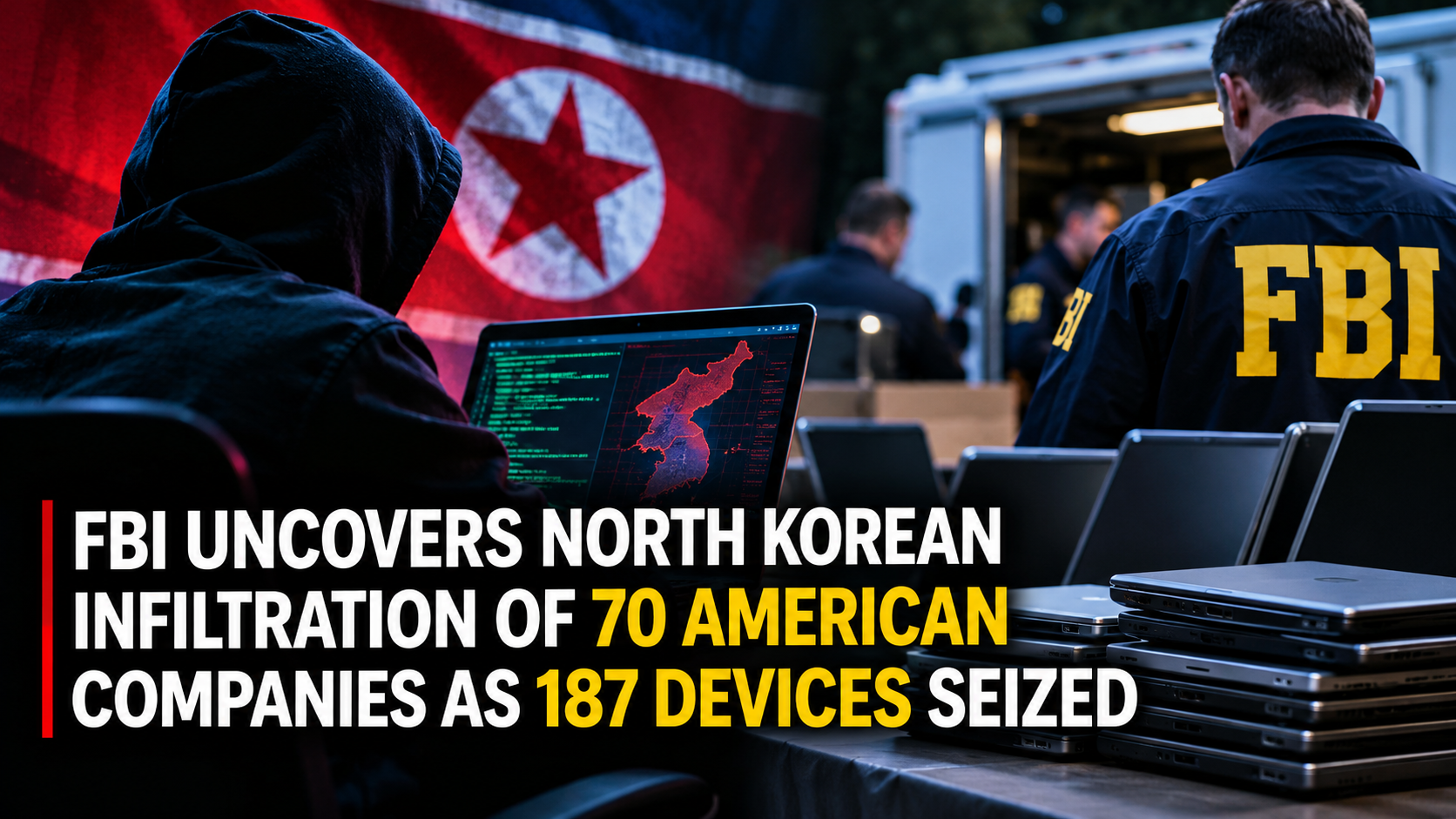
Federal investigators have uncovered an extensive operation allegedly allowing North Korean technology workers to infiltrate more than 70 American companies, collect millions of dollars in salaries, and secretly funnel revenue toward a hostile foreign government.
The Department of Justice announced the sweeping crackdown on October 13, 2026, revealing that federal agents had arrested two Americans, charged 14 individuals, and seized approximately 187 computer devices connected to a network of suspected fraudulent remote-work operations.
The investigation exposes a troubling national security vulnerability: foreign operatives do not necessarily need to hack their way into American businesses when they can allegedly obtain legitimate employee credentials, receive company-issued computers, and gain authorized access under stolen identities.
A Secret Network Operating Inside America
According to federal prosecutors, the scheme operated from approximately 2019 through July 2025, targeting businesses across the United States.
North Korean IT workers allegedly used stolen or fabricated identification documents, fraudulent employment profiles, and sophisticated internet-routing technology to convince American employers they were legitimate workers living in the United States.
Once hired, these individuals could receive salaries and access company computer systems just like ordinary employees.
But investigators say many were actually operating overseas, with assistance from individuals physically located inside America.
The scheme allegedly generated approximately $3 million from more than 70 American companies, with proceeds believed to have been transferred to entities controlled by North Korea.
The affected businesses operated in industries including healthcare, communications, cybersecurity support, retail, and manufacturing.
Companies in Ohio and 16 additional states, along with the District of Columbia, were affected.
FBI Raids More Than 40 Texas Locations
One of the most significant developments involved a coordinated FBI operation known as Operation Lonestar Roundup.
Between September 21 and September 25, federal agents conducted searches and other enforcement actions at more than 40 residences across Texas.
Investigators suspected these locations were being used as so-called laptop farms.
These operations allegedly allowed North Korean workers to appear as though they were working from American homes, even while physically located thousands of miles away.
The process was surprisingly straightforward.
An American company would hire someone it believed was a legitimate domestic employee and ship a company laptop to a United States address.
Instead of being used by the supposed employee, the computer would allegedly be received by a facilitator operating the laptop farm.
That facilitator would connect the machine to remote-access equipment, allowing an overseas worker to operate it.
To the employer, the computer appeared to be operating from within the United States.
In reality, investigators say the person controlling the device could be working on behalf of North Korea.
Federal agents seized approximately 187 laptops and related devices, including keyboard, video, and mouse equipment used to facilitate remote computer access.
The operation demonstrates how ordinary business equipment can become part of an international financial and national security scheme.
Two Americans Arrested, 14 People Charged
A federal grand jury in the Northern District of Ohio returned an indictment on October 1, 2026, which was unsealed on October 13.
The indictment charged 14 individuals in connection with the alleged conspiracy.
Among those arrested were Michael James Bostelle, 31, of Philadelphia, Pennsylvania, and Juan Cecilio Pena Carrillo, 37, of San Juan, Texas.
Ten named defendants were identified as being based in China, while the identities of two additional defendants remained under seal.
The charges include conspiracy to commit wire fraud, conspiracy to commit money laundering, conspiracy to commit identity theft, and aggravated identity theft.
Federal prosecutors allege that American facilitators helped foreign workers obtain jobs, maintain company-issued computers, and transfer money connected to the operation.
The investigation also highlights the role of international networks in helping North Korean workers circumvent restrictions and employment screening procedures.
The charges remain allegations that prosecutors must prove in court.
American Salaries Potentially Funding North Korean Weapons
Perhaps the most alarming aspect of the investigation is where federal authorities believe the money ultimately went.
North Korea has spent decades developing nuclear weapons, ballistic missiles, and other military capabilities while facing extensive international sanctions.
Those sanctions are intended to restrict the regime’s access to money and technology that could support its military ambitions.
Federal officials say fraudulent overseas IT employment has become one method North Korea uses to generate revenue despite those restrictions.
Instead of stealing money directly from bank accounts, operatives allegedly collect legitimate salaries from American businesses that do not realize who they are employing.
The Justice Department believes proceeds from the newly exposed scheme were sent to sanctioned North Korean entities.
Officials have warned that broader North Korean IT worker operations can generate hundreds of millions of dollars annually.
The roughly $3 million identified in this particular conspiracy represents only one alleged operation within a much larger international problem.
American businesses may therefore be unknowingly paying individuals whose earnings ultimately benefit a government openly hostile to the United States.
A Cybersecurity Threat Hidden Behind Legitimate Credentials
The financial implications are serious, but the cybersecurity risks could be even greater.
Traditional cybersecurity defenses focus heavily on preventing unauthorized outsiders from entering protected networks.
However, an employee who has passed the hiring process may already possess authorized access to sensitive systems.
That creates an entirely different security problem.
A fraudulent employee working inside a company’s network could potentially access internal communications, proprietary software, customer information, financial records, or other sensitive material, depending on the permissions granted.
Federal authorities have previously warned that North Korean remote IT worker schemes have involved data theft and extortion.
The Justice Department has not established that every company affected by this particular indictment suffered a data breach.
Nevertheless, the possibility of hostile foreign operatives obtaining legitimate access to American corporate systems raises significant concerns.
Healthcare companies may maintain sensitive patient information.
Cybersecurity firms may have access to valuable technical systems.
Manufacturers may possess proprietary designs and industrial information.
Communications companies may handle infrastructure or customer data.
The danger extends far beyond fraudulent paychecks.
How Did So Many Companies Fail to Detect the Scheme?
The case raises difficult questions about hiring practices and identity verification in an economy increasingly dependent on remote employment.
Remote work allows companies to recruit talented employees regardless of location, but it also creates opportunities for individuals to conceal their true identities.
Employers may conduct interviews through video calls, verify digital documents, and ship computers without ever meeting the employee in person.
Criminal networks can exploit weaknesses in these procedures.
According to investigators, the North Korean operation relied on stolen identities, fraudulent documentation, virtual private networks, proxy infrastructure, and American intermediaries.
The use of domestic laptop farms made the deception particularly difficult to identify through ordinary location checks.
Even a company monitoring the apparent geographic location of its equipment could be misled if the computer was physically operating inside the United States.
The case demonstrates why basic identity checks and network-location monitoring may not be sufficient against coordinated foreign operations.
The FBI Warns American Employers
Following the crackdown, the FBI issued additional guidance warning businesses about the evolving North Korean remote IT worker threat.
Investigators say the networks are adapting to improved detection methods by recruiting American facilitators and, in some cases, subcontracting work to third-party foreign nationals.
Companies are being encouraged to strengthen employment verification procedures, investigate suspicious remote-access arrangements, and carefully review unusual activity involving company-issued equipment.
The investigation involved cooperation between federal prosecutors, the FBI, and private-sector cybersecurity specialists.
The cybersecurity company CrowdStrike has tracked North Korean IT worker activity under the name Famous Chollima.
Federal authorities say continued cooperation between businesses and law enforcement will be necessary to identify similar operations before they become deeply embedded inside corporate networks.
A National Security Problem That Cannot Be Ignored
The broader implications of this case reach well beyond the companies that allegedly paid fraudulent workers.
For years, American officials have warned about cyberattacks originating from hostile foreign governments.
This investigation illustrates another approach: infiltrating businesses through the hiring process itself.
Instead of breaking through a company’s digital defenses, foreign operatives allegedly convinced employers to open the door.
The result was a network capable of collecting American salaries while potentially exposing sensitive corporate systems to individuals operating on behalf of North Korea.
Federal authorities have disrupted dozens of suspected laptop farms, seized nearly 190 devices, and brought charges against 14 individuals.
But the operation also raises an uncomfortable question.
If more than 70 American companies could allegedly employ North Korean operatives without realizing it, how many similar schemes remain undetected?
The October crackdown represents a significant enforcement action, but investigators have made clear that North Korean remote IT worker fraud is an ongoing threat.
For American businesses, the warning is unmistakable.
The next serious cybersecurity threat may not arrive through a suspicious email or an obvious computer intrusion.
It could arrive through an ordinary job application, receive a company laptop, and begin collecting a paycheck before anyone realizes who is actually behind the screen.