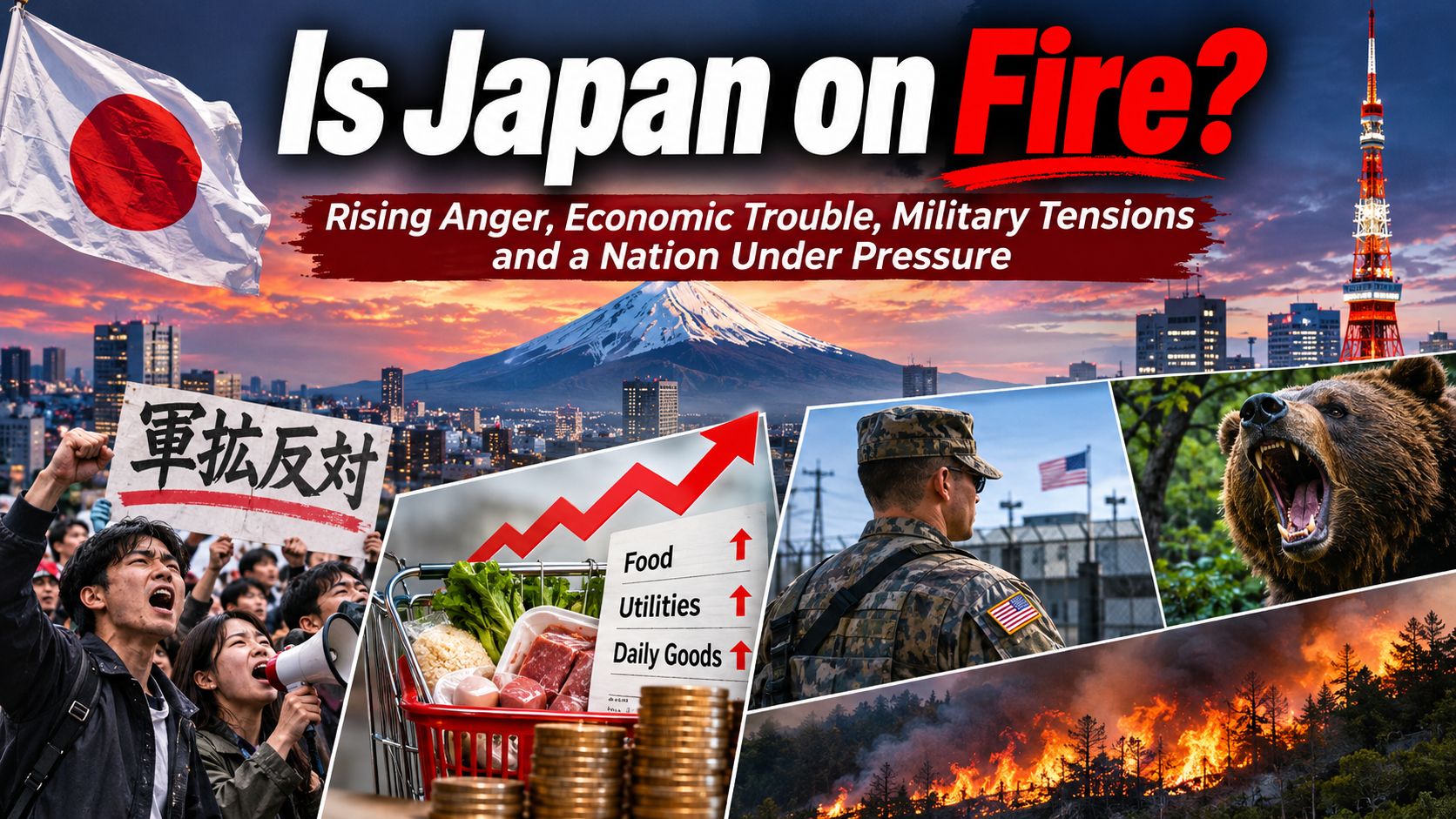
Japan has long been regarded as one of the safest, most disciplined, and most technologically advanced nations in the world. Its reputation for order, stability, and public safety has made it an example of what a modern society can achieve.
But beneath that reputation, serious problems are beginning to emerge.
Rising prices are squeezing households. Demonstrators are challenging the government’s military policies. A murder case involving an American serviceman has reignited tensions over the United States military presence. Meanwhile, increasingly dangerous encounters between bears and humans have exposed the consequences of Japan’s shrinking rural population.
The question is no longer whether Japan faces challenges. It is whether the country can address several major problems at once without sacrificing the stability that has defined it for generations.
An Economy Squeezing Ordinary Japanese Families
For decades, Japan struggled with weak inflation and sluggish economic growth. Today, many households are confronting a different problem: the rising cost of everyday necessities.
Food, utilities, and other expenses have placed growing pressure on consumers, particularly when wage increases fail to keep pace.
Recent retail industry figures indicate that customer traffic at Japanese convenience stores declined for 15 consecutive months. September traffic reportedly fell 3.8 percent compared with the previous year.
For a country famous for its convenience stores, that decline is significant.
Consumers are increasingly turning toward discount supermarkets and cheaper alternatives. Retailers are responding by introducing lower-priced products and promotional offers to attract shoppers.
The implications extend far beyond convenience stores.
Household consumption represents roughly half of Japan’s economic output. When consumers begin cutting back, businesses feel the consequences, potentially weakening an already fragile economic recovery.
Japan’s manufacturing sector is also showing signs of slowing momentum.
An October business survey indicated that manufacturing growth had fallen to its weakest pace in seven months, with slower increases in production and new orders.
The economy is still functioning, but the warning signs are becoming difficult to ignore.
Protesters Challenge Japan’s Military Direction
Japan is also experiencing public disagreement over its national security policies.
Prime Minister Sanae Takaichi’s government has pursued an expanded defense posture as tensions across East Asia continue to shape Japanese security planning.
Japan faces strategic concerns involving China, North Korea, and the security of Taiwan. Supporters of stronger defenses argue that the country must prepare for an increasingly dangerous regional environment.
But not everyone agrees with the government’s approach.
On October 21, demonstrators gathered outside Japan’s National Diet in Tokyo to protest military expansion and proposed constitutional changes.
Participants expressed concern that Japan could move further away from the pacifist principles established after World War II.
Japan’s postwar constitution, particularly Article 9, has historically restricted the country’s use of military force.
For critics, proposals involving greater military capabilities and constitutional revision raise concerns about the nation’s future direction.
For supporters, the changing security environment makes stronger defenses necessary.
The dispute reflects a difficult question facing Japanese society: How can a country committed to peace protect itself in a region where military threats continue to evolve?
Murder Case Involving U.S. Marine Sparks Anger
Another controversy has brought renewed scrutiny to America’s military presence in Japan.
In October, Japanese authorities accused U.S. Marine Lance Corporal Devin Jacob Ballard of killing 39-year-old Anna Yagi at a hotel in Naha, Okinawa.
Japanese prosecutors subsequently indicted Ballard on robbery and murder charges.
According to details of the allegations reported in connection with the prosecution, Yagi was strangled and a backpack containing her wallet was stolen.
Ballard has denied the allegations.
The case triggered demonstrations and renewed criticism of the conduct of American military personnel stationed in Japan.
Japanese leaders condemned the killing, while U.S. military authorities announced disciplinary restrictions and pledged cooperation with the investigation.
The controversy is especially sensitive in Okinawa.
The island hosts a substantial concentration of American military facilities, and residents have complained for decades about noise, accidents, crimes, and the burden of hosting foreign forces.
The United States considers its military presence essential to regional security, particularly given the strategic importance of the island chain near Taiwan and China.
But the latest criminal case has revived a longstanding debate about whether the security benefits outweigh the costs experienced by local communities.
Japan’s Bear Crisis Is Becoming a Public Safety Emergency
One of Japan’s most unusual and increasingly serious problems is taking place outside its major cities.
Bear encounters have surged in rural communities, residential areas, and locations once considered relatively safe.
Recent figures concerning wildlife encounters indicate that Japan recorded more than 50,000 bear sightings during fiscal year 2025.
During that period, bear attacks reportedly killed 13 people and injured 225.
The first half of fiscal year 2026 brought six additional deaths and 62 injuries.
Wildlife specialists warn that the situation cannot be solved through emergency responses alone.
Japan’s aging population and the abandonment of farmland have allowed forests and wildlife habitats to expand closer to residential communities.
Traditional boundaries between villages and wilderness are disappearing.
Food shortages in natural bear habitats can further encourage animals to enter populated areas.
Wildlife management specialists have warned that controlling the problem could require five to ten years of sustained management.
The bear crisis illustrates a much larger demographic challenge.
As rural populations decline, maintaining roads, farmland, public services, and safe communities becomes increasingly difficult.
What appears to be a wildlife emergency is also a warning about the changing structure of Japanese society.
An Aging Nation Facing an Uncertain Future
Japan’s demographic problems have been developing for decades.
Low birth rates, an aging population, and shrinking rural communities have created enormous long-term challenges.
An older population increases demand for healthcare and social services while placing pressure on the working-age population responsible for supporting those systems.
Businesses struggle to replace retiring workers, particularly in smaller communities.
Abandoned homes and farmland have become visible reminders of the population changes taking place across the country.
Japan has responded through automation, employment reforms, and policies intended to address labor shortages.
However, technological innovation alone cannot resolve every consequence of a shrinking population.
The country must determine how to sustain its economy, protect public services, and preserve communities as the number of residents in many regions continues to decline.
Wildfires Have Also Tested Japan’s Emergency Response
Japan has faced serious wildfire emergencies during 2026.
In April, major fires in northern Japan threatened residential neighborhoods and forced evacuation orders.
One blaze near Otsuchi in Iwate Prefecture reportedly burned more than 1,300 hectares as firefighters and Self-Defense Force personnel worked to contain the flames.
Emergency response figures indicated that approximately 1,400 firefighters were deployed, while additional fires broke out in other northern communities.
Dry conditions and strong winds complicated emergency operations.
Those April fires were real and destructive, although they should not be confused with wildfire emergencies occurring elsewhere in Asia.
The Japanese incidents demonstrated that even a country with extensive emergency preparedness systems remains vulnerable to natural disasters.
A Nation at a Crossroads
Japan is not experiencing one single nationwide catastrophe.
Instead, it is confronting several separate pressures that together raise important questions about the country’s future.
Consumers are becoming more cautious as living costs rise.
Political disagreements are intensifying over defense policy and constitutional reform.
The American military presence remains controversial in Okinawa.
Rural communities are struggling with population decline, abandoned land, and increasingly dangerous wildlife encounters.
And environmental emergencies continue to test public safety systems.
None of these problems automatically means Japan is approaching collapse. The country retains considerable economic strength, advanced infrastructure, established institutions, and significant technological capabilities.
But its reputation for stability should not obscure the challenges facing ordinary citizens.
The real test will be whether Japanese leaders can respond effectively to changing economic conditions, demographic realities, public safety concerns, and regional security threats.
Japan is not literally burning from one end to the other.
But the pressures building across the country are real, and the decisions made in the coming years could determine what Japan looks like for generations to come.