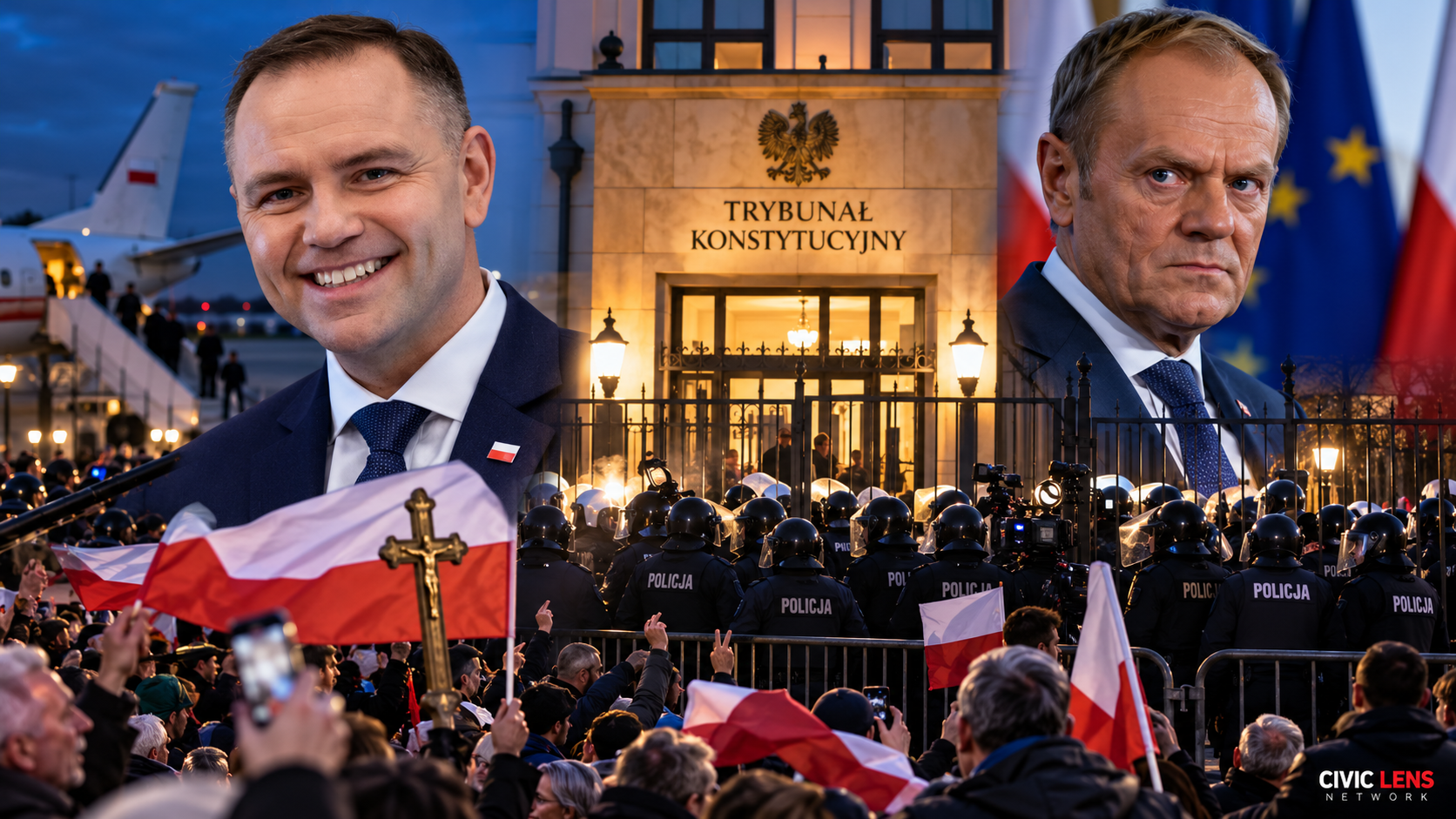
Poland was plunged into an extraordinary constitutional crisis Friday as riot police surrounded the country’s Constitutional Tribunal, its leadership was challenged, and President Karol Nawrocki abruptly turned his aircraft around while traveling to Africa.
Opposition leaders are accusing Prime Minister Donald Tusk’s government of orchestrating a coup against one of Poland’s most powerful judicial institutions. The government insists it is restoring the rule of law.
At the center of the confrontation is a question that could determine the future of Poland’s constitutional system: Who has the lawful authority to control the country’s highest constitutional court?
The situation has become so serious that Poland’s president abandoned an international diplomatic trip to return home as demonstrators gathered outside the court and rival judicial authorities issued conflicting statements.
Poland’s President Orders His Plane to Turn Around
President Karol Nawrocki was traveling to Senegal for an official visit when news of the confrontation reached him.
Rather than continuing his diplomatic mission, Nawrocki ordered his aircraft to return to Poland.
“At such a moment, the President must be in Poland,” Nawrocki announced on X.
His sudden decision underscored the seriousness of the unfolding dispute.
Nawrocki is politically aligned with the conservative Law and Justice movement, commonly known as PiS, which governed Poland from 2015 until 2023.
He has repeatedly opposed judicial changes pursued by Prime Minister Donald Tusk’s government, arguing that the administration has exceeded its constitutional authority.
Friday’s events brought that conflict to a dangerous new level.
Police Deployed as Court Leadership Is Suspended
The confrontation began when Constitutional Tribunal President Bogdan Święczkowski and his deputy, Bartłomiej Sochański, became the subjects of disputed suspension orders.
Judge Anna Korwin-Piotrowska announced that she was assuming temporary leadership of the tribunal and suspending the two officials for one month.
Święczkowski and his supporters rejected the action.
The tribunal’s official social media account issued a statement declaring that Święczkowski remained president and Sochański remained deputy president. It also challenged Korwin-Piotrowska’s authority to act as a tribunal judge.
The statement accused those involved in the leadership change of committing a coup d’état.
Police deployed to the tribunal grounds as the confrontation intensified.
Warsaw police maintained that their officers were acting to preserve public safety, not to interfere with judicial independence. Authorities also disputed claims that police had forcibly removed the tribunal’s security personnel.
Nevertheless, the sight of police surrounding a constitutional court while competing factions claimed control raised immediate concerns about the separation of powers.
Protesters Gather as Tensions Escalate
Outside the tribunal, protesters gathered to denounce the attempted leadership change.
Some demonstrators carried Polish flags, religious images and signs criticizing Prime Minister Tusk. Others prayed while police maintained a security perimeter.
The demonstration became confrontational.
Authorities reported that some protesters breached a fence surrounding the court and that objects were thrown toward officers.
Three people were detained.
Conservative political leaders joined the protests and accused the government of using state institutions to accomplish what it could not achieve through ordinary constitutional procedures.
Former Justice Minister Zbigniew Ziobro described the events as a criminal attack on Poland’s constitutional order and called for determined resistance.
Former Prime Minister Mateusz Morawiecki also condemned what he characterized as a forceful takeover of the tribunal.
The accusations were unmistakable. Senior opposition figures believe the government is attempting to replace existing judicial leadership through actions they consider unlawful.
Whether those actions legally constitute a coup remains disputed.
Prime Minister Donald Tusk Defends His Government
Prime Minister Donald Tusk offered a sharply different explanation.
His government argues that Poland’s Constitutional Tribunal has been compromised by controversial judicial appointments made during the previous Law and Justice administration.
Tusk has promised to restore judicial independence and reverse changes that previously brought Poland into conflict with European Union institutions.
On Friday, he defended the need for decisive action.
“Restoring the rule of law is our duty,” Tusk wrote on X.
He argued that correcting what he described as years of unlawful conduct under PiS would be difficult and sometimes painful.
Justice Minister Waldemar Żurek also announced that he had requested the lifting of judicial immunity for Święczkowski and Sochański, accusing them of preventing other judges from carrying out their responsibilities.
The government maintains that its actions are intended to restore the proper functioning of the Constitutional Tribunal.
Its opponents argue that removing disputed officials through extraordinary measures threatens the very constitutional principles Tusk claims to defend.
That contradiction lies at the heart of Poland’s political crisis.
Years of Judicial Conflict Reach a Breaking Point
The events in Warsaw did not emerge overnight.
For years, Poland has been divided over the independence and legitimacy of its judiciary.
When Law and Justice governed the country between 2015 and 2023, it introduced judicial reforms that supporters argued were necessary to make the courts more accountable.
Critics accused the party of weakening judicial independence and giving political authorities excessive influence over judicial appointments.
The European Union challenged several of those reforms, and Poland faced financial penalties and disputes over European funding.
When Tusk returned to power in 2023, his government promised to reverse the changes.
But Poland’s president retained significant constitutional powers, including a role in the judicial appointment process.
Nawrocki subsequently refused to receive the oaths of several judges selected by the current parliamentary majority.
Meanwhile, the existing tribunal leadership resisted allowing disputed appointees to assume their duties.
The resulting deadlock left one of Poland’s most important courts struggling to function normally.
Friday’s confrontation transformed that prolonged legal dispute into a public struggle for institutional control.
The Supreme Court Raises Constitutional Concerns
The controversy has extended beyond the Constitutional Tribunal itself.
Supreme Court Chief Justice Zbigniew Kapiński condemned the developments and questioned whether the actions were compatible with Poland’s constitutional order.
His intervention demonstrated that concerns about the leadership dispute were not limited to opposition politicians.
Poland now faces competing claims of legal authority involving its government, presidency and judiciary.
That creates a particularly troubling situation for a constitutional democracy.
Courts are supposed to resolve disputes over the law. But when the legitimacy of the judges themselves becomes the subject of the dispute, determining who has final authority becomes considerably more difficult.
The central issue is no longer simply which political party controls the government.
It is whether Poland’s constitutional institutions can resolve disagreements without one side imposing its interpretation through executive authority or police-backed security measures.
Why the United States and NATO Are Watching
Poland is one of the most strategically important members of NATO.
It shares borders with Ukraine, Belarus and Russia’s heavily militarized Kaliningrad region.
The country plays a significant role in European defense, military logistics and Western support for Ukraine.
A prolonged constitutional confrontation could create uncertainty within a government responsible for major national security decisions.
U.S. Ambassador to Poland Tom Rose expressed concern about the unfolding events, describing the confrontation as serious and warning against further escalation.
He emphasized that the United States supports Poland’s stability and democratic future while recognizing that the country’s internal constitutional disputes must be resolved by the Polish people and their institutions.
There is currently no verified evidence that Poland’s military has attempted to seize power or that the national government has been overthrown.
The immediate crisis concerns judicial authority, the legality of the disputed suspensions and the government’s use of state power.
Those distinctions matter, even as the accusations grow increasingly serious.
Is Poland Experiencing a Coup?
The word coup is now being used openly by influential figures in Poland.
The disputed tribunal leadership has characterized the attempted changes as a coup d’état.
Conservative opposition politicians have repeated the accusation, alleging that Tusk’s government is attempting to seize control of the judiciary.
Tusk’s administration rejects that interpretation and argues that its actions are necessary to repair institutions damaged by earlier political interference.
At present, the available evidence establishes a severe constitutional confrontation, but not a completed overthrow of Poland’s government.
The legal validity of the tribunal leadership change remains contested.
What cannot be dismissed is the significance of a country’s president abandoning an international trip while police deploy around its constitutional court and rival authorities claim control over the institution.
These are extraordinary developments for a European Union and NATO member state.
What Happens Next Could Define Poland’s Future
Poland now faces a critical test of its constitutional institutions.
If the competing factions cannot agree on who has lawful authority over the Constitutional Tribunal, the country risks entering an extended period of judicial paralysis and political confrontation.
President Nawrocki’s return places him directly at the center of the dispute.
Prime Minister Tusk appears determined to continue his government’s judicial restructuring efforts.
Opposition leaders have signaled that they will resist what they believe is an unlawful seizure of judicial power.
Meanwhile, the Polish public is watching a struggle unfold over the very institution entrusted with interpreting the country’s constitution.
The fundamental question is whether a government can legitimately claim to restore the rule of law while its methods are themselves being challenged as unconstitutional.
That question cannot be answered simply by accepting the government’s assurances or the opposition’s accusations.
It requires lawful procedures, transparent decisions and constitutional accountability.
For now, Poland remains a functioning state, but its constitutional order is under extraordinary strain.
The president has returned, police have secured the court grounds, judicial leaders are disputing their removal, and accusations of a coup are echoing through Warsaw.
The next decisions by Poland’s political and judicial authorities will determine whether Friday’s confrontation can be resolved through law or develops into an even deeper national crisis.