There are actors who play heroes, and then there are actors who become something far greater. They become part of our lives, our memories, and the very ideals we hold dear.
Sir Patrick Stewart was one of those extraordinary men.
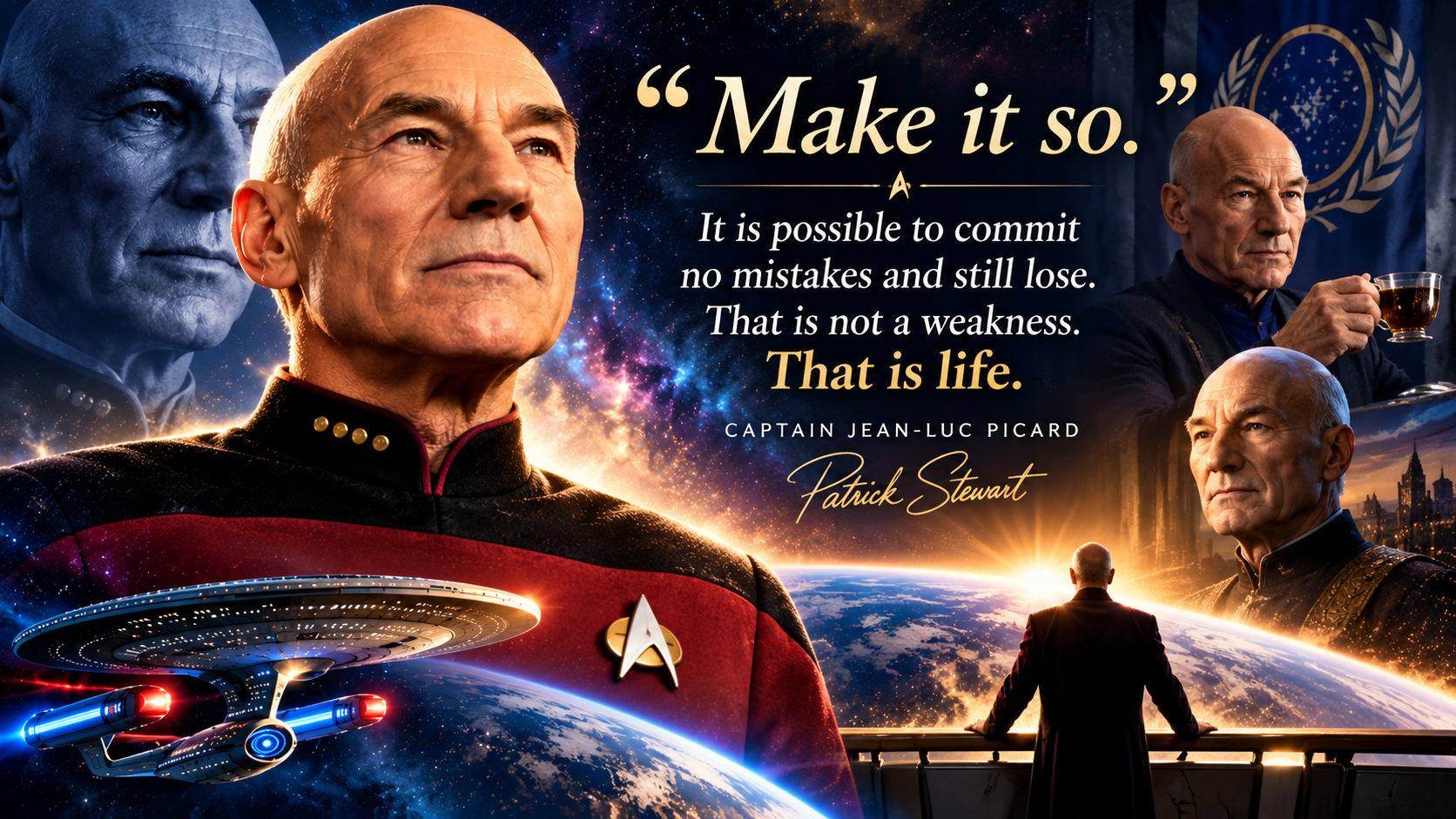
For millions of people around the world, he was Captain Jean-Luc Picard, the commanding officer of the USS Enterprise, a man whose wisdom, courage, dignity, and unwavering principles made him one of the most beloved characters in television history.
But behind the Starfleet uniform stood a remarkable human being whose journey began far from the stars.
On October 28, 2026, Sir Patrick Stewart passed away at his home in Los Angeles at the age of 86, closing the final chapter of an extraordinary life that spanned more than six decades of acting.
His passing marks the end of an era for generations of Star Trek fans, theater lovers, and moviegoers who grew up admiring a man whose unmistakable voice could command a starship, deliver Shakespeare, or bring an audience to tears.
The Enterprise has lost its captain.
But the legacy of Jean-Luc Picard, and the man who brought him to life, will never disappear.
From a Small English Town to the Stars
Patrick Stewart was born July 13, 1940, in Mirfield, West Yorkshire, England.
There was nothing glamorous about his childhood.
He grew up in a working-class household where money was scarce, comforts were few, and life could be painfully difficult.
His father, Alfred Stewart, was a British Army soldier who returned from World War II carrying the scars of his experiences. Stewart later spoke openly about witnessing domestic violence in his childhood home, memories that remained with him throughout his life.
Those early experiences helped shape his understanding of suffering, vulnerability, and the importance of standing against abuse.
Long before he became famous, Stewart discovered something that would change his life forever.
The theater.
A schoolteacher introduced him to Shakespeare, opening a door into a world where words possessed extraordinary power and where a young boy from Yorkshire could become a king, a warrior, a philosopher, or anyone his imagination allowed.
Stewart discovered that acting was more than entertainment.
It was freedom.
It gave him a voice, confidence, and a place where he could escape the hardships of his childhood.
That discovery would eventually carry him from modest beginnings to the command chair of the most famous starship in science fiction.
A Shakespearean Actor Before He Was a Starfleet Captain
Long before audiences heard Jean-Luc Picard issue his famous commands, Patrick Stewart had already established himself as an accomplished classical actor.
He joined the Royal Shakespeare Company in the 1960s, spending years mastering some of the most demanding roles in English theater.
He performed in productions of Macbeth, Hamlet, Antony and Cleopatra, and countless other works that demanded emotional depth, discipline, and extraordinary command of language.
His powerful voice became one of his greatest instruments.
Stewart did not need to shout to command attention.
A quiet sentence, a carefully measured pause, or a simple glance could carry more authority than an entire speech delivered by another actor.
His theatrical background would later become one of the defining qualities of Captain Picard.
Every speech from the bridge of the Enterprise carried the weight of a Shakespearean performance.
Every difficult decision felt like a matter of genuine moral consequence.
And every moment of compassion reminded audiences that true strength was not measured by aggression, but by character.
The Day Star Trek Found Its Captain
In 1987, television history changed forever.
A new series called Star Trek: The Next Generation prepared to launch, carrying the enormous responsibility of following the original Star Trek series.
William Shatner had already made Captain James T. Kirk a cultural icon.
Replacing that legacy would not be easy.
The producers needed someone who could lead an entirely new generation of explorers without simply imitating what had come before.
They found Patrick Stewart.
At 47 years old, Stewart was hardly the conventional choice for the leading man of a futuristic television adventure.
He was a distinguished British stage actor with a bald head, a commanding voice, and little interest in becoming a traditional Hollywood celebrity.
Some doubted whether audiences would embrace him.
Others wondered whether Star Trek could survive without Kirk and Spock at the center of its universe.
Those doubts would eventually disappear.
From the moment Stewart settled into the captain’s chair of the USS Enterprise-D, something remarkable began to happen.
Jean-Luc Picard became more than a fictional starship commander.
He became an example of leadership that millions of viewers would admire for decades.
Why Jean-Luc Picard Was the Greatest Captain
Every Star Trek captain brought something special to the franchise.
James T. Kirk had boldness and instinct.
Benjamin Sisko had determination and resilience.
Kathryn Janeway had courage and resourcefulness.
But Jean-Luc Picard possessed something extraordinary.
He understood that the greatest victories were not always won through combat.
Sometimes they were won through patience.
Sometimes through diplomacy.
Sometimes through the courage to stand alone against an injustice.
Picard believed that exploration was not about conquering the unknown. It was about understanding it.
He respected the dignity of other civilizations, valued the lives of his crew, and understood that possessing power did not automatically grant the moral right to use it.
He was a captain who could face a hostile alien fleet without flinching, yet still take time to understand the personal struggles of someone serving under his command.
His relationship with Commander William Riker demonstrated trust and mutual respect.
His friendship with Data revealed his belief that humanity was defined by more than biology.
His conversations with Counselor Deanna Troi showed that even the strongest leaders needed wisdom from others.
And his relationship with the Klingon officer Worf demonstrated that honor could transcend culture, species, and tradition.
Picard was not perfect.
He could be stubborn, distant, impatient, and occasionally overwhelmed by the responsibilities placed upon him.
But those imperfections made him believable.
He was not a superhero.
He was a man trying to do what was right, even when doing so came at enormous personal cost.
That was his greatness.
The Episodes That Made a Legend
Across seven seasons of Star Trek: The Next Generation, Stewart delivered performances that remain among the finest in science fiction television.
In The Best of Both Worlds, Picard was captured and transformed into Locutus of Borg, becoming an instrument of the very enemy he had fought to resist.
The storyline revealed a terrifying vulnerability in a character audiences had come to regard as almost unshakable.
Stewart’s performance brought a devastating emotional dimension to the captain, showing the psychological consequences of having his identity and free will stripped away.
In The Inner Light, Picard experienced an entire lifetime on a distant world, living as a husband, father, and member of a civilization facing extinction.
It was a beautiful and heartbreaking story about memory, love, and the passage of time.
For many fans, it remains one of the greatest episodes ever produced in the Star Trek universe.
In Chain of Command, Picard endured brutal interrogation and psychological torture while refusing to surrender his understanding of reality.
His defiance became one of the defining moments of the series.
And in The Measure of a Man, Picard fought to establish that Data, an artificial life-form, deserved recognition as an individual rather than property.
The episode explored questions about consciousness, freedom, and human dignity that remain relevant in an age increasingly shaped by artificial intelligence.
These were not simply stories about spaceships.
They were stories about what it means to be human.
And Patrick Stewart gave them a depth that few performers could have achieved.
A Captain Who Continued His Mission on the Big Screen
When Star Trek: The Next Generation concluded in 1994, Stewart’s journey as Jean-Luc Picard was far from over.
He returned to the role in four feature films.
Star Trek Generations brought together the worlds of Captain Kirk and Captain Picard.
Star Trek: First Contact delivered one of the franchise’s most memorable cinematic adventures, confronting Picard once again with the Borg and the trauma they had inflicted upon him.
Star Trek: Insurrection explored questions of morality, displacement, and the responsibilities of Starfleet.
And Star Trek: Nemesis brought another chapter of the Enterprise crew’s journey to the big screen.
Through every adventure, Stewart remained the emotional center of the story.
His portrayal reminded audiences that the Enterprise was never merely a machine traveling through space.
It represented humanity’s hope that the future could be better than the past.
Professor Charles Xavier and Another Legendary Role
Although Captain Picard became his defining television role, Stewart would introduce himself to an entirely new generation through the X-Men films.
Beginning in 2000, he portrayed Professor Charles Xavier, the wise and compassionate leader of a school for young mutants.
Once again, Stewart found himself playing a man who believed understanding was stronger than hatred.
Professor Xavier sought peaceful coexistence between mutants and humanity, even as others argued that conflict was inevitable.
The character shared many qualities with Jean-Luc Picard.
Both were teachers.
Both believed in diplomacy.
Both carried enormous responsibility.
And both understood that leadership required sacrifice.
Stewart’s portrayal of Xavier became one of the most recognizable performances in superhero cinema.
His work opposite Hugh Jackman and his longtime friend Ian McKellen helped give the X-Men franchise its emotional foundation.
In Logan, released in 2017, Stewart delivered a particularly moving performance as an aging and vulnerable Charles Xavier.
It was a reminder that even legendary heroes could grow old, become fragile, and face the painful realities of mortality.
Stewart never allowed those vulnerabilities to diminish the character’s humanity.
Instead, he made them central to the story.
The Friendship Between Two Giants
One of the most heartwarming chapters of Patrick Stewart’s life was his friendship with fellow British actor Sir Ian McKellen.
The two men shared a love of Shakespeare, a remarkable sense of humor, and decades of theatrical experience.
Their friendship became especially visible through their appearances together in the X-Men films and onstage in productions such as Waiting for Godot and No Man’s Land.
Away from the cameras, they delighted fans with photographs, public appearances, and affectionate exchanges that demonstrated how genuine their bond had become.
In 2013, McKellen even officiated Stewart’s wedding to singer-songwriter Sunny Ozell.
Their friendship was a reminder that behind the grand performances and legendary characters stood two men who genuinely enjoyed one another’s company.
Following Stewart’s death, McKellen paid tribute to a friend he deeply admired and loved.
For those who followed their careers, the loss carries an especially personal sadness.
The Man Behind the Uniform
Patrick Stewart’s life was about much more than acting.
His experiences growing up in a home affected by domestic violence inspired him to speak publicly against abuse and support organizations working to protect victims.
He became associated with Refuge, a British charity dedicated to helping people experiencing domestic abuse.
Stewart also supported causes involving veterans and people affected by the psychological consequences of war.
He understood that fame brought an opportunity to draw attention to suffering that might otherwise remain unseen.
In 2010, he was knighted by Queen Elizabeth II for his services to drama.
The boy who grew up in a modest Yorkshire household had become Sir Patrick Stewart, recognized for a lifetime of extraordinary achievement.
Yet even with the honors, worldwide recognition, and unforgettable characters, Stewart remained deeply connected to his beginnings.
In 2023, he published his memoir, Making It So, sharing the remarkable story of his childhood, theatrical career, personal struggles, and unexpected rise to international fame.
The title was a fitting tribute to the character who had become inseparable from his public identity.
One Last Journey Aboard the Enterprise
For years, fans believed that Star Trek: Nemesis might have been Patrick Stewart’s final appearance as Jean-Luc Picard.
Then, in 2020, something extraordinary happened.
Stewart returned.
Star Trek: Picard brought the legendary captain back to television, now older, carrying the memories of a lifetime and confronting a galaxy that had changed around him.
The series explored aging, regret, loyalty, loss, and the question of what remains when a person steps away from the position that once defined them.
Its third and final season, released in 2023, reunited Stewart with beloved members of the original Next Generation cast.
For longtime fans, seeing Picard, Riker, Data, Worf, Geordi La Forge, Beverly Crusher, and Deanna Troi together again was an emotional experience.
They were no longer the young officers who had first appeared on television in 1987.
Time had passed.
Their faces had changed.
Their lives had taken different paths.
But the friendship, loyalty, and sense of purpose that made The Next Generation special remained.
The reunion offered something precious.
A chance to say goodbye.
Not merely to a television series, but to a group of characters who had accompanied millions of viewers through their own lives.
The Final Days of Sir Patrick Stewart
On October 28, 2026, Patrick Stewart died at his Los Angeles home at the age of 86.
His representative confirmed that he had experienced Alzheimer’s disease and Lewy body dementia, illnesses that had not previously been publicly disclosed.
According to the statement announcing his passing, Stewart spent his final moments surrounded by love, family, friends, music, and prayer.
It was a deeply personal farewell to a man who had spent his life giving so much to others through his performances.
He is survived by his wife, Sunny Ozell, and his two children, Daniel and Sophie.
Tributes quickly emerged from across the entertainment industry.
William Shatner, the original Captain Kirk, remembered Stewart’s extraordinary talent and the humanity he brought to his work.
Hugh Jackman honored a friend and colleague whose influence extended far beyond their years together on the X-Men films.
Ian McKellen mourned the loss of a man whose friendship had become one of the great treasures of his life.
And around the world, Star Trek fans began remembering the captain who had taught them that courage and compassion could exist side by side.
The Enterprise Will Always Have Its Captain
There is something profoundly fitting about the fact that Patrick Stewart became famous portraying a man who believed humanity could rise above its worst instincts.
Jean-Luc Picard represented a future in which knowledge mattered more than ignorance, cooperation mattered more than division, and moral courage mattered more than personal ambition.
He commanded the Enterprise with intelligence rather than intimidation.
He inspired loyalty through respect rather than fear.
And he reminded viewers that civilization was measured not simply by technological achievement, but by the way people treated one another.
Patrick Stewart gave that vision a face.
He gave it a voice.
And most importantly, he gave it a soul.
For nearly four decades, fans watched Captain Picard stand on the bridge of the Enterprise, looking into the vast unknown with a determination to discover what lay beyond the next star.
Now the actor who brought that extraordinary character to life has completed his own journey.
The command chair is empty.
The bridge is quieter.
And somewhere in the imaginations of millions of fans, the Enterprise continues its voyage through the stars.
Perhaps that is the greatest gift Patrick Stewart leaves behind.
The reminder that our time is limited, but the things we create, the people we inspire, and the kindness we show can endure long after we are gone.
Sir Patrick Stewart may have taken his final bow, but Captain Jean-Luc Picard will continue inspiring generations who have yet to discover the wonders of Star Trek.
For those who grew up watching him, there will never be another captain quite like him.
A gentleman.
A Shakespearean master.
A beloved husband, father, and friend.
An extraordinary actor.
And to millions of us, the greatest captain ever to command the USS Enterprise.
Rest in peace, Sir Patrick Stewart.
July 13, 1940 – October 28, 2026.
Your final mission is complete, Captain.
Your legacy will travel among the stars forever.