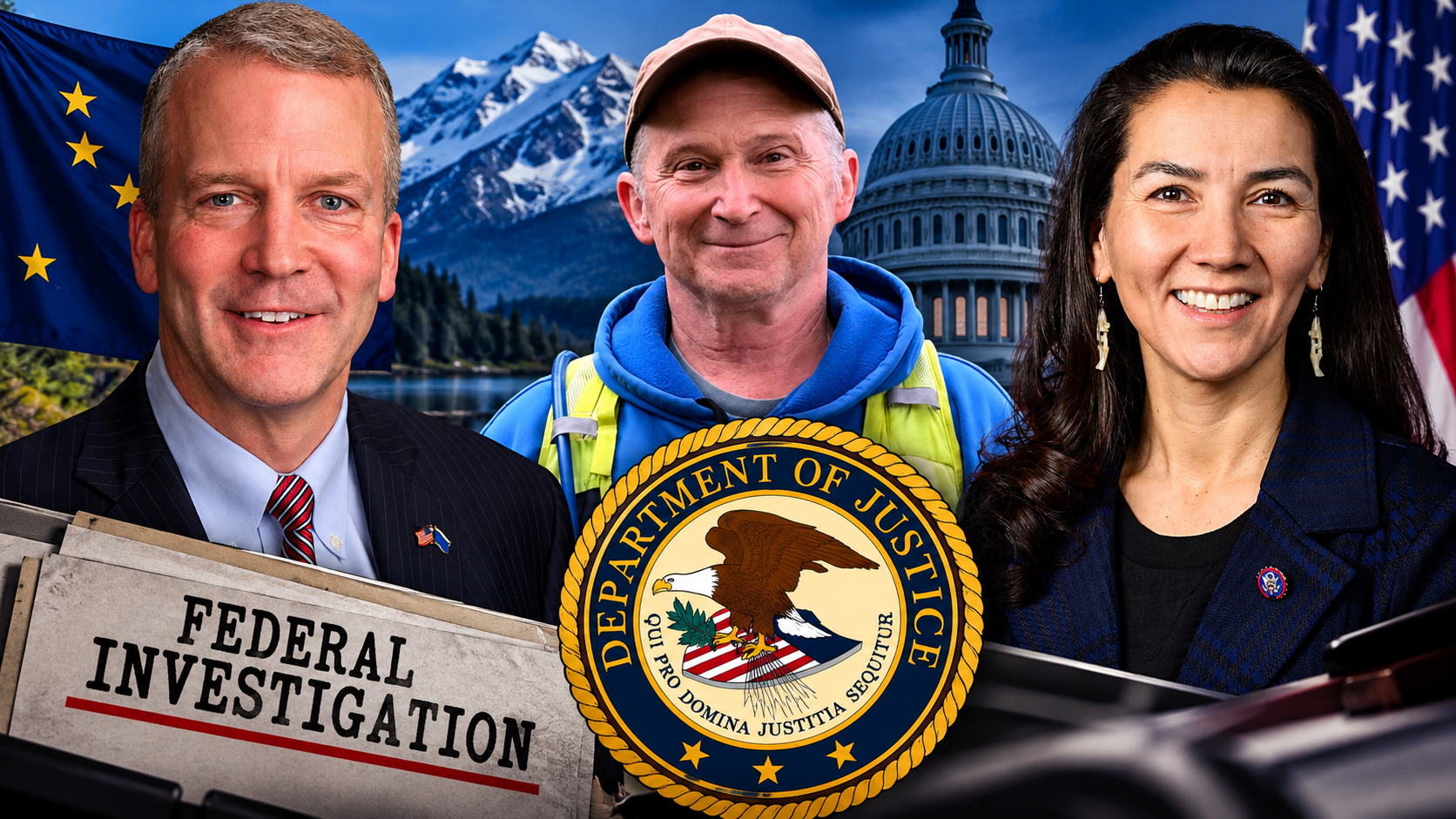
A federal criminal investigation is underway in Alaska following explosive allegations that Democratic political operatives helped recruit a candidate with the same name as Republican Senator Dan Sullivan in an attempt to confuse voters and influence one of the nation’s most closely watched Senate races.
The controversy has escalated into a federal criminal investigation, grand jury subpoenas, a separate state investigation and an extraordinary legal battle over whether the election results should be certified if the Republican incumbent loses by a narrow margin.
At the center of the dispute is a retired teacher named Daniel J. Sullivan Jr., whose name closely resembles that of incumbent Republican Senator Daniel S. Sullivan.
Federal investigators are now examining whether the candidacy was part of a coordinated political operation designed to divert votes from the Republican senator and benefit Democratic challenger Mary Peltola.
Federal Prosecutors Confirm Criminal Investigation
On October 30, U.S. Attorney Michael J. Heyman publicly confirmed that federal authorities have been investigating allegations surrounding the Alaska Senate race for several months.
Speaking during a news conference in Anchorage, Heyman revealed that recent developments had prompted a significant increase in federal law enforcement resources assigned to the investigation.
The Justice Department has issued grand jury subpoenas and sought records connected to the alleged recruitment operation.
According to ABC News, subpoenas have targeted Democratic officials believed to have connections to efforts to recruit the similarly named candidate.
Heyman declined to identify specific targets or potential criminal charges, emphasizing that investigators were still gathering evidence.
The announcement represents a significant escalation in a controversy that began months before the November 3 election.
The Alleged Plan to Put Another Dan Sullivan on the Ballot
The controversy intensified following an October 28 investigation published by The New York Times.
According to the newspaper’s reporting, individuals associated with Peltola’s campaign and Democratic political organizations allegedly worked to recruit candidates who could draw support away from the Republican incumbent.
The reported effort included searching for individuals named Dan Sullivan who might be persuaded to enter the race.
The Times based its findings on interviews, text messages and documents associated with the alleged recruitment effort.
The report also described efforts to encourage additional candidates to enter the election, potentially dividing support that otherwise might have gone to the incumbent.
The allegations have raised serious questions about whether political operatives were attempting to exploit similarities between candidate names rather than compete solely on political issues.
If the recruitment effort occurred as described, the central question is whether it constituted lawful political maneuvering or crossed the line into illegal deception.
Recruiting additional candidates is not automatically a crime. Federal investigators would need evidence of a specific legal violation before criminal charges could be justified.
Alaska Election Officials Had Already Raised Concerns
Questions surrounding Daniel J. Sullivan Jr.’s candidacy did not begin with the latest newspaper investigation.
Earlier this year, Alaska election officials examined whether his campaign represented a legitimate effort to seek public office.
In June, the state’s Division of Elections concluded that the evidence did not support treating his candidacy as a genuine campaign conducted in good faith.
Election officials expressed concern that the candidacy had been filed to confuse or mislead voters.
The retired teacher challenged that determination in court.
An Alaska Superior Court judge overturned the decision to exclude him, and subsequent court proceedings allowed his candidacy to continue.
The rulings established that concerns about a candidate’s motives do not necessarily provide legal grounds to remove that individual from an election ballot.
As a result, both men named Sullivan are scheduled to appear on the November ballot.
Mary Peltola Denies Involvement
Democratic Senate candidate Mary Peltola has denied knowing about or participating in an effort to recruit another candidate named Sullivan.
Speaking publicly on October 29, Peltola said she had no knowledge of such an operation and rejected the suggestion that she wanted to trick voters.
The Democratic Senatorial Campaign Committee has also denied involvement in the alleged recruitment effort.
Daniel J. Sullivan Jr. has maintained that his candidacy is legitimate and that he did not coordinate with Peltola’s campaign.
Those denials are significant because the existence of a recruitment operation would not, by itself, establish that Peltola personally authorized or knew about it.
Investigators must determine who organized any recruitment effort, what communications took place, whether campaign officials were involved and whether any laws were broken.
Trump Administration Takes the Fight to Federal Court
The Justice Department has also filed a civil lawsuit concerning the disputed candidacy.
Federal attorneys are seeking measures that could affect certification of the Senate election if the incumbent Republican loses by a margin smaller than the number of votes received by the similarly named candidate.
The department has additionally requested that Alaska preserve and separate ballots ranking Daniel J. Sullivan Jr. so investigators can examine possible voter confusion.
President Donald Trump has publicly supported the Justice Department’s intervention and accused Democrats of attempting to manipulate the election.
However, the federal government’s legal strategy faces significant obstacles.
Alaska officials argue that existing election procedures already distinguish the candidates.
The ballot identifies the Republican incumbent as Dan S. Sullivan and identifies the other candidate as Daniel J. Sullivan Jr.
The state’s ranked-choice voting system also permits voters to rank multiple candidates, potentially reducing the consequences of confusing one Sullivan with the other.
Legal experts have questioned whether federal authorities possess sufficient grounds to interfere with certification based on an allegation of voter confusion.
The criminal investigation and civil lawsuit are separate proceedings, and neither establishes that election fraud occurred.
Alaska Governor Orders Separate Investigation
Republican Governor Mike Dunleavy has ordered state authorities to investigate the alleged recruitment operation.
His decision followed the publication of the Times investigation, which raised new questions about communications between political operatives and potential candidates.
The state investigation will examine whether Alaska laws were violated.
Federal and state investigators may pursue different legal questions, including whether campaign activities involved unlawful conduct or misleading representations.
The existence of two investigations demonstrates the seriousness with which authorities are treating the allegations, although neither investigation establishes criminal wrongdoing.
Why the Senate Race Matters
The controversy comes at a particularly sensitive moment.
Alaska’s Senate election is among the races that could determine which political party controls the United States Senate after the November midterms.
Republican Senator Dan Sullivan is seeking another term against former Democratic Congresswoman Mary Peltola.
With control of the Senate potentially at stake, even a relatively small number of votes could become politically significant.
That possibility helps explain why the similarly named candidacy has attracted national attention.
The dispute also raises broader questions about campaign ethics and the lengths political organizations may go to influence competitive elections.
Both major political parties have faced criticism over efforts to encourage spoiler candidates in previous elections.
Such tactics may be legal under certain circumstances, but their legitimacy becomes more contentious when accusations of deliberate voter deception emerge.
What Happens Next?
Federal investigators are expected to continue examining communications, campaign records and testimony connected to the alleged recruitment operation.
The Justice Department has not publicly announced criminal charges arising from the alleged scheme.
The courts must also determine whether the federal government’s requested intervention in Alaska’s election certification process is legally justified.
Meanwhile, voters are preparing to cast their ballots in an election now overshadowed by questions about political manipulation.
The allegations deserve a thorough investigation, particularly if evidence establishes that political operatives deliberately attempted to exploit candidate-name confusion to influence the outcome.
But the investigation must distinguish between aggressive campaign tactics, unethical behavior and conduct that actually violates criminal law.
For Alaska voters, the most important issue remains whether their ballots will accurately reflect their intentions.
With federal prosecutors, state investigators and the courts now involved, the controversy surrounding the two Dan Sullivans has become one of the most unusual election disputes of 2026.
The unanswered question is whether investigators will uncover evidence of criminal conduct or whether the controversy will ultimately be resolved as a dispute over political tactics and ballot access.