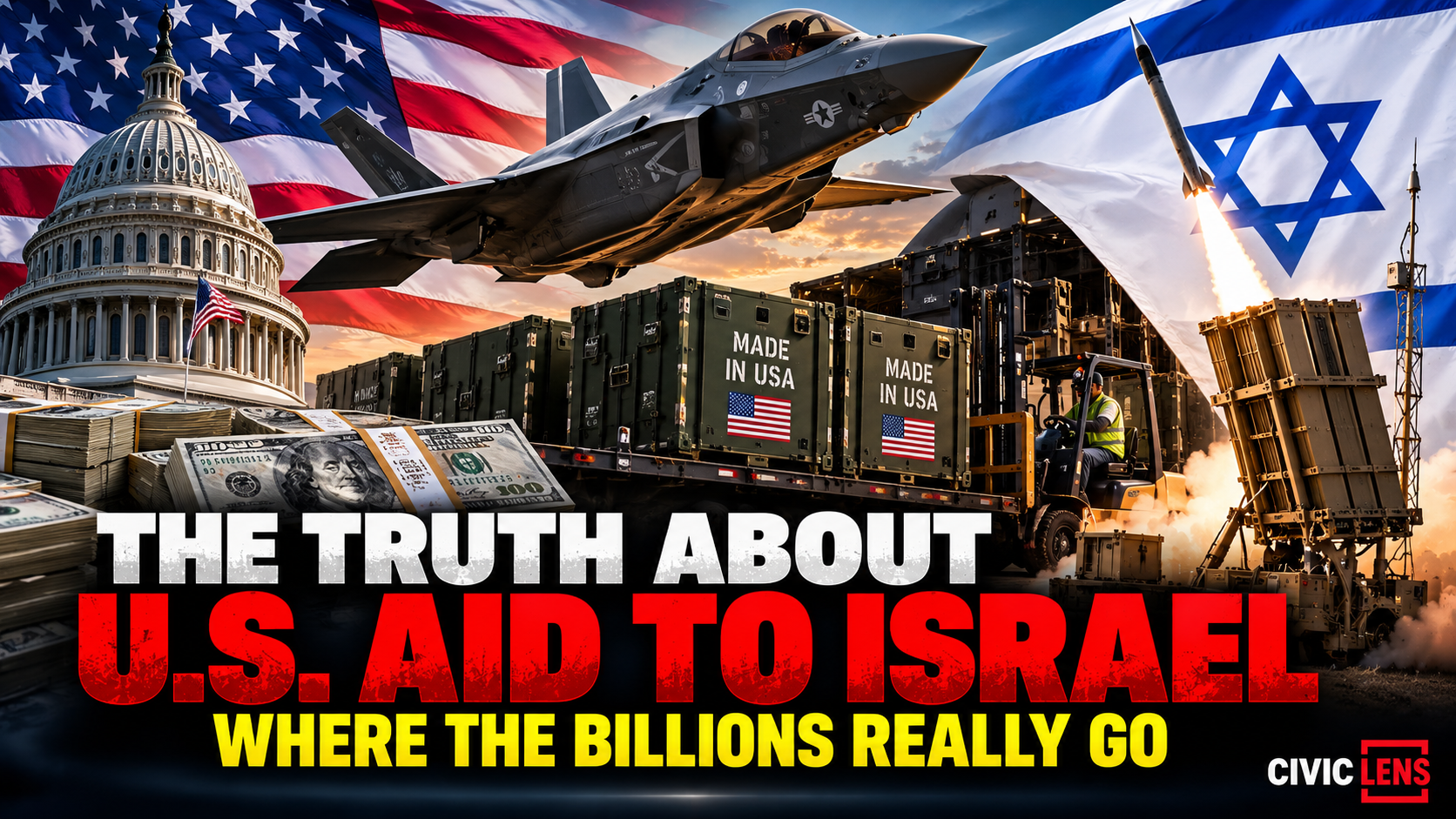
Most Americans have heard the same claim repeated for years: The United States sends billions of dollars to Israel while American taxpayers are left footing the bill.
What rarely gets explained is where much of that money actually goes.
The reality is more complicated than the familiar image of Washington writing a multibillion-dollar check and allowing Israel to spend it however it pleases.
A substantial portion of American military assistance to Israel is specifically designated for purchasing American-made weapons, aircraft, ammunition, military equipment, and defense services.
That means billions in military assistance ultimately finance contracts with American defense manufacturers.
It is still taxpayer-funded foreign aid. But it is also a system that supports American defense production, strengthens military cooperation, and helps maintain a strategic relationship in the Middle East.
Understanding that distinction is essential to understanding the actual cost and purpose of American assistance to Israel.
The $38 Billion Agreement Most Americans Never Hear Explained
In 2016, the Obama administration signed a ten-year security assistance agreement with Israel covering fiscal years 2019 through 2028.
The agreement committed the United States to seek $38 billion in military assistance over that period.
Under its terms, Israel receives approximately $3.8 billion annually, subject to congressional appropriations.
That annual amount consists of $3.3 billion in Foreign Military Financing and another $500 million for cooperative missile defense programs.
The $3.3 billion is not simply unrestricted money for Israel’s government to spend on whatever it chooses.
It is provided through a military financing program that generally requires the funds to be used for approved defense purchases, primarily from American suppliers.
The additional $500 million supports cooperative missile defense programs, including systems such as Iron Dome, David’s Sling, and Arrow.
These programs involve American and Israeli defense companies, technological cooperation, and military research.
In other words, the financial arrangement is closely connected to American defense production.
How the Money Flows Back Into American Industry
Consider what happens when Israel uses American military financing to purchase an American-made fighter aircraft.
The United States appropriates money for military assistance.
Israel uses that financing to acquire approved equipment.
An American defense contractor receives payment for manufacturing and delivering the aircraft.
The aircraft eventually goes to Israel, but the manufacturing contracts support production facilities, employees, suppliers, engineering operations, and industrial capacity connected to the United States.
Lockheed Martin’s F-35 program is one prominent example of American military technology purchased by Israel.
Other major American defense companies, including Boeing and RTX, participate in the broader defense industry that supplies equipment and services to American allies.
The money does not simply disappear into Israel’s economy.
Much of it becomes revenue for American manufacturers and their suppliers.
That distinction matters because it changes how the public should understand the assistance.
The United States is financing weapons for an ally, while American defense companies receive much of the resulting business.
However, revenue returning to American contractors is not the same as money being returned to the federal Treasury. Taxpayers still finance the purchases, and the equipment is delivered to Israel rather than retained by the United States.
Why Washington Uses This System
The United States has long used military assistance and weapons sales as instruments of foreign policy.
Rather than requiring allied countries to develop entirely independent weapons systems, Washington can help them purchase American equipment.
This creates several strategic advantages.
First, it encourages allies to operate weapons and technologies compatible with American military systems.
Second, it strengthens long-term defense relationships.
Third, it supports American defense manufacturers and their extensive supply chains.
Fourth, it creates continuing demand for American maintenance, spare parts, training, and technical support.
For Israel, American military financing helps pay for expensive aircraft, weapons, and defensive systems.
For the United States, the arrangement supports a military partnership with a country Washington has historically regarded as an important Middle Eastern ally.
American policymakers have also viewed Israel’s intelligence capabilities, technological development, and military experience as valuable components of that relationship.
These are the strategic arguments behind the program, although the value of those benefits remains a legitimate subject of debate.
American Jobs and American Manufacturing
Military assistance to Israel can create demand for American industrial production.
Modern military equipment involves far more than a single manufacturer assembling a finished weapon.
Fighter aircraft, missile defense systems, radar equipment, and advanced munitions require complicated supply chains.
Those supply chains involve manufacturers, electronics specialists, aerospace engineers, software developers, transportation companies, and maintenance providers.
When American military assistance finances eligible purchases from American defense companies, the contracts can support employment and production across multiple states.
That economic activity is a real component of the arrangement.
But it should not be confused with a complete financial return on the government’s expenditure.
A billion dollars in weapons purchases does not produce a billion dollars in federal tax revenue. The economic benefit depends on where production occurs, how contracts are structured, and what other activities the spending might have supported.
The argument for the program is therefore not that the assistance costs American taxpayers nothing.
It is that the spending can serve both foreign-policy objectives and domestic industrial interests.
The Important Exception: Not Every Dollar Stays in America
There is another detail often overlooked in discussions of Israeli military assistance.
For decades, Israel received a special privilege known as Offshore Procurement.
This arrangement allowed Israel to spend a portion of its American military financing on equipment manufactured by Israeli defense companies.
That made Israel different from many other countries receiving American military financing.
The 2016 agreement established a gradual phaseout of this privilege, scheduled to end in fiscal year 2028.
As the phaseout progresses, a greater share of American military financing must be used for eligible American defense purchases.
That development reinforces the connection between American assistance and American manufacturing.
It also demonstrates why the statement that every dollar of American aid immediately returns to the United States would be inaccurate.
Some financing has historically supported Israeli production, while other forms of assistance involve cooperative development and additional spending arrangements.
What About Iron Dome?
Israel’s Iron Dome missile defense system is one of the best-known examples of American-Israeli military cooperation.
Designed to intercept short-range rockets and other airborne threats, the system has become a major component of Israel’s defensive infrastructure.
American funding has supported the program, including cooperative production arrangements involving American defense companies.
RTX has worked with Israel’s Rafael Advanced Defense Systems on Iron Dome interceptor production.
That cooperation demonstrates how American military assistance can support industrial partnerships between the two countries.
The benefits are not exclusively financial.
American military planners and defense manufacturers can also gain experience from cooperation involving missile interception technologies and operational lessons.
However, those benefits do not mean the United States receives every dollar of its investment back.
The assistance supports defense capabilities primarily intended for Israel, even when American manufacturers participate in production.
Israel Also Purchases American Weapons With Its Own Money
Another distinction is frequently missing from public discussions.
Not every American weapons sale to Israel is financed by American foreign aid.
Israel also purchases military equipment using its own national funds.
Those purchases represent ordinary defense sales, although they remain subject to American export controls and government approvals.
The Congressional Research Service reported that, as of April 2025, the United States had 751 active Foreign Military Sales cases with Israel valued at approximately $39.2 billion.
That figure represents the value of active sales cases, not $39.2 billion in new aid or completed deliveries.
Some purchases are financed through American assistance, while others rely on Israeli funds or different financing arrangements.
It is therefore important to distinguish between military aid, approved weapons sales, signed contracts, and actual equipment deliveries.
They are not interchangeable figures.
The Criticism That Still Deserves an Answer
The fact that military assistance supports American defense companies does not eliminate legitimate questions about federal spending.
American taxpayers still provide the money.
Congress must still appropriate it.
And every dollar allocated to foreign military assistance is a dollar that cannot simultaneously be used for another federal priority without additional spending or borrowing.
Critics question whether the strategic benefits justify the expense, particularly when Israel possesses a substantial economy and advanced domestic defense industry.
Others raise concerns about the use of American-supplied weapons during military operations and whether existing oversight and human-rights restrictions are sufficient.
Supporters argue that the assistance helps maintain regional deterrence, strengthens an important American security partnership, and sustains defense production.
Both the economic benefits and the public costs deserve to be examined rather than reduced to political slogans.
Could Israel Eventually Pay for More of Its Own Weapons?
The future of American assistance is already under discussion.
In June 2026, the Congressional Research Service reported that the Trump administration and Israel were discussing a possible successor to the current ten-year military assistance agreement.
Israeli Prime Minister Benjamin Netanyahu has publicly discussed gradually ending American military aid and replacing portions of the relationship with joint investments and cooperative defense projects.
Such an arrangement could change how American taxpayers finance Israel’s military purchases.
Instead of relying on the existing annual grant structure, Israel could increasingly purchase weapons using its own resources while continuing to cooperate with American defense manufacturers.
Whether such changes would save the United States money would depend on the final agreement and the amount of joint funding Congress continued to authorize.
No replacement agreement should be treated as finalized merely because negotiations or proposals have been reported.
The Bottom Line: America Is Financing Weapons Purchases, Not Simply Handing Over Unrestricted Cash
The common claim that America gives Israel billions without receiving anything in return leaves out a major part of the story.
Much of the assistance finances American-made weapons, military equipment, and defense services.
American defense manufacturers receive contracts. Their suppliers receive business. Workers participate in producing the equipment. And the United States maintains a military relationship with an important regional partner.
But the opposite claim, that America does not actually give Israel money, is also incorrect.
The United States provides real taxpayer-funded military grants, and those grants help Israel acquire equipment it otherwise would have to finance itself.
The financial benefit to American companies does not erase the federal cost.
The most accurate explanation is that American military assistance to Israel functions in large part as a taxpayer-financed weapons purchasing program that supports American defense production while supplying military equipment to Israel.
That is a very different arrangement from simply handing another country unrestricted billions of dollars.
Americans deserve to understand where their tax dollars go, who receives the contracts, what strategic benefits the country gains, and how much the arrangement ultimately costs.
Those facts should be at the center of any serious debate about American aid to Israel.