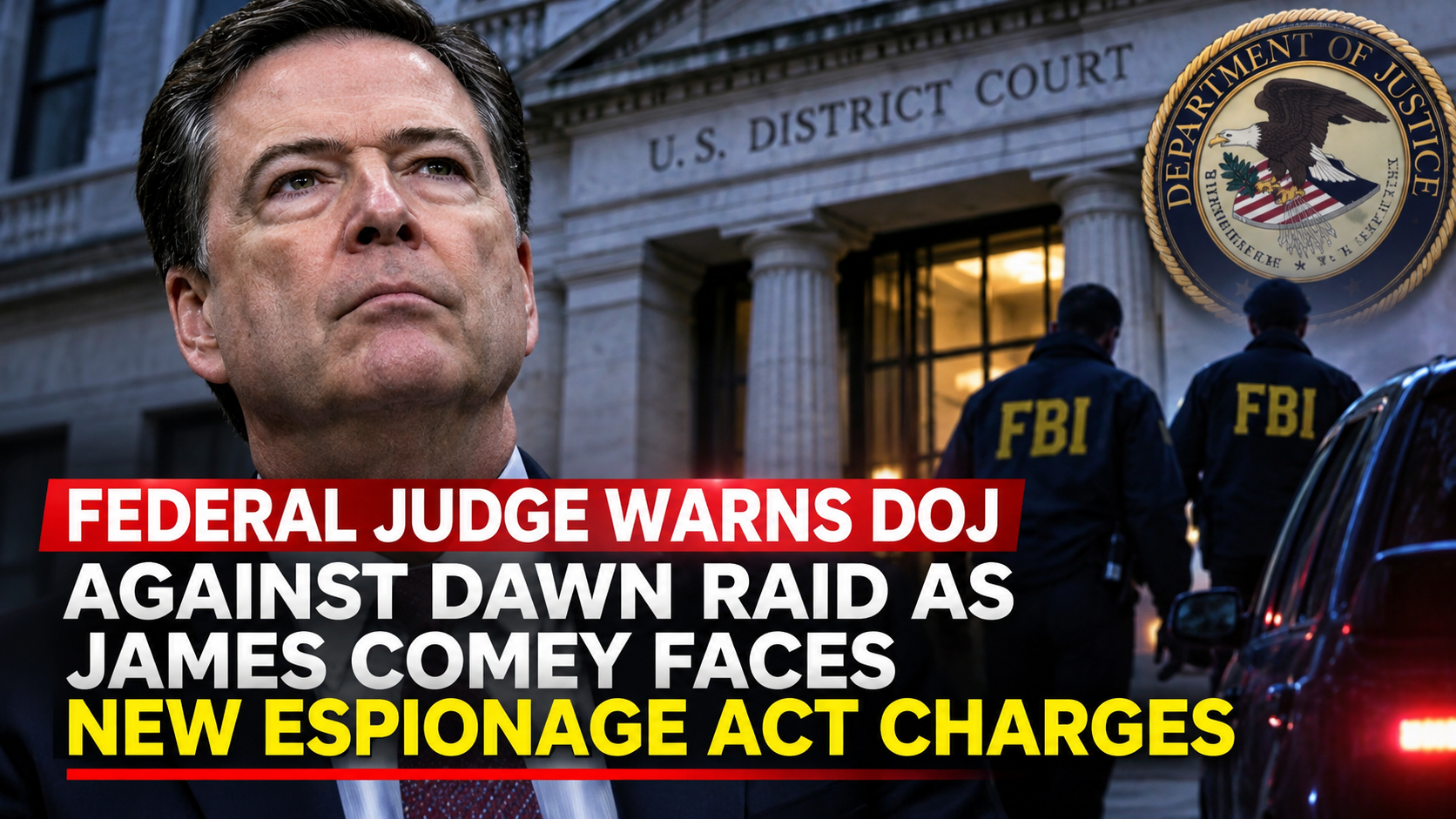
WASHINGTON, D.C. — Former FBI Director James Comey is once again at the center of a major federal criminal investigation, this time involving allegations that he authorized the disclosure of classified national defense information to the news media while leading one of America’s most powerful law enforcement agencies.
The latest confrontation reached a federal courtroom Friday, October 30, 2026, where U.S. District Judge Trevor McFadden considered whether the Justice Department could proceed with its third attempt to prosecute Comey in just over a year.
During the hearing, the judge issued an unusual warning to federal prosecutors about the possibility of an early morning arrest at Comey’s home.
McFadden said he would be extremely frustrated if authorities conducted a dawn raid while the court was still considering the legality of the government’s charging documents.
Federal prosecutor Dustin Farahnak assured the judge that such an operation would not happen.
The exchange added another dramatic chapter to a legal battle involving classified information, disputed prosecutorial tactics, and a former FBI director whose tenure remains one of the most controversial in modern American history.
The Classified Information Allegations
At the center of the investigation is an October 2016 report published by The New York Times concerning secret government surveillance activities involving Yahoo.
According to federal prosecutors, Comey directed FBI personnel to communicate with a Times reporter about sensitive government information after a Reuters article raised questions about surveillance activities involving the technology company.
The original controversy concerned whether Yahoo had cooperated with federal intelligence authorities in scanning incoming emails for information associated with suspected foreign terrorist organizations.
Prosecutors allege that Comey authorized FBI employees to disclose information that was classified and related to national defense.
Federal court filings accuse Comey of unlawfully transmitting national defense information and conspiring to commit that offense.
The allegations are serious because the federal government places strict restrictions on who may disclose classified national security information, even when those individuals occupy senior positions within federal law enforcement.
An FBI director possesses extraordinary access to sensitive intelligence. That access does not automatically authorize the director to release classified material to journalists.
However, the government must still establish that the particular information was protected under the applicable criminal statute and that the defendant’s conduct satisfied the required elements of the offense.
Comey denies wrongdoing, and the latest allegations have not resulted in a grand jury indictment.
A Legal Battle Over the Ten-Year Deadline
The Justice Department’s latest effort faces a significant procedural obstacle.
The alleged disclosures occurred in October 2016, making the ten-year federal statute of limitations a central issue.
Prosecutors filed a document known as a criminal information on October 5, 2026, the date they identified as the deadline for bringing charges over the alleged conduct.
Unlike a grand jury indictment, a criminal information is filed directly by prosecutors without obtaining approval from a grand jury.
That distinction is now at the center of the dispute.
Comey’s defense attorneys argue that the government cannot use the document to bypass the requirement for a timely indictment in this felony case.
His legal team contends that the statute of limitations has expired and that the criminal information must be dismissed.
Federal prosecutors disagree.
They maintain that their filing was legally permissible and preserved the government’s ability to pursue the case.
The disagreement raises a question extending beyond Comey himself: Can federal prosecutors preserve an expiring national security prosecution by filing criminal allegations without first obtaining an indictment?
The answer could determine whether the Justice Department’s latest case survives.
Judge McFadden, appointed by President Donald Trump during his first administration, did not immediately resolve that question Friday.
Instead, he postponed his decision while prosecutors continued efforts to present evidence to a federal grand jury.
Prosecutors Suggest Additional Evidence From 2017
Another significant development emerged during Friday’s hearing.
Federal prosecutors indicated that their investigation had uncovered evidence potentially involving conduct as recent as April 2017.
That matters because alleged criminal activity occurring in 2017 could fall within a different limitations deadline.
If prosecutors can establish legally sufficient evidence of an offense during that later period, they may have additional time to pursue charges.
But the possibility of additional evidence does not establish that another crime occurred.
The Justice Department would still need to convince a grand jury that probable cause exists to support an indictment.
And ultimately, a conviction would require prosecutors to prove their case beyond a reasonable doubt.
The government has not publicly established that its newer evidence will produce an indictment.
FBI Agents Reportedly Outside Comey’s Home
The possibility of Comey’s arrest became another point of contention.
During Friday’s proceedings, his attorneys told the court that FBI agents had reportedly been stationed outside the former director’s residence on several occasions.
The defense raised concerns that the government might attempt to arrest Comey before the legal dispute was resolved.
Judge McFadden addressed those concerns directly.
He warned prosecutors against conducting an aggressive early morning operation while the case remained unsettled.
The government’s attorney assured the court that no such raid would occur.
The warning was not a judicial finding that federal agents had engaged in misconduct. Nor was it a ruling that Comey could not eventually be arrested if valid charges were brought.
It was a caution about how the government should proceed while the legality of its latest prosecution remains in question.
The Third Criminal Case Against Comey
This is not the first time Comey has faced federal criminal allegations since leaving the FBI.
In September 2025, federal prosecutors obtained an indictment accusing him of making false statements and obstructing a congressional proceeding related to his 2020 testimony.
Comey pleaded not guilty.
That prosecution was subsequently dismissed after a federal judge determined that the prosecutor responsible for bringing the case had been improperly appointed.
The dismissal did not amount to a trial verdict resolving the underlying factual allegations.
The Justice Department has pursued an appeal.
A separate criminal case arose from a social media post Comey published showing seashells arranged to form the numbers 86 and 47.
Federal prosecutors interpreted the image as a potential threat against President Trump, the 47th president of the United States.
Comey denied intending any threat and said he removed the post after learning that some people interpreted the numbers as advocating violence.
A federal grand jury in North Carolina indicted him in that matter in April 2026. The case remains pending, with Comey’s attorneys challenging the prosecution.
Together, the three cases have produced an extraordinary series of legal confrontations involving a former director of the FBI.
The Political History Behind the Confrontation
Comey’s relationship with President Trump has been contentious for nearly a decade.
Trump fired Comey in May 2017 while the FBI was investigating Russian interference in the 2016 presidential election and possible connections involving Trump associates.
The dismissal generated enormous political controversy and contributed to the appointment of Special Counsel Robert Mueller.
Comey subsequently became a prominent public critic of Trump, publishing a book, giving interviews, and challenging the president’s conduct.
Trump, meanwhile, repeatedly criticized Comey’s leadership and accused him of misconduct.
That history has become central to arguments surrounding the current prosecutions.
Comey’s defense maintains that the latest charges are politically motivated.
The Justice Department maintains that it is pursuing criminal allegations arising from evidence gathered during an investigation.
Neither the president’s longstanding criticism of Comey nor Comey’s opposition to Trump resolves whether the alleged disclosures violated federal law.
The legal question remains whether prosecutors can establish a valid case supported by admissible evidence.
Why the Allegations Matter
The controversy reaches into a broader question about accountability within the federal government.
Senior intelligence and law enforcement officials routinely handle information that ordinary Americans are prohibited from accessing.
Those officials also operate under laws governing the unauthorized disclosure of national defense information.
The rules do not disappear because an official holds a powerful position or believes a disclosure serves an important public purpose.
If federal prosecutors can prove that Comey knowingly authorized an unlawful transfer of protected national defense information, the conduct could carry serious criminal consequences.
At the same time, the government must follow the constitutional and procedural requirements governing criminal prosecutions.
The existence of classified information does not eliminate those requirements.
A federal criminal case cannot succeed merely because prosecutors believe a defendant deserves to be investigated.
It must survive judicial scrutiny, satisfy the relevant deadlines, and establish the necessary facts.
Those principles apply whether the defendant is a former FBI director, an ordinary government employee, or any other American citizen.
What Happens Next?
The immediate future of the latest Comey prosecution rests with the federal courts and the grand jury process.
Judge McFadden must determine whether the Justice Department’s criminal information was legally sufficient to preserve the government’s allegations before the statute of limitations expired.
Federal prosecutors are also attempting to secure an indictment that would allow them to move forward with the case.
The possibility of additional alleged conduct in 2017 could complicate the timeline.
For now, the judge has not dismissed the latest allegations, and prosecutors have not obtained a grand jury indictment in this particular case.
Comey remains under intense legal scrutiny while maintaining that he committed no crime.
The central issue is no longer simply whether the former FBI director should face questions about his handling of sensitive information.
It is whether the Justice Department can prove that his actions crossed the line from controversial leadership decisions into criminal violations of federal national security law.
The next court ruling could determine whether that question ever reaches a jury.