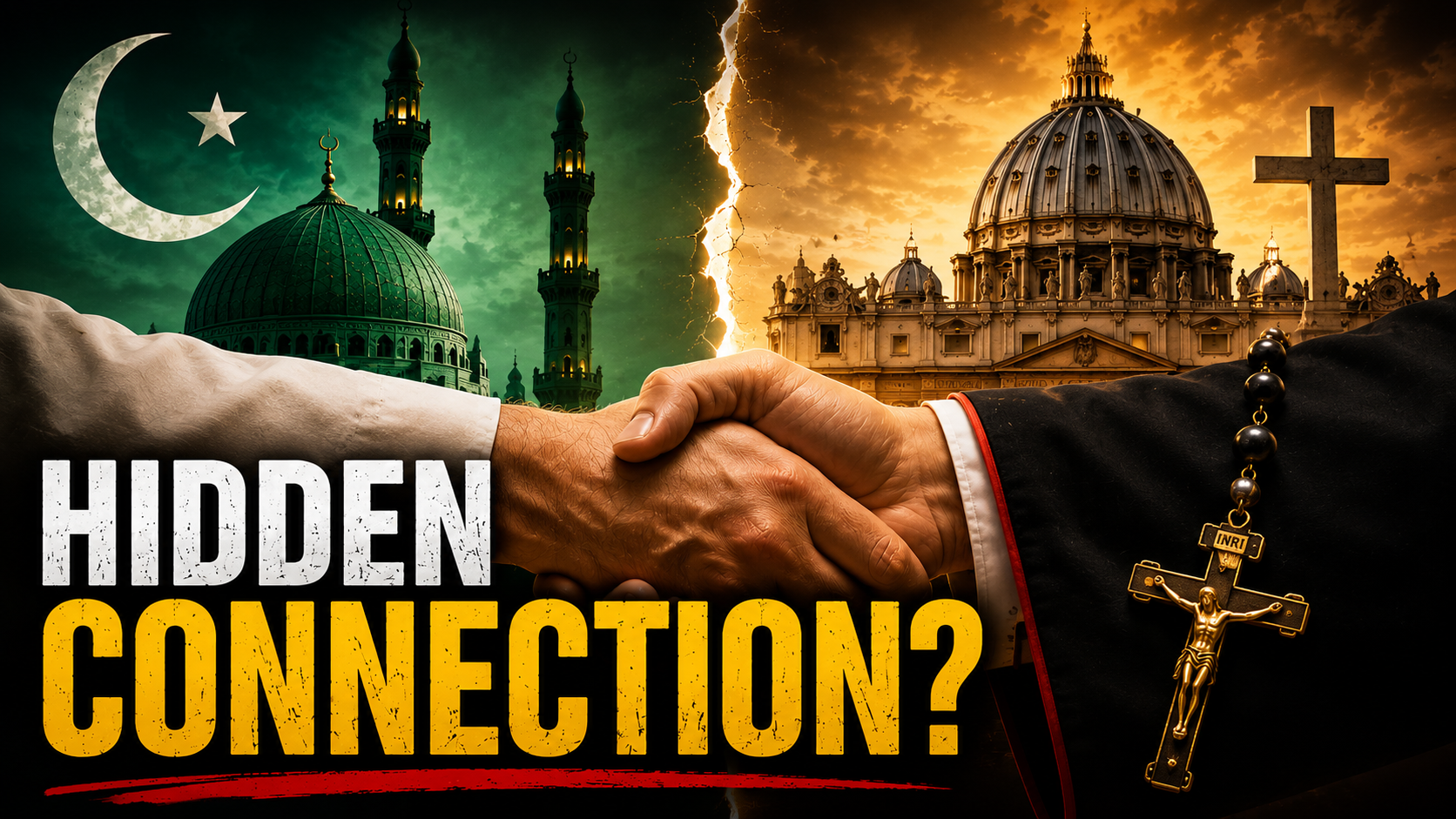
Islam and Catholicism: The Religious Connection and the Coming Sunday Law
The relationship between Islam and Catholicism raises questions about theology, religious history, prophecy, and the role these two major religious systems could play in future events. Although they appear very different on the surface, a comparison of their teachings reveals similarities that suggest a deeper theological connection.
One place to begin is by comparing the Bible with the Quran.
The Bible presents itself as a historical book containing extensive accounts of nations, kingdoms, individuals, and events. Much of this history has been examined through archaeology, particularly as archaeological discoveries in the Middle East have uncovered evidence connected with biblical locations and civilizations.
The Bible is also a book centered on salvation and prophecy. Its prophecies contain specific kingdoms, powers, events, and timelines that ultimately point toward the establishment of the Kingdom of God.
The Quran is different in this respect. While it describes events, Allah, and the relationship between Allah and humanity, it does not contain the same type of prophetic timelines found throughout the Bible.
One of the greatest differences concerns Jesus Christ.
The Identity of Jesus
The central figure of the Bible is the Messiah. Biblical prophecy points toward the Messiah, His mission, and His role in salvation. The New Testament identifies this Messiah as Jesus Christ.
The Bible presents Jesus as more than a prophet. He is presented as divine.
The Gospel of John declares that in the beginning was the Word, that the Word was with God, and that the Word was God. Jesus is therefore presented as the Creator and as the divine Messiah.
Islam recognizes Jesus, but only as a prophet. His mother, Mary, is also given an extremely prominent position in the Quran.
This creates one of the fundamental differences between biblical Christianity and Islam. The Bible presents Jesus as divine and central to God’s plan of salvation, while Islam rejects His deity.
However, when Islamic theology is compared with Catholic theology, similarities begin to emerge.
The Question of Atonement
One of the strongest connections presented between Islam and Catholicism concerns the atonement.
Islam rejects the idea that Jesus needed to sacrifice His life as payment for humanity’s sins. Allah does not require such a sacrifice because forgiveness can be granted by decree.
Catholicism is presented as reaching a similar conclusion through a different theological system.
Under this understanding of Catholic teaching, Christ provided a perfect sacrifice through obedience but did not personally take the full penalty for an individual’s sins. The existence of purgatory means that individuals must still undergo punishment or purification associated with their sins.
This creates an important theological similarity.
In biblical Christianity, Christ is the sin bearer. The wages of sin is death, and Christ takes that penalty upon Himself.
Islam rejects this concept of atonement, while Catholicism is presented as undermining the same principle through its teachings concerning personal sin and purgatory.
Therefore, although the two religions appear different, they arrive at similar theological positions concerning the atonement.
Mary in Islam and Catholicism
Another connection involves Mary.
The Quran elevates Mary above other women and gives her an extraordinary position within Islam. Catholicism similarly places Mary in an extremely prominent religious position.
This connection becomes particularly interesting when considering Fatima.
Fatima has become one of the most famous Marian locations within Catholicism. At the same time, Fatima is also an important name within Islamic history.
There are also places in the Middle East where Muslim pilgrims reportedly visit shrines associated with Mary and communicate their wishes to her.
These practices create another similarity between the two religious systems.
The connection therefore goes beyond a single theological teaching. Similarities appear concerning Mary, Jesus, salvation, and the attributes assigned to God.
Are the Two Systems Connected?
The argument ultimately presented is that the God described within Islam possesses attributes similar to the portrayal of God within Catholic theology.
However, this portrayal is considered different from the God revealed in the Bible.
From this perspective, Islam and Catholicism may appear to be opposing religious systems while nevertheless sharing important theological foundations.
The similarities are significant enough to raise the possibility that the two systems are related and that one may even have influenced or given birth to the other.
This becomes particularly important when biblical prophecy is brought into the discussion.
The books of Daniel and Revelation describe religious and political powers that would influence the world. They also describe a corrupted form of Christianity emerging and exercising enormous authority.
The Protestant Reformers historically identified the papal system with the Antichrist power described in biblical prophecy.
If Islam possesses theological similarities to Catholicism, then its relationship with Catholicism becomes significant when considering future prophetic events.
Islam and the Coming Sunday Law
One of the biggest questions concerns what Muslims would do if Sunday observance were eventually enforced.
At first, Islam might appear to present an obstacle to worldwide Sunday observance because Friday holds special religious significance for Muslims.
However, Friday within Islam is described primarily as a time for congregational prayer rather than a biblical-style Sabbath rest day.
Human society still operates around established weekly patterns of commerce, banking, employment, and rest.
The argument presented is that much of the Muslim world has already accepted Sunday as a practical rest day in areas such as commerce and banking.
If that is true, there would be no fundamental obstacle preventing Muslims from eventually accepting Sunday observance.
This becomes especially significant within the prophetic interpretation that identifies enforced Sunday observance with the mark of the beast.
The Abrahamic Connection
Another important development involves increasing cooperation between Judaism, Christianity, and Islam under the banner of their shared connection with Abraham.
This movement is presented as evidence that Islam is already moving into a religious union with Catholicism.
The architecture and religious symbolism associated with modern Abrahamic religious projects are described as being based primarily on Catholic rather than Protestant Christianity.
From this perspective, the movement is not leading Muslims toward biblical Christianity. Instead, it is bringing different religions together under a religious structure heavily influenced by Catholicism.
That becomes important when considering the prophetic warning against accepting the authority represented by the mark of the beast.
If Muslims already recognize Sunday within commercial and social life and are simultaneously participating in greater interfaith cooperation, there would be little preventing the Islamic world from eventually participating in a worldwide Sunday system.
Coming Out of Religious Deception
The message is not directed only toward Muslims.
Catholics, Muslims, Jews, Hindus, Buddhists, occultists, shamans, and people belonging to every other religious system are presented as needing to examine their beliefs according to Scripture.
The biblical message is to come out of religious systems that conflict with biblical truth.
Muslims therefore must come out of theological deception just as Catholics must come out of theological deception.
The same principle applies to every religion.
The purpose is ultimately presented as salvation rather than condemnation. God seeks to reach individuals regardless of the religious system in which they were raised.
Dreams and visions are also presented as one method through which God may be reaching people who otherwise would be extremely difficult to reach.
This is connected with the prophecy of Joel concerning people receiving dreams and visions.
The Sabbath and the Final Conflict
The issue ultimately returns to the Sabbath.
The seventh-day Sabbath represents God’s creative and redemptive authority. According to the biblical account, God created the world and rested on the Sabbath.
Keeping the Sabbath therefore declares that God is the Creator.
It also represents His redemptive power.
This creates the central conflict between the biblical Sabbath and an enforced Sunday observance.
Under this prophetic interpretation, Sunday legislation will eventually become more than a question of choosing one day over another. It will become a question of religious authority.
When Sunday laws are enforced, people from many different religions may ultimately accept Sunday worship.
Muslims would not necessarily be an exception.
Because Islam does not possess a weekly rest day comparable to the biblical Sabbath, and because Sunday has already been incorporated into commercial and banking practices throughout parts of the Muslim world, Islam could participate in a worldwide Sunday system.
The theological similarities between Islam and Catholicism therefore take on prophetic significance.
Both systems are presented as differing from biblical Christianity concerning fundamental questions involving Jesus Christ, His divinity, the atonement, Mary, salvation, and the character of God.
What initially appears to be a conflict between two completely separate religions may therefore conceal substantial theological similarities.
And as worldwide religious cooperation continues to develop, those similarities could become increasingly important.
The ultimate issue presented is not simply Islam versus Christianity or Islam versus Catholicism.
It is a conflict over biblical authority, the identity and divinity of Jesus Christ, the meaning of His sacrifice, the Sabbath, and which religious authority humanity will ultimately choose to follow.