Laura Ingalls Wilder did not write a seminar. She wrote a childhood. She wrote cold winters, a fiddle in a small room, a mother who kept order with her hands, a father who hunted and built and moved his family because the land still promised something if a man was willing to work it. She wrote faith without a press release.
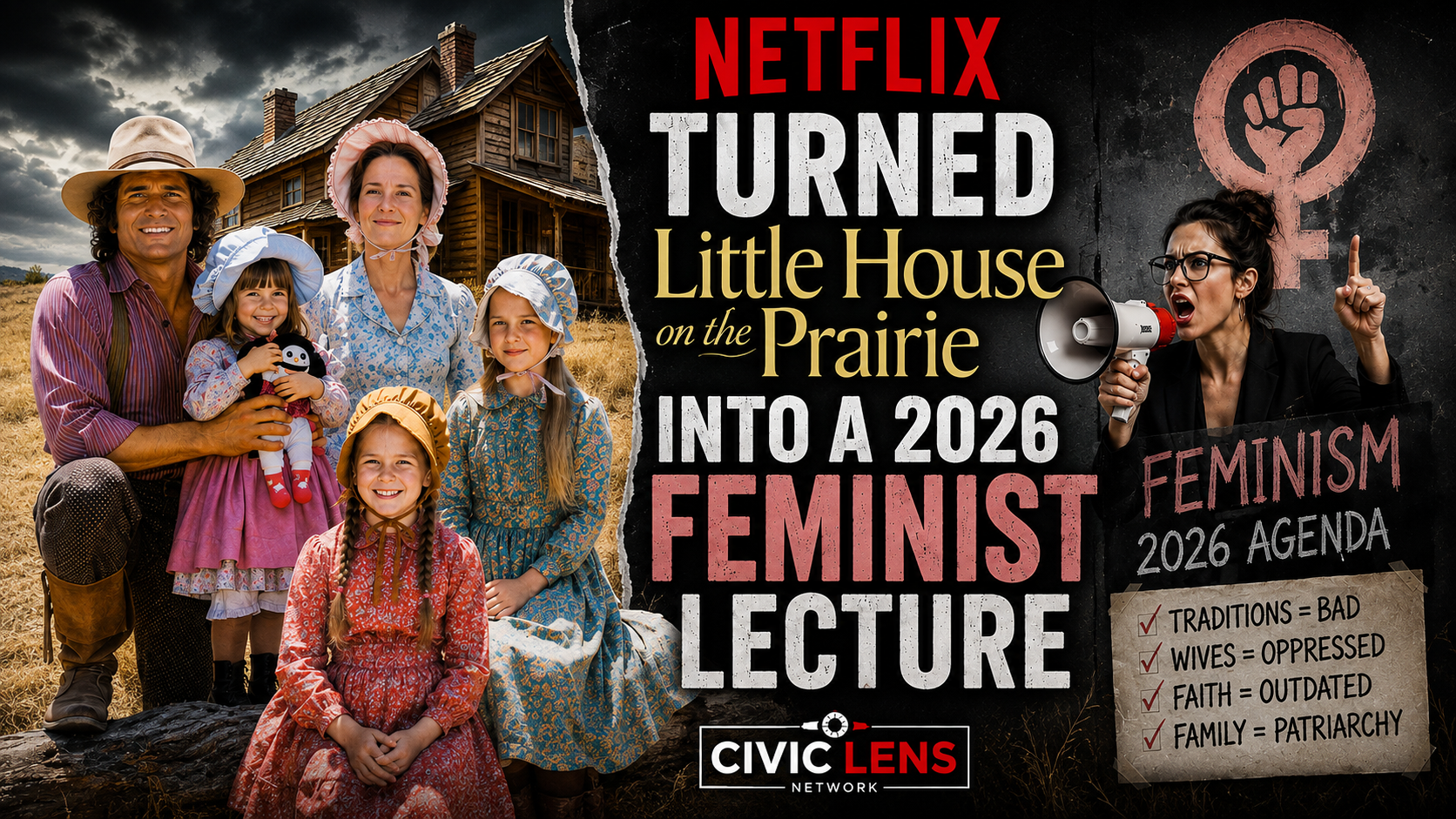
She wrote a girl who watched the world and learned what it cost. That is the book people kept for almost a century. That is the story parents put in their children’s hands because it felt like America before the lecture hall got hold of it. Netflix premiered its new Little House on the Prairie on July 9, 2026, and the people who made it want credit for reverence.
They talk about the books. They talk about history. They talk about “reckoning.” What they delivered is not Wilder’s prairie.
It is a 2026 product with bonnets on it. It is a remake that treats the original as raw material for a modern sermon about women, power, prejudice, and the supposed sins of the people who settled the country. Call it what it is. Hollywood took an all time loved classic and ran it through the same machine that has been chewing up every other American story until the old meaning is gone and only the talking points remain.
This is not a small update. This is a change of ownership. The books belong to a child’s memory of her family. Pa is the engine.
Charles Ingalls is not a supporting actor in his own house. He is the man who decides to go west, who puts a roof over heads, who plays the fiddle when there is nothing else to give. Ma is not a mascot and she is not a doormat. Caroline Ingalls is steel in a dress.
She keeps the home civil when the country is still wild. She teaches manners, faith, work, and restraint. Laura watches both of them and grows. That is the shape of the story.
Father, mother, daughters, hardship, grit, God, and land. The new series moves the center of gravity. The people in charge said it out loud. Women wrote six of the eight first season episodes.
Women directed the whole first season. The showrunner, Rebecca Sonnenshine, has said the West was not settled by men with guns and that women were the backbone. She has talked about marriages of equality and about not falling back on what she calls tropes of masculinity. That is not an adaptation note.
That is an agenda note. It tells you the target. The target is the old picture of a father who leads and a mother who builds the inner life of the home. The new picture wants Ma as the real protagonist and Pa as a handsome accessory who learns the correct modern lessons.
Watch how they rewrite Caroline. In the books she is devout, practical, and loyal. She follows her husband into danger because that is what a family did when survival was the job. She is not silent.
She is not weak. She is not waiting for a 2026 writer to “empower” her. The new Ma is sold as newly strong, as if strength did not already live in a woman who buried children, cooked over fire, sewed until her fingers split, and held a household together with almost nothing. The series needs you to see her snapping and correcting and standing over the old order so the audience can clap.
One of the early signals is the refusal of the old domestic rhythm. The point is not breakfast. The point is the pose. She must not look like the woman Wilder wrote.
She must look like a rebuttal to the women the culture now mocks as traditional. That is the feminism they are pushing. Not the plain fact that pioneer women worked themselves raw. Everybody who read the books already knew that.
The push is ideological. It is the belief that a classic is unsafe until the women lecture the men, until marriage is recast as a partnership seminar, and until the audience is trained to see the old family as a problem to be fixed. In 2026 that is the house style. Take a story that honored fathers and mothers in their different work.
Flatten the difference. Call the flattening “truth.” Call the protest “fear.” They aged the girls up too.
In the book that gives the series its name, Laura is a little child and Mary is not far ahead of her. The Netflix Laura is about ten and Mary about twelve. The producers admit the reason is labor rules for child actors. Convenient.
Older girls can carry speeches. Older girls can “challenge authority,” which is how the new Laura is described. Curious is fine. Strong willed is fine.
Wilder’s Laura had both. What they want is a junior activist with dirt on her dress. They want a child who already sounds like she has been to the right classrooms. A four year old looking at the prairie with wonder does not deliver the program.
A ten year old with a “deep sense of justice” does. Then come the additions that tell you who the show is for. The books have the Ingalls living on land that was Osage land. Wilder’s pages are a child’s view, incomplete, sometimes harsh by later standards, and later punished for it when her name was stripped from an award.
A serious adaptation could have handled that with adult honesty: settlers wanted land, tribes were already there, the government played both sides, and the result was tragedy and nation building at the same time. That is history. What streaming television prefers is a second family installed as the moral chorus. The series invents and expands Osage figures such as Good Eagle, White Sun, and Mitchell so the prairie is no longer seen through Laura’s eyes alone.
The new eyes are there to correct the old ones. The Ingalls may still suffer weather and hunger, but the spiritual plot is about prejudice being challenged on schedule. Faith gets crowded out too. The old books and the old series treated church, prayer, hymns, and the minister as part of the air people breathed.
The new show keeps a moral vocabulary and drops most of the religion that formed it. Golden Rule without the pulpit. Empathy without Sunday. That is not how those people lived.
It is how 2026 writers live. They will take the fruit and deny the root. They want the warmth of a Christian culture and none of the authority. A pioneer family without a living faith is a costume party.
None of this happened by accident. Netflix ordered the series in 2025. The same people who cannot leave a Western alone, cannot leave a Christmas story alone, and cannot leave a children’s classic alone got their hands on the Ingalls wagon. They announced a “reimagining.”
That word is a confession. You reimagine what you do not trust. You adapt what you respect. When they say they must reckon with “problematic” parts of the books, they are telling you the author is on probation.
Laura Ingalls Wilder is allowed to furnish the cabin and the grass and the names. She is not allowed to furnish the meaning. The 1974 series with Michael Landon was already a television invention. It moved the family, added plots, and preached its own sermons.
Plenty of those sermons look like modern social issue television because that is what network drama did. People who love that show are free to love it. But even that show still believed in a father at the center, a family as the unit of meaning, and a country that was hard and worth the hardness.
The new series is aimed at a different country, the one that thinks 1869 Kansas is mainly a crime scene and that the job of art is to put the settlers in the dock. Look at the language around the launch. The prairie is “updated.” Ma is “empowered.”
New Black and Native characters are there to “challenge prejudices.” Women settled the West. Masculinity is a trope. Changing your mind is the point.
That is not how a faithful dramatist talks. That is how a program officer talks. The year is 2026, the nation’s 250th year is in the air, and the last thing the current taste makers want is an unembarrassed story about a White Protestant family taking land, keeping Sabbath, raising daughters, and calling it a good life. So the good life has to be supervised.
The family may remain likable. The likability is the bait. The lesson is the hook. They even know the fight they started.
Before a single episode streamed, the project was already wrapped in the same argument that now attaches to every remake. One side said do not turn this into another lecture. The other side said the lecture was always there and you are just now noticing. The production answered by doing what these productions always do.
They widened the cast, shifted the power in the marriage, sanded down the old religion, and congratulated themselves for bravery. Then they acted shocked that millions of people who kept the books on the shelf did not want a new catechism. A classic survives because it tells a people who they were without asking permission. Little House on the Prairie survived because it made poverty look dignifiable and family look necessary.
It made a girl the witness, not the commissar. It made work holy without a speech about systems. The new series cannot stand that simplicity. Simplicity feels like a threat to people whose jobs depend on complication.
If the Ingalls are just a father, a mother, and children trying to live, there is no role for the rewriter. The rewriter needs guilt, imbalance, and a missing chorus of the approved oppressed. So the chorus is hired, the mother is promoted, the father is softened, the child is aged, and the church goes quiet. This is how a culture loses its memory.
It does not ban the old books first. It films them “better.” It keeps the title so your mother will click play. It keeps the grass so the pictures look expensive.
It keeps a fiddle so the trailer can lie. Then it teaches your children that the real story was always about power and that the people who loved the old version were naive or worse. That is the 2026 agenda in a sunbonnet. Not a law.
A mood. A capture of the inheritance. You can put Osage lives on screen without turning Laura into a defendant. You can show a Black doctor without turning the town into a diversity brochure.
You can show a strong wife without treating the husband’s leadership as a problem to be solved. Wilder already wrote strong women. She wrote them inside a world of sex, duty, scarcity, and God. The new makers do not want that world.
They want our world in old clothes. They want the prairie as a backdrop for the same argument you can get from any streaming drama set in a city loft. Season two was ordered before the first season even aired. That tells you the institution had already decided the rewrite was correct.
The wagon is rolling toward Minnesota next, toward Plum Creek, toward Nellie Oleson on a delay. The machine will keep going as long as the title still prints money. Titles like this always print money at first because the audience comes home hoping to see the house they remember. Some will stay for the scenery.
Some will stay because they have been trained to call every objection bigotry. The rest will feel the theft and not be able to name it. Name it. They did not fail to copy a few chapters.
They replaced the moral architecture. The books say a family is the first government and that a man and a woman together can make a life out of almost nothing. The new series says the old family is incomplete until modern politics arrives to finish it. That is why Ma has to overshadow Pa.
That is why Laura has to sound like a junior reformer. That is why the neighbors have to be redesigned as a lesson plan. That is why faith is a garnish. Feminism here is not “women are capable.”
Women on the prairie were capable in ways that would put most of us to shame. Feminism here is the insistence that the story cannot be itself. It must be a correction of itself. America is full of people who still want the thing Wilder made.
They want dirt, winter, Scripture, a father’s promise, a mother’s standard, and a girl who learns by living, not by being handed the right opinions. They wanted a remake that trusted those things. They got a committee with a research packet. They got Winnipeg standing in for Kansas and 2026 standing in for 1869.
They got a beloved classic used as a delivery system. If you want Little House on the Prairie, the books are still there. The sentences still work. The cold is still cold and the fiddle still means more than a speech.
What Netflix put on the screen is a different country pretending to be the old one. Do not let the title confuse you. The little house is still in the pictures. The prairie they built is a set.
The soul they sold you is a 2026 product, feminist in the current sense, liberal in the current sense, and loyal first to the people who cannot stand an American story until they have rewritten the family that lived it.