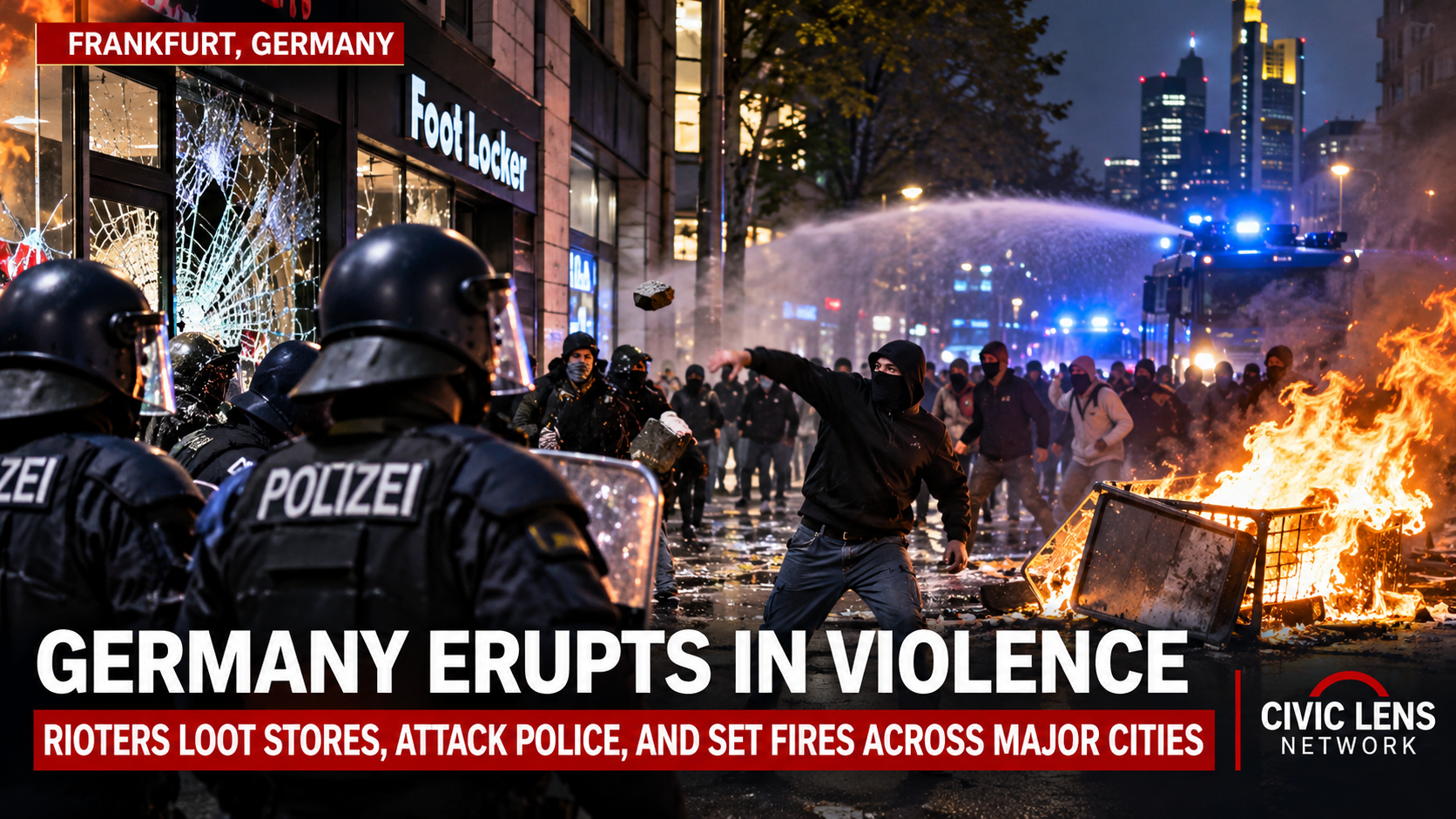
FRANKFURT, GERMANY — Germany became the latest European nation to experience violent street unrest Saturday as masked rioters smashed storefronts, looted businesses, set fires, and attacked police officers during a night of chaos that spread beyond the financial capital of Frankfurt.
What began as nationwide demonstrations over rising living costs, government spending, education, and military service descended into violent confrontations in several major German cities.
Police deployed water cannons, armored vehicles, helicopters, and drones as groups of rioters hurled rocks, fireworks, bottles, and incendiary devices at officers attempting to restore order.
The violence comes as neighboring France struggles with its own episodes of destructive unrest, raising troubling questions about the growing instability spreading across parts of Europe.
Frankfurt Becomes the Center of the Violence
Frankfurt, one of Europe’s most important financial centers, experienced some of Saturday’s worst disturbances.
Masked individuals smashed windows along the city’s busy Zeil shopping district, breaking into stores and stealing merchandise.
At least two businesses were looted, while several others suffered damage.
A shoe store was among the businesses targeted. Authorities also responded to an attack on a weapons shop, where officers recovered two weapons and detained several individuals.
Police sealed off portions of the city center, including the Hauptwache and Konstablerwache areas, as confrontations continued into the evening.
Videos and eyewitness accounts described fireworks exploding near police lines, burning trash containers, overturned barricades, and groups of young people moving through the streets.
Emergency personnel faced particularly dangerous conditions as rioters reportedly threw Molotov cocktails and other projectiles toward officers.
Several police officers were injured.
The scenes were a dramatic departure from the peaceful demonstrations that had taken place earlier in the day.
Tens of Thousands Protest Across Germany
The nationwide demonstrations were organized primarily by youth-oriented groups, including Gen Z regelt, a movement whose name roughly translates to Gen Z Takes Charge.
Events were planned across 34 German cities, including Berlin, Frankfurt, Munich, Cologne, and Hamburg.
Organizers had anticipated more than 160,000 participants nationwide, although early police estimates suggested actual turnout was considerably lower.
In Frankfurt alone, approximately 8,000 demonstrators participated in the largely peaceful afternoon march.
Their demands included increased funding for schools and universities, relief from rising living costs, improvements to public services, and opposition to compulsory military service.
Many young Germans argue that government policies are placing an increasingly heavy financial burden on their generation.
Germany’s economic difficulties, aging population, and pressure on public finances have intensified those concerns.
However, legitimate economic grievances do not explain or justify the destruction that followed.
Peaceful demonstrations and violent attacks on businesses and police are fundamentally different activities.
Officials Warn of Far-Left Extremist Involvement
German authorities had warned before Saturday’s demonstrations that extremist organizations might attempt to exploit the gatherings.
Those concerns appeared increasingly significant as the violence unfolded.
Hesse Interior Minister Roman Poseck said authorities believed approximately 100 individuals motivated by left-wing extremism had participated in attacks against police in Frankfurt.
He described officers being targeted with bottles, stones, and pyrotechnics.
Federal authorities had previously identified participation by elements of Germany’s far-left extremist scene in efforts to mobilize support for the demonstrations.
The involvement of extremist groups raises an important question: Were legitimate protests being used as an opportunity by violent activists seeking confrontation with authorities?
That distinction matters.
The majority of demonstrators were not involved in the violence, and organizers publicly distanced themselves from the destruction.
Local reporting indicated that many of the young people involved in the later disturbances had not participated in the original protest march.
Nevertheless, the ability of violent groups to exploit large public gatherings presents a serious challenge for German authorities.
Germany Faces Scenes Already Familiar in France
The violence comes against a backdrop of growing unrest across Europe.
France has experienced repeated demonstrations that escalated into rioting, vandalism, and looting.
German officials had already expressed concerns that similar scenes could unfold in their own cities.
The parallels became difficult to ignore Saturday night.
Boarded-up storefronts, police water cannons, masked rioters, and burning barricades have become increasingly familiar images in European coverage.
But the causes and participants are not necessarily identical from one country to another.
In Germany, Saturday’s demonstrations centered on economic concerns, education funding, and opposition to compulsory military service.
Authorities specifically raised concerns about far-left extremists exploiting the protests.
The broader question is whether European governments can address legitimate public dissatisfaction while preventing violent organizations from turning demonstrations into destructive confrontations.
Businesses Pay the Price
For business owners, the political arguments surrounding the demonstrations offer little comfort when their windows are smashed and merchandise disappears.
Some retailers anticipated trouble before the demonstrations even began.
Businesses in major shopping districts boarded up windows or closed early in an attempt to protect their property.
In Berlin, stores along the well-known Kurfürstendamm shopping boulevard took precautions ahead of the planned gatherings.
Those preparations illustrate how the threat of civil unrest can disrupt ordinary commercial activity even before violence begins.
Workers lose hours, businesses lose revenue, and property owners face expensive repairs.
The consequences are especially frustrating when businesses have no direct involvement in the political disputes driving the demonstrations.
When authorities cannot guarantee the safety of commercial districts, public confidence in law enforcement and government leadership can suffer.
German Police Face Growing Pressure
The response to Saturday’s disturbances involved substantial police resources.
In Frankfurt, authorities deployed water cannons, armored vehicles, aerial surveillance, and additional officers to contain the disorder.
The decision to disperse the original demonstration followed reports of repeated attacks involving stones and pyrotechnics.
Yet ending the march did not immediately end the violence.
Groups continued confronting police and damaging property in surrounding streets.
The attacks placed officers in dangerous circumstances while forcing authorities to balance public safety with the legal right to peaceful assembly.
Germany’s constitutional protections allow citizens to demonstrate against government policies.
Those protections do not extend to assaulting police officers, looting stores, or destroying private property.
Officials now face pressure to identify those responsible and determine whether the violence was coordinated by organized extremist networks or developed through smaller groups acting independently.
Frankfurt police have appealed for photographs and videos from witnesses to help identify individuals involved in property crimes and attacks on officers.
A Generation Angry With Its Government
Behind the violent headlines lies a broader political problem.
Many younger Europeans increasingly believe their governments are failing to provide affordable housing, reliable public services, economic opportunity, and a secure future.
Germany’s younger generation faces growing concerns about educational infrastructure, economic stagnation, and the financial burden of supporting an aging society.
Military service has become another source of controversy as European governments reassess defense requirements amid continuing international tensions.
For some young Germans, the prospect of compulsory service represents another obligation being imposed by political leaders who have failed to address their existing concerns.
These frustrations have helped fuel demonstrations across Europe.
But violent extremists can undermine those demands by transforming political protests into public disorder.
Instead of debating education funding or economic policy, the public is left watching police confront rioters and businesses clean up shattered glass.
What Happens Next?
As Germany assesses the damage from Saturday’s unrest, several questions remain unanswered.
Authorities must determine how many people participated in the violence, how many officers and civilians were injured, and whether additional arrests will follow.
Investigators will also need to establish the extent of extremist involvement and whether particular groups deliberately organized attacks.
For Chancellor Friedrich Merz and Germany’s political leadership, the unrest presents another challenge during an already difficult economic and political period.
The government must address public dissatisfaction without allowing violent groups to dictate events on the streets.
Germany’s Halloween demonstrations began with demands for better living conditions and greater political accountability.
They ended with smashed windows, looted businesses, injured police officers, and streets filled with emergency vehicles.
The lesson extends beyond Germany.
A democratic society must protect the right to peaceful protest. But when demonstrations become opportunities for violence, intimidation, and destruction, the people who ultimately suffer are often ordinary citizens who had nothing to do with the political dispute.
Germany now faces the task of proving that peaceful dissent can be protected while those responsible for criminal violence are held accountable.