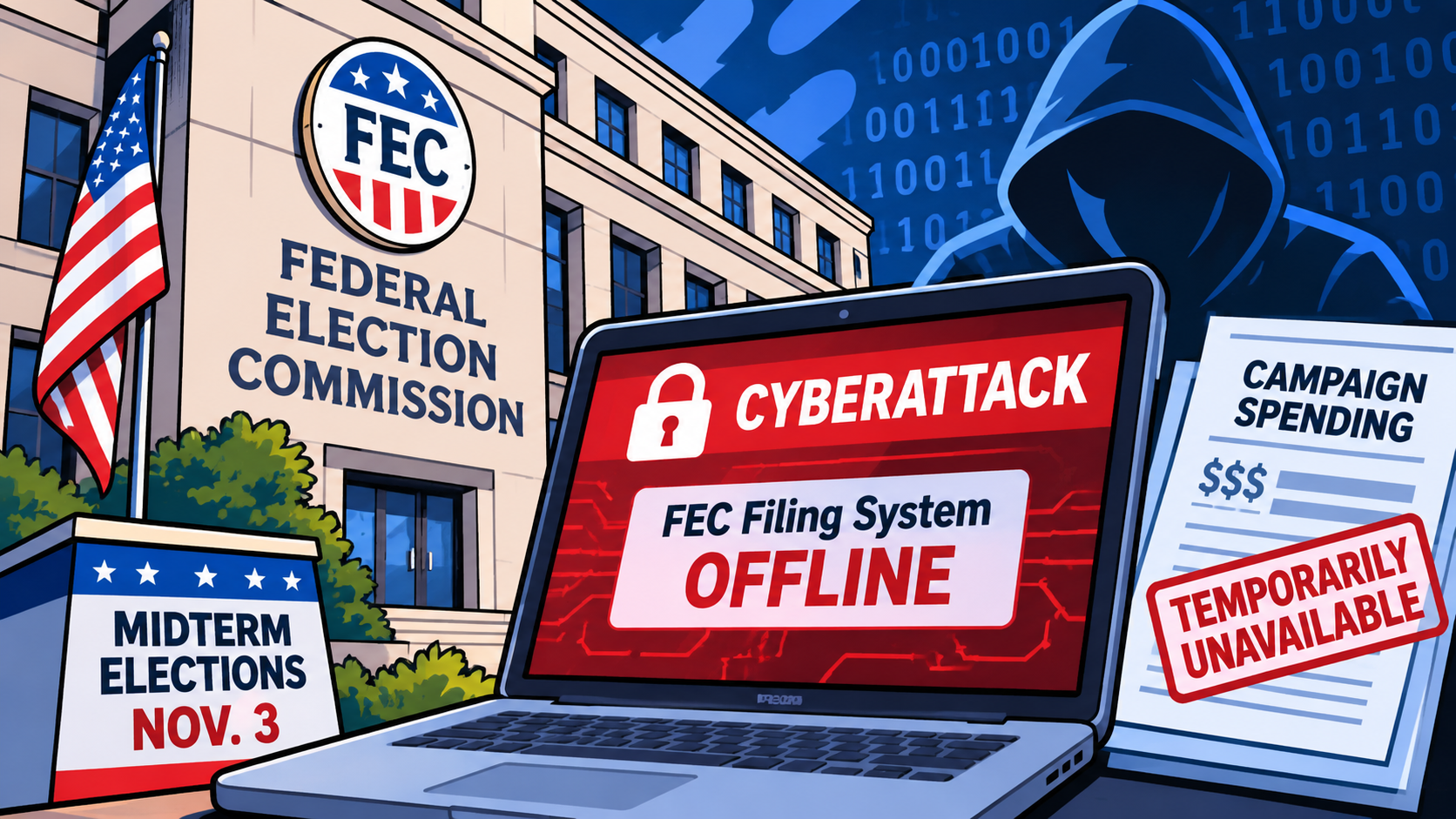
Just days before Americans head to the polls for the November 3 midterm elections, a cyberattack targeting the Federal Election Commission disrupted one of the nation’s most important political transparency systems, temporarily preventing the public from seeing critical information about who is spending money to influence congressional races.
The timing could hardly have been worse.
As political organizations poured tens of millions of dollars into last-minute campaign advertising, the federal government’s electronic reporting system went offline for nearly 41 hours, leaving watchdog organizations, journalists, and voters without timely access to new campaign spending disclosures.
The system was restored Wednesday, October 28, but serious questions remain about who was responsible for the attempted intrusion, whether sensitive information was compromised, and how a critical federal transparency system could become unavailable during the final days of a national election.
A Cyberattack at the Worst Possible Moment
The disruption began Monday evening, October 26, when the Federal Election Commission reported major problems affecting its electronic filing services.
According to an internal communication reviewed by reporters, an unidentified malicious actor had attempted to breach the agency’s computer systems.
Federal officials responded by temporarily shutting down public-facing services to contain the potential threat.
While taking systems offline can be a necessary cybersecurity precaution, the decision had immediate consequences for political transparency.
The FEC requires campaigns, political action committees, and other organizations to disclose certain contributions and expenditures. During the final days before an election, some of those disclosures must be submitted within just 24 or 48 hours.
With the electronic filing system unavailable, organizations could not submit those reports through the normal process.
Previously filed information remained accessible through portions of the agency’s website, but the flow of new spending information was interrupted.
That distinction matters.
The incident did not erase millions of dollars from campaign accounts or establish that financial records had been stolen. Instead, it temporarily prevented new disclosures from becoming available to the public at precisely the moment those disclosures were most important.
More Than $50 Million Being Spent Every Day
The scale of political spending surrounding the 2026 midterm elections makes the outage particularly troubling.
According to campaign finance research organization OpenSecrets, super PACs and other outside political groups had been spending an average of more than $50 million per day during the week preceding the incident.
On October 20 alone, more than $250 million in political spending was reported.
Those figures illustrate just how much financial activity can occur in a relatively short period during the final stretch of a national election.
Super PACs are permitted to raise and spend unlimited amounts of money independently to support or oppose political candidates.
Other politically active organizations can operate under disclosure rules that make identifying their original financial backers considerably more difficult.
When reporting systems function properly, voters can examine available disclosures to better understand which organizations are financing advertisements, political messaging, and efforts to influence congressional races.
When those systems fail, the public loses some of that visibility.
Even a temporary interruption can become significant when Election Day is approaching and millions of dollars are moving through the political system.
Who Benefits When Political Spending Becomes Harder to Track?
The most troubling aspect of this incident is not simply that a government computer system experienced a cybersecurity emergency.
It is that the disruption occurred during one of the most financially intense periods of the election cycle.
Political organizations often reserve substantial advertising expenditures for the final days before voting, when campaigns are attempting to influence undecided voters and increase turnout.
These advertisements can reach millions of Americans through television, streaming services, digital platforms, and social media.
Knowing who is financing those messages allows voters to evaluate the interests behind them.
When financial disclosures are delayed, political organizations may continue advertising while the public has less timely information about the money supporting those efforts.
That creates a serious transparency problem.
However, there is an important distinction between the consequences of the outage and the intentions of whoever attempted the intrusion.
Investigators have not publicly established that the attacker intended to conceal political spending. There is also no verified evidence that a particular political party, campaign, or donor organization orchestrated the incident.
The interruption nevertheless demonstrates how a cyberattack can undermine election transparency without changing a single vote.
Federal Officials Have Not Identified the Attacker
Despite the seriousness of the incident, important details remain unresolved.
The Federal Election Commission has not publicly identified the individual or organization responsible for the attempted breach.
Officials have also not provided a complete public explanation of the technical vulnerability involved or established that hackers successfully accessed sensitive information.
The FBI and the Cybersecurity and Infrastructure Security Agency referred questions about the incident to the FEC.
The lack of detailed information has created uncertainty about the scope of the attempted intrusion.
Was the attack financially motivated?
Was it an attempt to steal sensitive political information?
Was the timing connected to the upcoming elections?
Or was the incident an opportunistic attack against a vulnerable government system?
At this stage, those questions remain unanswered.
Any suggestion that the attack was directed by a political organization or foreign government would require evidence that has not been publicly established.
A Federal Election Agency Already Facing Serious Problems
The cyberattack also exposed vulnerabilities at an agency that has experienced significant institutional difficulties.
The Federal Election Commission is responsible for enforcing federal campaign finance laws and maintaining public records of political fundraising and spending.
However, the agency has lacked the four commissioners necessary for a voting quorum since May 2025.
By October 2025, only two commissioners remained in office.
Without a quorum, the commission cannot take certain official actions, including voting on enforcement matters, adopting regulations, or approving some agency decisions.
Career employees continue performing routine administrative duties, including processing campaign finance reports.
Nevertheless, the commission’s limited membership raises broader concerns about the federal government’s ability to oversee campaign finance activity effectively.
The cybersecurity incident adds another problem to an agency already facing questions about its operational capacity.
Americans deserve to know whether federal institutions responsible for election transparency have the staffing, leadership, and technological protections necessary to perform their duties.
Did the Cyberattack Affect Actual Votes?
There is currently no evidence that this incident affected voting machines, ballot counting, voter registration databases, or the ability of Americans to cast ballots.
The Federal Election Commission does not administer elections or count votes.
Those responsibilities are handled primarily by state and local election officials.
The FEC instead oversees federal campaign finance reporting and enforcement.
That means the immediate impact of the attack involved financial transparency rather than the mechanics of voting.
Still, election integrity involves more than the physical act of casting a ballot.
It also depends on public confidence that political activity is conducted under established laws and that voters have access to information about the interests attempting to influence their decisions.
A breakdown in financial disclosure systems can damage that confidence even when election equipment remains completely unaffected.
The System Is Back Online, but Questions Remain
The Federal Election Commission restored its electronic filing system Wednesday evening after nearly 41 hours of disruption.
Campaign finance organizations were again able to submit required reports, although some related services required additional restoration work.
The agency also instructed certain users to reset their passwords before returning to the system.
Cybersecurity specialists have noted that temporarily shutting down vulnerable services can be the responsible decision when officials are uncertain about the extent of an attempted intrusion.
Preventing unauthorized access and protecting the integrity of government records must remain priorities.
But restoring a website is not the same as providing a complete public accounting of what happened.
Americans still deserve answers about the origin of the attempted attack, the extent of any unauthorized access, and whether additional protections are being implemented.
The government should also explain what safeguards exist to ensure mandatory campaign finance disclosures remain accessible during future cybersecurity emergencies.
Election Transparency Should Never Depend on a Single Vulnerable System
The broader lesson from this incident is difficult to ignore.
In an election cycle involving billions of dollars in political advertising, a disruption lasting less than two days was enough to interrupt the public’s ability to follow some of the money influencing federal campaigns.
That is a vulnerability worth addressing regardless of political affiliation.
Republicans, Democrats, independent candidates, journalists, and ordinary voters all depend on accurate campaign finance records.
The public should not have to wonder whether important financial disclosures will become unavailable during the most consequential days of an election.
Congress and federal oversight authorities should demand a thorough explanation of the incident and examine whether stronger cybersecurity protections, backup filing procedures, and emergency disclosure systems are necessary.
The November 3 midterm elections are now just days away.
While there is no established evidence that this attack changed votes or was designed to benefit any political organization, the disruption revealed a weakness in the nation’s election transparency infrastructure.
The central question is no longer simply how the FEC’s filing system went offline.
It is whether the federal government will take the necessary steps to ensure that Americans can always see the political money flowing through their elections, especially when that information matters most.