November 2, 2026
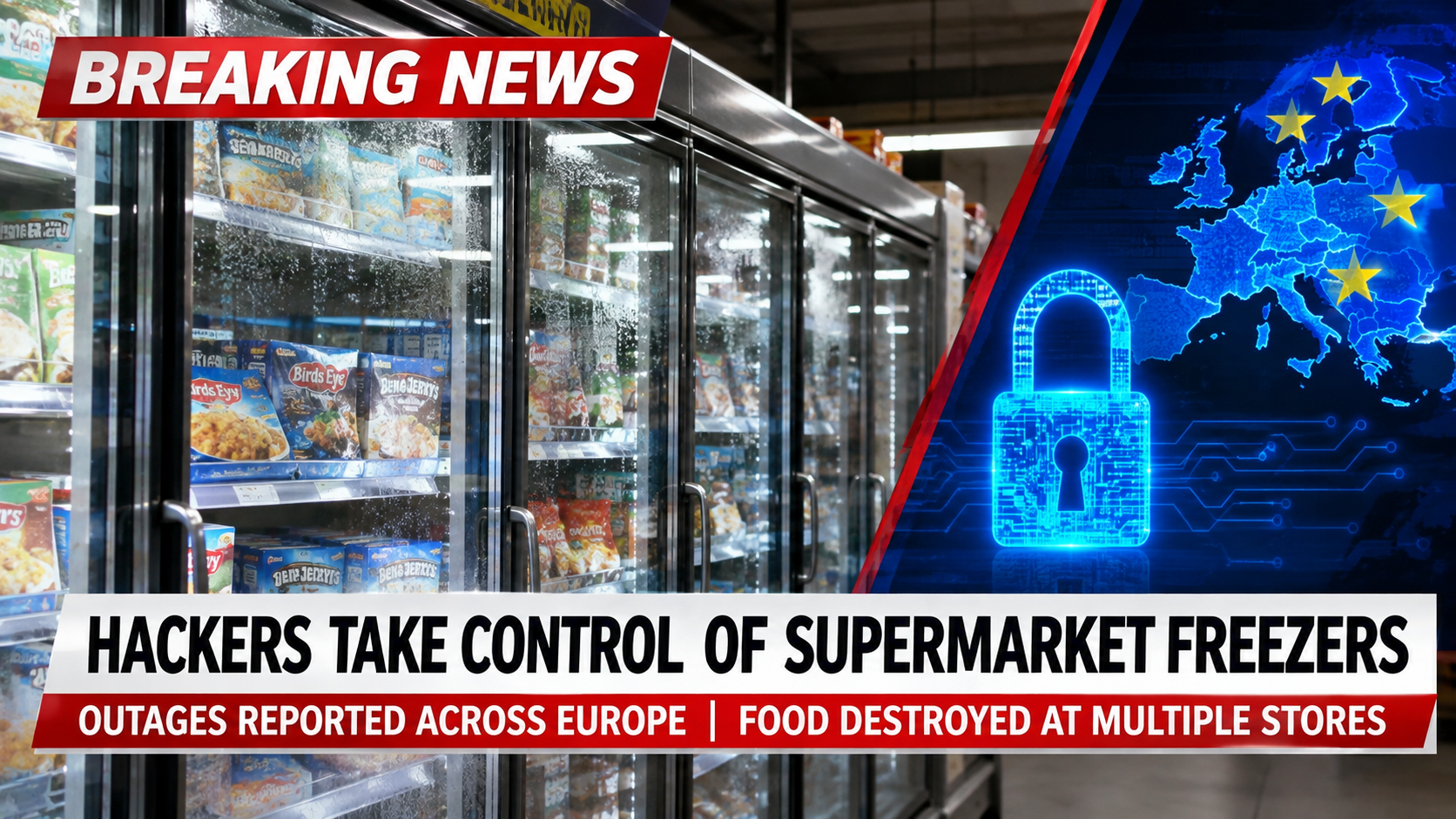
A disturbing wave of cyberattacks is sweeping across European supermarkets, and this time hackers are not simply stealing passwords, demanding ransom payments, or accessing confidential information.
They are reportedly taking control of refrigeration systems, remotely changing temperatures, and destroying food before store employees can stop the damage.
Supermarkets in Sweden, Belgium, Luxembourg, Ireland, and Estonia reported refrigeration disruptions on Monday, November 2, in incidents that have raised serious questions about the security of Europe’s food distribution infrastructure.
At one Swedish supermarket, refrigerators and freezers were reportedly manipulated to reach an astonishing 122 degrees Fahrenheit.
That is not a refrigeration failure caused by an ordinary power outage. It is the equivalent of turning equipment designed to preserve food into machinery capable of ruining thousands of dollars in merchandise.
The incidents come just weeks after a massive cyberattack affected hundreds of supermarkets across France, destroying enormous quantities of refrigerated and frozen food and reportedly causing fires at some locations.
The growing concern is that criminals have discovered a way to attack businesses through the very equipment they depend on to operate.
Hackers Turn Refrigeration Systems Against Store Owners
The latest incidents unfolded overnight Sunday into Monday.
Swedish supermarket chains ICA and Coop reported unexpected temperature increases in refrigeration systems at several locations.
One ICA store in Sjöbo, southern Sweden, publicly reported that its refrigerators and freezers had been hacked and their temperatures set to 50 degrees Celsius, equivalent to 122 degrees Fahrenheit.
The store temporarily closed while employees assessed the damage and worked to remove affected food.
ICA acknowledged that a limited number of its stores had experienced refrigeration disruptions.
Coop also confirmed problems at several locations, with reports indicating that at least six stores experienced similar incidents.
The problem was not confined to Sweden.
In Belgium and Luxembourg, supermarket operator Ahold Delhaize reported refrigeration problems affecting dozens of stores.
Carrefour Belgium confirmed that 15 of its more than 700 locations were affected by a cyberattack targeting refrigeration equipment.
Five Spar stores operated by the Colruyt Group were also reportedly affected.
In Ireland, supermarket operator Musgrave reported refrigeration problems involving a particular equipment model at 13 SuperValu stores.
Affected stores removed chilled and frozen products from sale as employees and technicians worked to determine whether the merchandise remained safe.
In Estonia, refrigeration technology company Kitman Coldtech reported that attackers had accessed a computer controlling a retail refrigeration system and changed its temperature to 50 degrees Celsius.
The company said the incident was addressed within minutes and did not cause significant damage.
Although the extent of damage varied by location, the pattern was alarming.
Equipment responsible for keeping food safe was being manipulated through digital systems.
A Cyberattack That Can Destroy Food Without Entering a Store
Most people associate cybercrime with stolen credit card information, identity theft, and computer systems locked by ransomware.
This attack represents a different type of danger.
Modern supermarkets increasingly rely on internet-connected refrigeration equipment that allows technicians to monitor temperatures, diagnose mechanical problems, and adjust settings remotely.
Those features can reduce maintenance costs and help stores detect equipment failures.
But they also introduce potential vulnerabilities.
If an unauthorized person gains access to a refrigeration controller, that person may be able to manipulate settings without ever entering the building.
According to reporting on the Belgian incidents, attackers switched refrigeration equipment into defrost mode.
Defrost cycles are a normal part of refrigeration maintenance, but improper activation or prolonged operation can cause temperatures to rise and compromise food safety.
For supermarkets carrying large inventories of meat, dairy products, seafood, frozen meals, and other perishables, the consequences can be immediate.
Once products have been exposed to unsafe temperatures, businesses may have no choice but to discard them.
Even when refrigeration equipment can be restored quickly, the financial damage may already be done.
France Was Hit First, and the Damage Was Enormous
The November incidents follow a major attack on French supermarkets in October.
French authorities reported that attackers remotely accessed refrigeration systems at hundreds of grocery stores and manipulated their operating temperatures.
Approximately 700 supermarkets were reportedly affected during the earlier wave.
Major French retailers, including Intermarché, Carrefour, E.Leclerc, Monoprix, and Coopérative U, were among the businesses reporting disruptions.
Some refrigeration systems were reportedly pushed to temperatures reaching 122 degrees Fahrenheit.
In certain cases, food remained exposed to dangerous temperatures for hours.
Businesses were forced to dispose of large quantities of meat, dairy products, frozen goods, and other perishables.
Intermarché reported losses reaching tens of millions of euros across its affected operations.
French prosecutors also reported that fires occurred at some locations during the incidents.
The attacks demonstrated that compromising a relatively ordinary piece of connected equipment could create serious physical and financial consequences.
Authorities launched investigations, while France’s national cybersecurity agency warned businesses about vulnerable refrigeration controllers and exposed remote-access systems.
The November incidents now raise an obvious question.
Was the French attack an isolated event, or has it exposed a weakness that attackers are exploiting across Europe?
Investigators have not established whether the incidents are connected.
Cybersecurity Officials Sound the Alarm
Sweden’s national cybersecurity center is investigating the latest disruptions.
Its leadership has warned that numerous operational technology devices remain exposed to potential attackers.
Operational technology refers to computerized systems that control physical equipment.
These systems are used throughout modern society, including in factories, utilities, transportation networks, hospitals, warehouses, and commercial buildings.
Unlike traditional office computers, compromised operational technology can directly affect machinery and physical processes.
A successful attack may do more than interrupt access to information.
It can damage equipment, halt production, destroy inventory, or create safety hazards.
The supermarket incidents demonstrate that these vulnerabilities are not limited to military installations, electrical grids, or major industrial facilities.
Ordinary grocery stores can become targets.
And because many businesses use similar equipment from the same manufacturers, a vulnerability affecting one system may potentially threaten numerous locations.
Could America’s Grocery Stores Be Vulnerable?
The attacks should attract attention far beyond Europe.
American supermarkets, food warehouses, distribution centers, restaurants, and refrigerated transportation facilities also rely on digitally controlled refrigeration equipment.
Many businesses use remote monitoring systems to manage temperatures, energy consumption, and maintenance requirements.
Those systems offer significant operational benefits.
However, their security depends on proper configuration, timely software updates, restricted access, and protection against unauthorized connections.
The European incidents do not establish that American supermarkets are currently experiencing the same attacks.
They do demonstrate a type of vulnerability that American businesses should take seriously.
A criminal does not necessarily need to steal a customer’s financial information to cause substantial damage.
Manipulating equipment that protects valuable inventory may be enough.
A prolonged disruption at a major refrigerated warehouse could potentially destroy enormous quantities of food.
If similar incidents affected multiple facilities simultaneously, the consequences could extend beyond individual businesses.
The risk is not proof that a nationwide food shortage is imminent.
It is a warning that food distribution systems have become increasingly dependent on technology that must be properly secured.
Who Is Behind the Attacks?
As of November 2, authorities have not publicly identified the individuals or organizations responsible for the latest incidents.
No verified claim of responsibility has established who carried them out.
Investigators have also not confirmed whether the attacks in different countries were coordinated by a single group.
That distinction matters.
The similarity between the incidents raises legitimate questions about shared vulnerabilities and possible connections.
But similar methods do not automatically prove a coordinated international operation.
Cybercriminal groups, individual hackers, and state-sponsored actors can all exploit insecure internet-connected equipment.
Determining who was responsible will require forensic evidence, technical analysis, and cooperation among investigators.
Until authorities establish those facts, assigning blame to a particular country or organization would be speculation.
The Hidden Danger of Connecting Everything to the Internet
For years, manufacturers and technology companies have promoted the advantages of connecting everyday equipment to the internet.
Refrigerators, heating systems, security cameras, thermostats, industrial machinery, and even building access controls can now be managed remotely.
The technology promises convenience, lower operating costs, and improved efficiency.
But every connected device introduces another possible point of attack.
A poorly secured refrigeration controller may seem insignificant compared with a bank’s computer network.
Yet the European incidents show how attackers can exploit equipment that was never designed to withstand modern cybersecurity threats.
Some of the systems implicated in the French attacks were older controllers with known security weaknesses.
Manufacturers and cybersecurity officials have urged businesses to install available updates, secure remote connections, and replace equipment that can no longer be adequately protected.
The challenge is that upgrading industrial equipment can be expensive.
Businesses may continue using older systems for years because the machinery itself still functions.
Unfortunately, equipment that works mechanically may remain vulnerable digitally.
A Warning the United States Should Not Ignore
The most disturbing element of these attacks is their simplicity from the victim’s perspective.
A supermarket can be operating normally one evening and discover the next morning that its refrigeration systems have been manipulated and thousands of dollars in food must be discarded.
There may be no broken windows, no forced entry, and no physical evidence of someone entering the building.
The damage can originate from unauthorized access to a connected control system.
For consumers, the immediate concern is food safety.
For businesses, it is the possibility of significant financial losses and operational disruption.
For governments, it raises broader questions about the resilience of infrastructure that increasingly depends on networked technology.
The attacks across Europe should serve as a warning that cybersecurity is no longer only about protecting information.
It is also about protecting the physical systems that keep modern society functioning.
Hackers have demonstrated that even a supermarket freezer can become a target. The unanswered question is how many other essential systems remain exposed to the same kind of attack.