TALLAHASSEE, FLORIDA — November 2, 2026
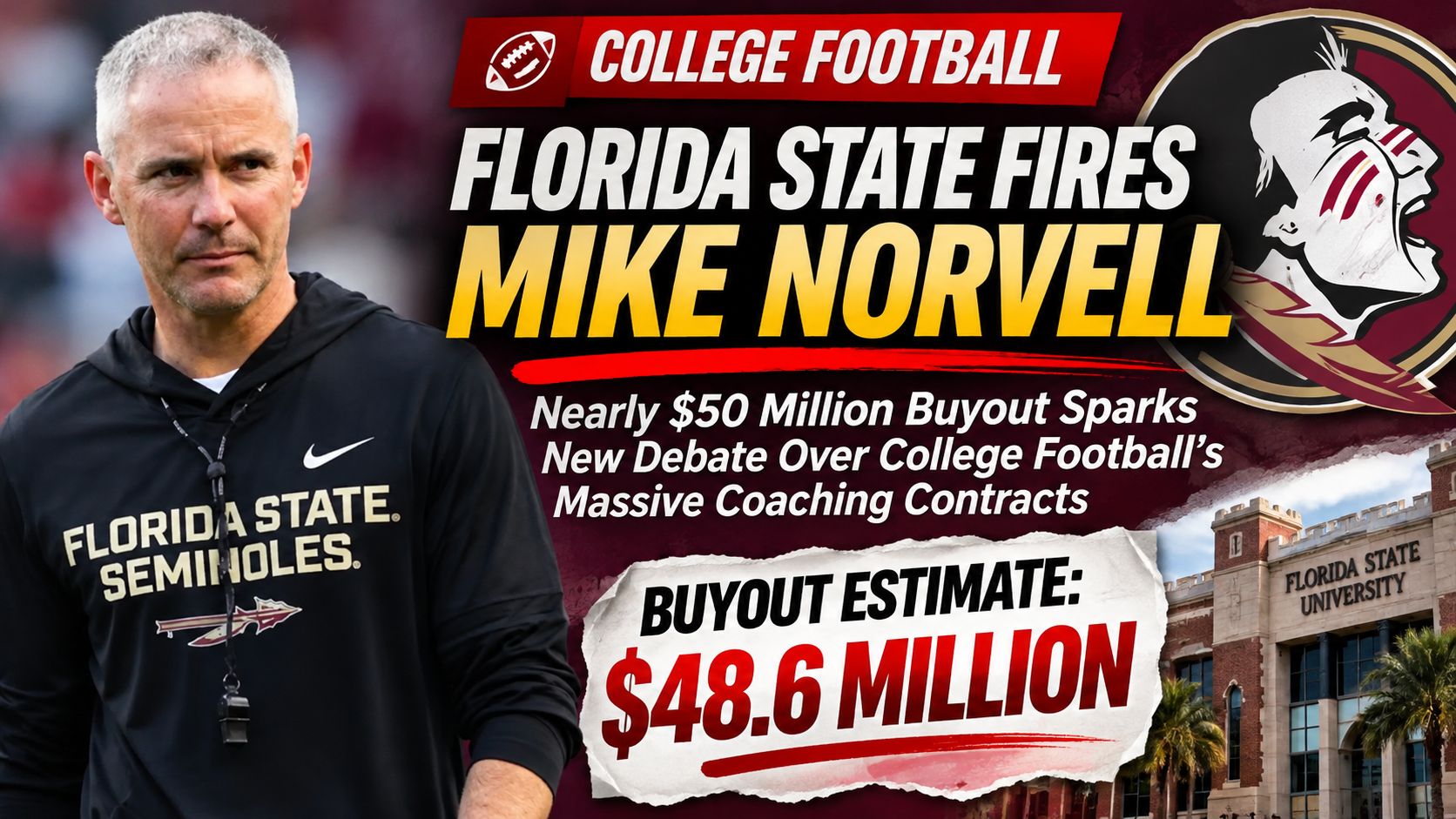
Florida State University has officially fired head football coach Mike Norvell, bringing an expensive and embarrassing end to a once-promising era of Seminoles football. But the biggest story may not be the firing itself. It is the staggering amount of money the university is expected to pay a coach who will no longer be leading its football program.
Norvell’s departure could cost Florida State approximately $49 million in contractual buyout obligations, making it one of the most expensive coaching dismissals in college football history.
For a sport supposedly rooted in school pride, student athletes, tradition, and competition, the financial consequences raise a serious question: When did college football become a business where losing coaches can walk away with fortunes?
A $49 Million Goodbye
Florida State announced Norvell’s dismissal Sunday, November 1, following a disappointing 36–24 home loss to Clemson.
The defeat dropped the Seminoles to 3–5 on the season, continuing a collapse that has stunned supporters of one of college football’s most recognizable programs.
Norvell leaves Florida State with a 41–39 overall record across seven seasons.
His contract, however, tells a much different story about the financial rewards available to elite college football coaches.
After leading Florida State to an undefeated regular season and an Atlantic Coast Conference championship in 2023, Norvell received an eight-year contract extension reportedly worth more than $84 million.
The agreement runs through 2031 and contains a provision entitling him to approximately 85 percent of his remaining compensation if dismissed without cause.
Following his firing, estimates of the obligation range from roughly $47 million to more than $50 million, depending on the contractual calculation and adjustments.
A detailed breakdown places the obligation at approximately $48.6 million.
That money is owed despite the fact that Norvell will no longer coach another game for Florida State.
The contract also includes provisions that could reduce the eventual obligation if he secures other employment.
Nevertheless, the initial financial exposure is enormous.
From Undefeated to Unemployed
The downfall is particularly shocking considering where Florida State stood just three years ago.
In 2023, Norvell led the Seminoles through an undefeated regular season and an ACC championship, restoring excitement around a football program that had struggled to reclaim its national prominence.
Florida State completed its conference championship campaign with a 13–0 record but was controversially excluded from the four-team College Football Playoff.
That exclusion generated national outrage and intensified debate about how championship contenders were selected.
At the time, Norvell appeared to be the man who had brought Florida State football back from the brink.
University leaders rewarded him with a massive extension designed to secure his future in Tallahassee.
Then everything unraveled.
The Seminoles finished 2–10 in 2024.
They followed that with a 5–7 campaign in 2025.
And through eight games in 2026, Florida State had managed only three victories.
Since the beginning of the 2024 season, the Seminoles have compiled a disastrous 10–22 record.
The program that once appeared ready to challenge college football’s biggest names had become a symbol of unmet expectations and costly decisions.
University Leadership Finally Pulls the Plug
Florida State President Richard McCullough confirmed the university was moving in a different direction.
In announcing the decision, McCullough thanked Norvell for his service and acknowledged the high expectations of Seminoles supporters.
Rick Stockstill, a former Florida State quarterback and longtime college football coach, has been appointed interim head coach.
The university has also announced a national search for a permanent replacement.
But replacing Norvell will involve far more than finding someone capable of winning football games.
Florida State must confront the financial consequences of terminating one highly compensated coach while potentially offering another lucrative contract to attract a proven successor.
Reports suggest that when additional coaching staff departures and the expense of hiring replacements are considered, the overall financial impact could climb substantially beyond Norvell’s buyout alone.
That is an extraordinary amount of money for a university athletics program to spend simply changing leadership.
The Bigger Problem With College Football
Norvell’s dismissal exposes an uncomfortable reality about modern college athletics.
Universities are increasingly competing in an environment where coaching salaries, recruiting expenses, player compensation, television contracts, and donor contributions involve enormous sums of money.
Successful coaches command contracts resembling those offered to executives of major corporations.
But unlike most ordinary employees, some of these coaches receive extraordinary financial protections even when their teams consistently fail to meet expectations.
A factory worker, small-business employee, or average American who repeatedly fails to perform rarely leaves a job with tens of millions of dollars in guaranteed compensation.
Yet in major college football, these arrangements have become an accepted part of doing business.
Supporters of such contracts argue that universities must offer competitive compensation and financial security to recruit and retain successful coaches.
Critics counter that university administrators have created a system where enormous financial risks are accepted during moments of athletic success, only to become expensive liabilities when performance deteriorates.
Florida State’s decision demonstrates how quickly those liabilities can become reality.
Who Actually Pays for These Decisions?
One of the most important questions surrounding this controversy is where the money comes from.
College athletic departments frequently rely on a combination of television revenue, ticket sales, sponsorship agreements, licensing income, and private donor contributions.
Major coaching buyouts are often supported by athletic boosters and other privately raised funds.
That distinction matters because it would be inaccurate to automatically claim that Florida taxpayers or students will directly pay Norvell’s entire buyout.
However, the broader issue remains legitimate.
Even when private donors provide the money, tens of millions of dollars are being directed toward terminating contracts rather than supporting active coaches, athletes, facilities, or other university priorities.
The university should provide clear information about how the obligation will be financed and what impact, if any, it will have on the athletic department’s future spending.
Transparency is especially important when financial decisions reach this magnitude.
A Nationwide Arms Race With No Easy Exit
Florida State is hardly alone in facing enormous coaching buyouts.
Texas A&M’s 2023 dismissal of Jimbo Fisher carried a reported buyout of approximately $76.8 million, demonstrating how expensive these agreements can become.
Other major college programs have committed tens of millions of dollars to coaching changes in pursuit of championship success.
The underlying problem is that university administrators often face intense pressure to win immediately.
When a coach delivers a breakthrough season, schools fear losing that individual to a competing program.
They respond with extensions, salary increases, and contractual guarantees.
When the victories disappear, those same guarantees can make firing the coach extraordinarily expensive.
The result is a financial cycle in which universities may spend heavily to retain a coach and then spend heavily again to remove that same coach.
Norvell’s contract illustrates the dangers of that approach.
Florida State rewarded an outstanding 2023 campaign with a long-term financial commitment, only to find itself attempting to escape the agreement less than three years later.
What Happens Next at Florida State?
The Seminoles must now attempt to salvage what remains of their 2026 season.
With a 3–5 record, Florida State needs a dramatic turnaround to reach the six victories generally required for bowl eligibility.
Stockstill inherits a program struggling with inconsistent quarterback play, disappointing conference performances, and a fan base increasingly frustrated by years of underachievement.
The next head coach will face enormous expectations.
Florida State supporters are not simply looking for modest improvement. They want a return to national relevance.
But the university’s next coaching search will take place under the shadow of one of the largest buyouts in college football history.
Administrators must decide how much money they are willing to guarantee another coach and whether the lessons from Norvell’s contract will influence future negotiations.
The Real Scandal Is the System
Mike Norvell did not force Florida State to offer him an enormous contract extension.
University leadership agreed to the terms.
Norvell delivered a championship season, and administrators decided that securing his services for years to come justified a substantial financial commitment.
The responsibility for that decision ultimately belongs to the people who negotiated and approved the agreement.
But when those same administrators later conclude that the program cannot afford to continue under the coach they rewarded, the consequences become difficult to ignore.
Florida State is now facing an expensive reset while its football team struggles to remain competitive.
The university will move forward, hire another coach, and promise supporters that better days are coming.
Norvell, meanwhile, retains substantial contractual protections negotiated during his tenure.
And college football continues operating in a financial environment where winning can produce enormous rewards, but losing does not necessarily prevent a coach from collecting millions.
Florida State’s nearly $50 million coaching breakup should serve as a warning to universities across America: A championship season may justify a celebration, but it should never eliminate financial accountability.