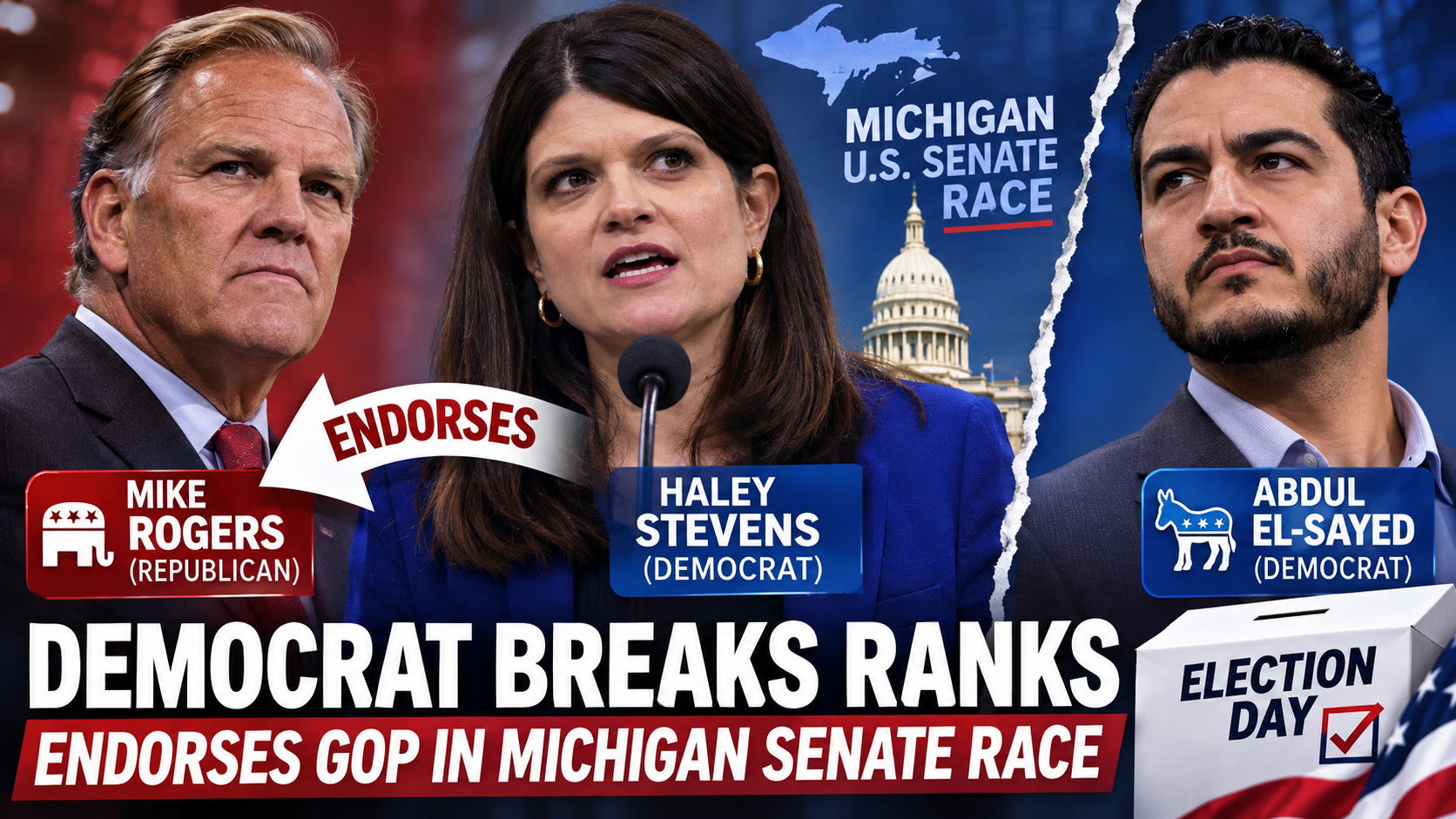
In a remarkable political reversal just 48 hours before Election Day, Democratic Congresswoman Haley Stevens has publicly endorsed Republican Mike Rogers in Michigan’s closely watched U.S. Senate race, rejecting her own party’s nominee, Abdul El-Sayed.
The announcement on Sunday, November 1, 2026, immediately ignited controversy within the Democratic Party, drawing sharp criticism from prominent party leaders while earning praise from President Donald Trump.
Stevens, who lost the Democratic Senate primary to El-Sayed in August, had previously pledged to support him in the general election. Her decision to back Rogers instead represents an extraordinary public split within the party at a critical moment in the campaign.
The dispute has also exposed deeper divisions among Michigan Democrats over Israel, political messaging, party loyalty and the direction of the Democratic Party.
A Democratic Congresswoman Crosses Party Lines
Stevens announced her endorsement in a video posted Sunday, explaining that El-Sayed’s campaign had made it clear she was no longer welcome at campaign events.
Rather than quietly withdrawing her support, Stevens took the unusual step of endorsing the Republican nominee.
She then appeared alongside Rogers at Perfecting Church in Detroit, creating one of the most unexpected political images of the 2026 midterm campaign.
The appearance was especially striking because Stevens had spent much of the Democratic primary criticizing Rogers and portraying him as closely aligned with President Trump.
Now, with the election approaching, she has reversed course.
Despite endorsing a Republican, Stevens has insisted that she remains a Democrat and continues to support many of the policies she has advocated throughout her political career.
Her decision was not a formal announcement that she was switching parties. It was an endorsement of a Republican candidate over the nominee of her own party.
Nevertheless, the political consequences were immediate.
The Dispute Over Israel and Campaign Advertising
The breakdown between Stevens and El-Sayed did not happen overnight.
Their relationship had been strained since the Democratic primary, during which they competed for the party’s nomination.
Although Stevens initially endorsed El-Sayed after losing, tensions resurfaced over political advertisements and disagreements involving Israel.
A political advertisement from an outside organization connected rising living costs to American support for Israel.
Stevens criticized the advertisement as antisemitic and demanded that El-Sayed publicly reject its message.
She also objected to a separate campaign advertisement featuring conservative commentator Tucker Carlson.
El-Sayed subsequently distanced himself from the outside advertisement, stating that his campaign had not produced it and that he disagreed with its contents.
However, the disagreement had already escalated.
El-Sayed’s campaign informed Stevens that she would not be welcome at campaign appearances during the final days before the election.
Stevens cited that exclusion when announcing her decision to endorse Rogers.
The controversy illustrates how disagreements over American foreign policy and Israel have become a significant source of friction within the Democratic coalition.
President Trump Welcomes the Endorsement
President Donald Trump quickly celebrated Stevens’ decision.
In a social media statement, Trump praised her willingness to break with her party and support Rogers.
He characterized the endorsement as an act of loyalty to Michigan and suggested that Stevens could potentially join the Republican Party in the future.
Stevens, however, has not announced any intention to change her party affiliation.
For Rogers, the endorsement provides a prominent example of a Democratic elected official publicly rejecting her party’s Senate nominee.
The former Republican congressman has sought to present himself as a candidate capable of attracting support beyond traditional Republican voters.
Stevens’ endorsement gives his campaign an opportunity to highlight that message, although it remains uncertain how many voters will be influenced by her decision.
Democratic Leaders Respond With Anger
The reaction from Democratic leadership was swift.
Senate Minority Leader Chuck Schumer condemned Stevens’ endorsement as a betrayal and reaffirmed his support for El-Sayed.
Former House Speaker Nancy Pelosi also criticized the decision, arguing that supporting Rogers would undermine Democratic priorities involving healthcare and other domestic policies.
Michigan Democratic Party Chairman Curtis Hertel issued a particularly forceful response, accusing Stevens of abandoning the principles she previously claimed to support.
Other Democratic lawmakers expressed frustration that the controversy was dominating political discussion during the final hours before Election Day.
Some House Democrats have even called for Stevens to face consequences within the Democratic caucus.
The response underscores how seriously party leaders view a prominent Democratic officeholder endorsing the opposing party’s candidate in a competitive Senate election.
El-Sayed Campaign Reports Major Fundraising Surge
Although Rogers gained a high-profile endorsement, El-Sayed’s campaign reported an immediate financial response from supporters.
According to figures released by the campaign Monday, November 2, El-Sayed raised approximately $2.4 million in a single day following Stevens’ announcement.
The campaign said more than 65,000 donors contributed, including nearly 30,000 first-time donors.
Those figures were reported by the campaign and have not independently established what portion of the donations came directly because of Stevens’ endorsement.
Nevertheless, the fundraising announcement suggests that the controversy has energized at least part of El-Sayed’s political base.
The situation presents two competing political narratives.
Republicans can point to Stevens’ endorsement as evidence that their candidate has attracted support from across party lines.
Democrats supporting El-Sayed can point to the fundraising response as evidence that their voters are rallying behind their nominee.
Which interpretation carries greater significance will depend on how Michigan voters respond.
A Senate Race With National Implications
Michigan’s Senate contest is receiving national attention because the outcome will contribute to determining the balance of power in Washington.
Rogers, a former Republican congressman, is competing against El-Sayed, a physician and former public health official who defeated Stevens in the Democratic primary.
The candidates represent substantially different approaches to federal policy, including healthcare, taxation, foreign affairs and the Trump administration’s agenda.
A New York Times and Siena College poll cited in reporting on November 2 showed El-Sayed leading Rogers by 53 percent to 42 percent among the poll’s surveyed voters.
That measurement reflects one survey rather than a final election result, and the impact of the late endorsement remains unknown.
The unusual nature of Stevens’ announcement has ensured that the race will receive additional scrutiny in the final hours before voting concludes.
A Larger Debate About Party Loyalty
Beyond Michigan, the endorsement raises questions about how political parties handle internal disagreements.
Stevens has argued that her decision reflects her personal judgment and concerns about the direction of El-Sayed’s campaign.
Her critics argue that supporting a Republican after losing the Democratic primary violates the expectations of party unity and could undermine policy goals she previously championed.
Supporters of her decision, meanwhile, may view the endorsement as an example of an elected official refusing to follow party leadership when she disagrees with its nominee.
Those competing interpretations demonstrate the tension between political independence and party loyalty.
The disagreement over Israel also reflects broader ideological divisions that extend beyond a single candidate or election.
Michigan Voters Will Have the Final Word
With Election Day set for Tuesday, November 3, Michigan voters will soon decide the contest between Mike Rogers and Abdul El-Sayed.
What began as an internal disagreement between two Democratic primary rivals has developed into a nationally watched controversy involving the president, congressional leaders and the future direction of the Democratic Party.
Haley Stevens remains a Democratic congresswoman, but her endorsement of a Republican Senate candidate has placed her at odds with much of her party’s leadership.
Whether her decision influences the election, strengthens Rogers’ cross-party appeal or further mobilizes El-Sayed’s supporters remains to be seen.
Regardless of the outcome, the episode illustrates how quickly political alliances can fracture when disagreements over policy, campaign strategy and party loyalty collide.