November 2, 2026
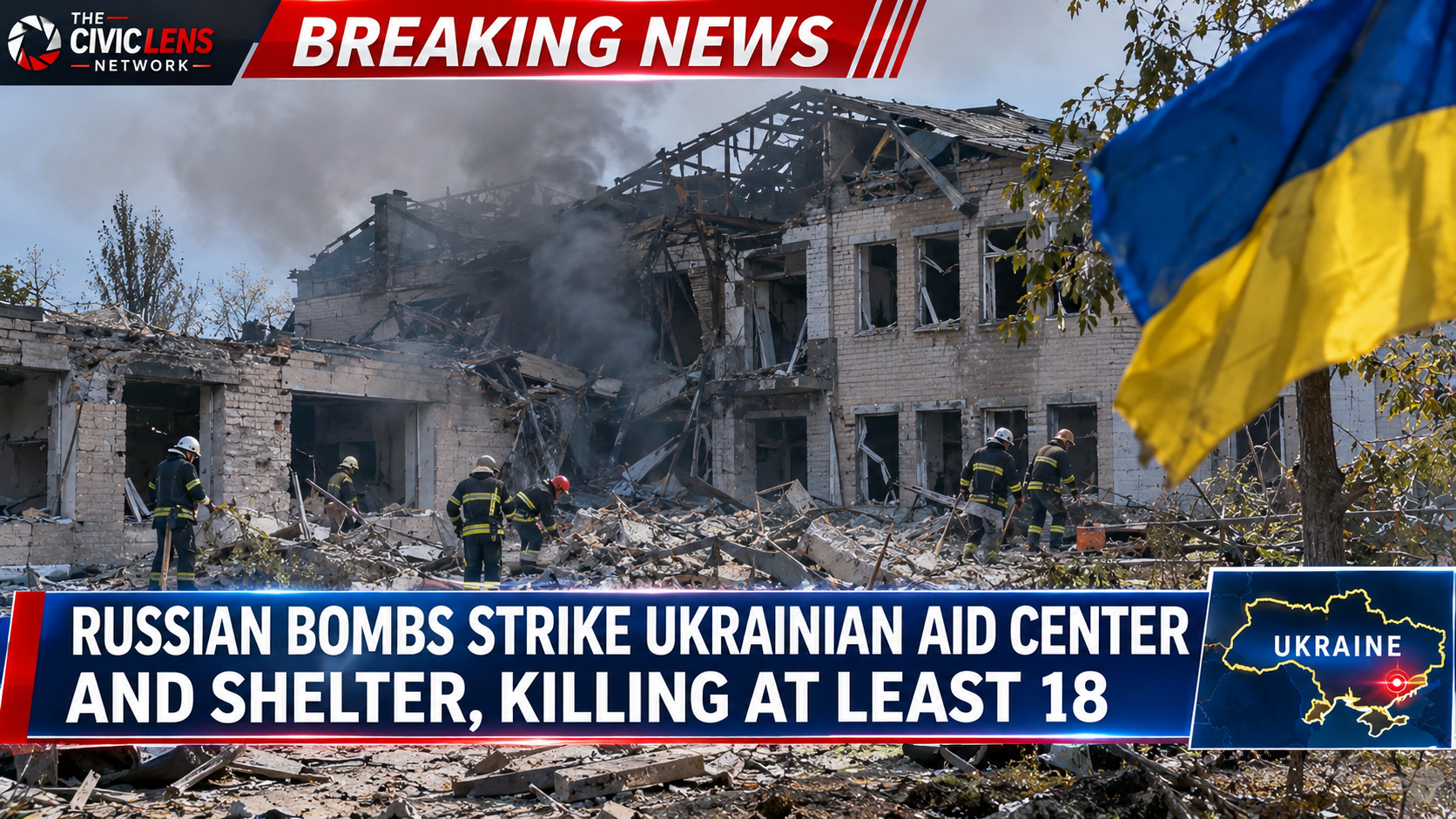
A devastating Russian airstrike has struck a humanitarian aid distribution center and a nearby civilian shelter in southeastern Ukraine, killing at least 18 people and injuring five others, according to Ukrainian President Volodymyr Zelenskyy.
The attack took place Monday in Komyshuvakha, a settlement in Ukraine’s Zaporizhzhia region, where residents were gathering to receive desperately needed humanitarian assistance.
What began as an attack on a school being used to distribute aid reportedly escalated into a second bombardment of a shelter where people had gathered for protection.
Zelenskyy said Russian aircraft dropped additional bombs during the second strike, raising urgent questions about whether civilians seeking refuge were deliberately targeted.
Rescue crews rushed to the scene, searching through damaged structures and debris as authorities attempted to determine the full number of casualties.
The attack represents another devastating episode in a war that has repeatedly placed civilian communities directly in the path of military operations.
A School Providing Humanitarian Aid Becomes a Target
According to Zelenskyy, Russian forces launched multiple aerial attacks against Komyshuvakha on Monday morning.
One of the initial strikes hit a school that was no longer functioning solely as an educational facility.
Instead, the building was being used for humanitarian purposes, including the distribution of essential supplies to residents who had remained in the war-torn settlement.
For civilians living near active combat zones, humanitarian distribution centers can provide critical access to food, medicine, and other necessities.
Many residents who remain in such communities are elderly, financially vulnerable, or unable to relocate.
The school had reportedly become a regular location where people could obtain assistance.
Zelenskyy said Russian forces should have known that local residents gathered there for humanitarian aid each week.
That allegation raises serious questions about the selection of the target.
However, independent investigators have not yet established what Russian military personnel knew about the building’s civilian use or the intended targets of the strike.
A Second Wave of Bombs Hits the Shelter
The most alarming allegation concerns what happened after the initial bombing.
Zelenskyy said Russian forces launched another attack involving nine additional aerial bombs, striking a shelter where people had gathered.
The reported sequence suggests civilians may have faced renewed bombardment after seeking protection from the first attack.
Military analysts and humanitarian organizations have long warned about the dangers of repeated strikes on locations where civilians, emergency workers, or other noncombatants may be present.
Such incidents can dramatically increase casualties because people may move toward shelters or damaged buildings following an initial explosion.
In Komyshuvakha, Ukrainian authorities say the second wave struck a location being used for refuge.
The exact timing between the attacks, the weapons employed, and the military’s targeting decisions have not yet been independently established.
Those details will be critical to determining whether the attack violated international humanitarian law.
At Least 18 Dead as Rescue Operations Continue
Zelenskyy initially reported that 18 people had been killed and five wounded.
Emergency personnel, military units, and other specialized responders were deployed to search the damaged area.
Rescue operations were complicated by destruction at the scene and the possibility that additional victims remained beneath debris.
Local authorities also reported that people were missing following the bombardment.
The casualty figures were preliminary and could change as rescuers reached additional areas.
At the time of the president’s announcement, the identities of those killed had not been fully released.
For families living in the affected community, the uncertainty added to the devastation.
Residents who had gathered for basic assistance suddenly found themselves caught in a deadly attack.
The destruction also threatens the community’s ability to continue distributing essential supplies to those who remain.
Why Attacking Humanitarian Facilities Raises Serious Legal Questions
International humanitarian law requires parties to armed conflicts to distinguish between military targets and civilians or civilian objects.
Schools, humanitarian facilities, and civilian shelters are generally protected from deliberate attack unless specific circumstances make them lawful military objectives.
Even when a legitimate military target exists, attacking forces must comply with the principles of proportionality and precautions in attack.
The fact that a building was previously used as a school does not automatically establish whether it was a lawful target at the time of a strike.
Likewise, the presence of civilians does not by itself establish that an attack was intentionally directed against them.
Investigators must examine available evidence, including the building’s actual use, the presence or absence of military activity, the weapons employed, and the information available to commanders.
If evidence establishes that Russian forces knowingly targeted civilians or intentionally attacked a protected humanitarian facility without lawful military justification, the incident could constitute a war crime.
The reported second strike on a shelter makes a thorough investigation especially important.
At present, the allegations have not been adjudicated by an international court.
A Region Living Under Constant Threat
Zaporizhzhia has remained one of the most dangerous regions of Ukraine throughout the conflict.
Russian forces occupy portions of the region, while Ukrainian forces retain control of the regional capital and other communities.
Settlements near the fighting have endured repeated shelling, drone attacks, infrastructure destruction, and disruptions to essential services.
For people who have remained in their homes, ordinary activities can carry significant risks.
Traveling to obtain food, collecting medicine, repairing damaged property, or visiting a humanitarian center can place civilians in danger.
Komyshuvakha lies southeast of the city of Zaporizhzhia, within a region where military activity has repeatedly affected civilian life.
The latest bombardment demonstrates how quickly an already precarious humanitarian situation can deteriorate.
The Attack Comes During a Fragile Diplomatic Moment
The bombing occurred as a limited humanitarian ceasefire in another part of southern Ukraine came to an end.
The temporary arrangement had been established around the Russian-occupied community of Oleshky in the Kherson region.
Its purpose was to allow humanitarian operations and the evacuation of civilians trapped by years of fighting.
The pause began on October 27 and lasted approximately six days.
The agreement was geographically limited and did not represent a nationwide ceasefire between Russia and Ukraine.
Nevertheless, it offered a rare example of cooperation intended to protect civilians.
The Komyshuvakha attack occurred against that broader backdrop of attempts to negotiate humanitarian access while fighting continued elsewhere.
Zelenskyy argued that the bombing demonstrated Russia’s unwillingness to pursue meaningful de-escalation.
Moscow’s intentions cannot be conclusively established from this incident alone, but the attack has intensified concerns about the prospects for reducing violence.
Zelenskyy Demands an International Response
Following the attack, Zelenskyy condemned the bombardment and called for a strong international response.
He accused Russian forces of attacking a location where civilians regularly gathered for assistance.
The Ukrainian president said the reported strike demonstrated the need for continued international support and greater pressure on Moscow.
His remarks reflect Ukraine’s longstanding position that Russia must face consequences for attacks that harm civilian populations.
Ukraine has repeatedly called for stronger military assistance, improved air defenses, and international accountability mechanisms.
The Komyshuvakha bombing is likely to renew those demands.
At the same time, determining individual criminal responsibility requires evidence beyond public statements.
Independent documentation and forensic investigation will be essential to establishing precisely what happened.
The Humanitarian Consequences Extend Beyond the Death Toll
The immediate tragedy is the loss of human life.
But the consequences of the attack may continue long after rescue operations conclude.
When a humanitarian distribution point is destroyed or rendered unusable, residents can lose access to supplies they depend on.
Aid organizations may be forced to relocate operations, change delivery schedules, or suspend activity until conditions become safer.
For people with limited transportation or serious medical needs, those disruptions can be devastating.
A damaged shelter also reduces the options available to civilians during future attacks.
In communities where infrastructure has already been severely weakened, the loss of even one functioning public facility can have consequences for hundreds of residents.
The attack therefore raises two separate humanitarian concerns: the immediate casualties and the longer-term disruption of assistance to an already vulnerable population.
The Questions Investigators Must Answer
Several important questions remain unresolved.
Investigators will need to establish the precise locations and timing of the strikes, the number and types of weapons used, and whether any military objectives were present.
They must also determine whether Russian commanders knew that humanitarian aid was being distributed at the school and that civilians were sheltering nearby.
The reported second bombardment requires particular scrutiny.
Evidence such as satellite imagery, witness testimony, weapons fragments, and military communications could help reconstruct the sequence of events.
The number of people killed or injured may also change as rescue and recovery operations continue.
Until those findings are available, claims about deliberate targeting must be distinguished from independently established facts.
A Devastating Reminder of the War’s Civilian Cost
For the people of Komyshuvakha, Monday’s attack was not an abstract development in an international conflict.
It was a deadly assault on a community where residents were reportedly gathering for humanitarian assistance.
At least 18 people were initially reported dead, with others injured and rescue teams continuing their work.
The reported second strike on a civilian shelter makes the incident especially disturbing and demands close examination.
Whatever investigators ultimately determine about the military’s intended targets, the human consequences are undeniable.
Families have lost loved ones. A community has suffered further destruction. And people already struggling to survive the war now face even greater uncertainty.
A place where civilians gathered to receive help became the scene of a deadly bombardment. The world now awaits answers about why it happened and who will be held accountable.