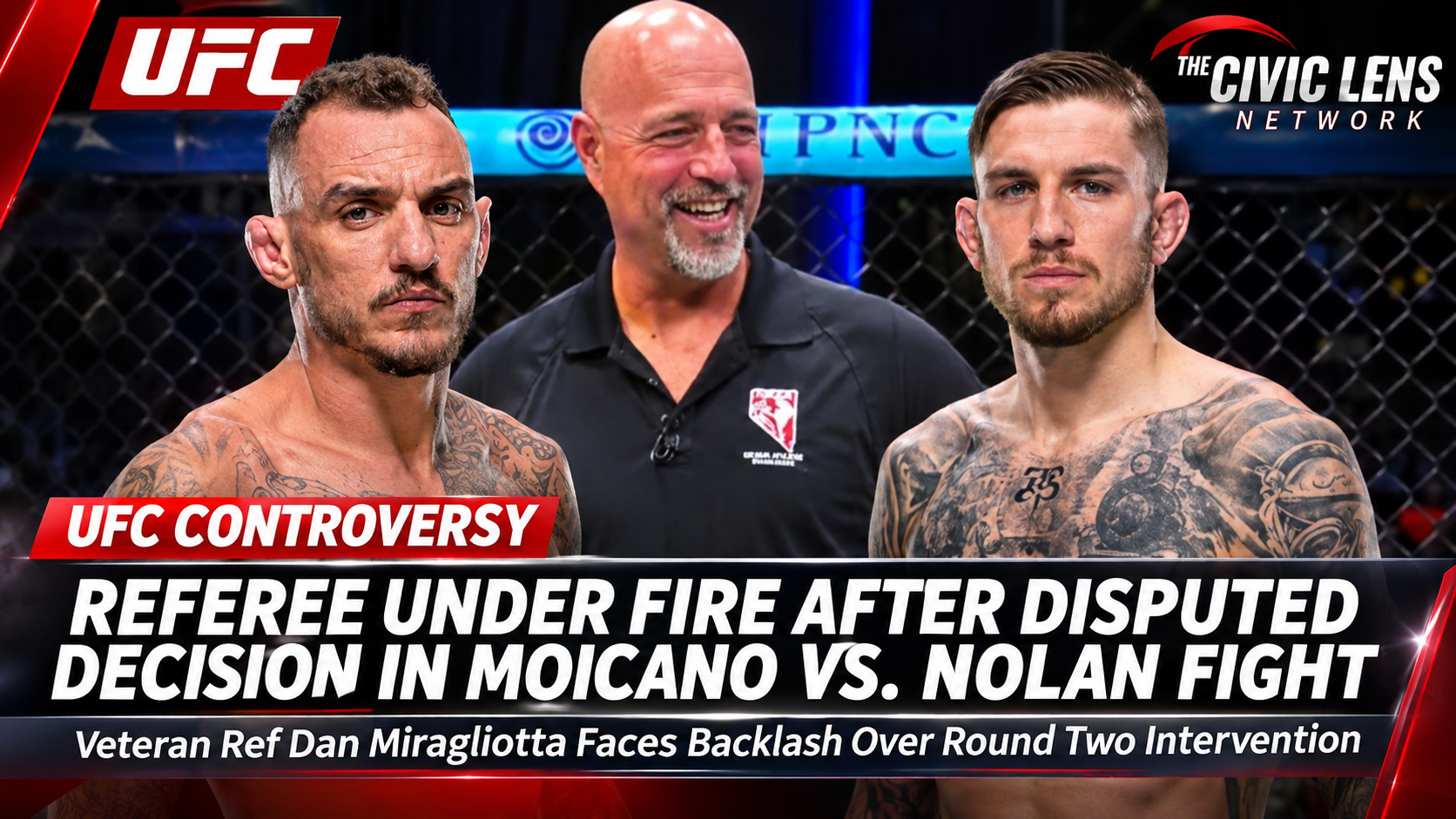
A major controversy has erupted across the Ultimate Fighting Championship following a questionable refereeing decision that may have dramatically altered the outcome of a high-profile main event.
The October 31 showdown between Brazilian lightweight veteran Renato Moicano and rising Australian contender Tom Nolan at UFC Vegas 123 was supposed to be an opportunity for both fighters to prove themselves inside the Octagon.
Instead, the fight has become the center of an intense debate over officiating, fairness, and whether referees should be allowed to interrupt a fighter who has earned a dominant position.
At the center of the controversy is veteran UFC referee Dan Miragliotta, whose decision to separate the fighters during the second round has drawn widespread criticism from fighters, commentators, and one of the most respected officials in mixed martial arts history.
A Fight That Changed in Seconds
For much of the opening two rounds, Renato Moicano appeared to have a clear advantage on the ground.
Known for his dangerous Brazilian jiu-jitsu skills, Moicano repeatedly worked his way into dominant positions against Nolan, controlling the Australian fighter’s back and threatening potential submissions.
During the second round, Moicano secured back control with a body triangle, a position that allows a fighter to restrict an opponent’s movement while searching for a choke or delivering strikes.
In mixed martial arts, securing an opponent’s back is widely considered one of the strongest positions a fighter can achieve.
But rather than allowing Moicano to continue working, Miragliotta unexpectedly ordered the fighters to stand.
The decision immediately drew criticism because Moicano had not simply been lying motionless on his opponent. He had been throwing strikes and attempting to improve his position.
Moments after the restart, Nolan landed damaging strikes that dramatically shifted the momentum.
By the third round, Nolan had taken control of the contest and ultimately finished Moicano by technical knockout.
Nolan officially earned the victory, extending his winning streak to six fights.
However, the circumstances surrounding the victory have left many questioning whether the fight would have unfolded differently without the referee’s intervention.
Legendary UFC Referee Speaks Out
Among the most prominent critics is legendary mixed martial arts referee John McCarthy, widely known throughout the sport as Big John.
McCarthy, whose career helped establish many of the officiating standards used in modern MMA, publicly criticized Miragliotta’s decision during an appearance on the Weighing In podcast.
His central argument was simple: A fighter who works to establish a dominant position should not lose that advantage merely because the referee wants more action.
McCarthy explained that controlling an opponent’s back requires considerable skill and effort.
Once a fighter earns that position, the opponent should be responsible for escaping through legitimate defensive techniques.
By ordering the fighters to stand, McCarthy argued, Miragliotta effectively erased the advantage Moicano had earned.
He also questioned whether the referee had sufficient justification to declare the action stalled.
According to McCarthy, Moicano was actively attempting to create opportunities for a submission while delivering strikes.
The veteran official emphasized that referees are responsible for enforcing the rules and protecting fighters, not manufacturing excitement for spectators.
McCarthy made clear that he respects Miragliotta personally and professionally, but believes the intervention was unfair to Moicano.
Did the Referee Influence the Outcome?
The controversy raises a troubling question for professional mixed martial arts.
How much influence should a referee have over the outcome of a fight?
Referees possess significant authority inside the Octagon. They can stop contests, deduct points, separate fighters, and order competitors to change positions when necessary.
Those powers are essential for maintaining safety and enforcing the sport’s rules.
However, critics argue that using those powers unnecessarily can undermine the competitive integrity of a contest.
In this case, Moicano had spent considerable time establishing control over Nolan.
That control was not accidental. It was the result of successful grappling exchanges and technical positioning.
When Miragliotta restarted the action on the feet, Nolan was given an opportunity to fight from a position more favorable to his striking abilities.
The Australian capitalized almost immediately.
That sequence does not prove Nolan would have lost without the intervention. Fighters regularly overcome difficult positions, and Nolan still had to execute the strikes that ultimately secured his victory.
Nevertheless, the timing of the restart and the immediate momentum shift have intensified criticism of the officiating.
Fighters and Fans React
The disputed decision quickly became one of the biggest talking points following UFC Vegas 123.
Professional fighters and MMA observers questioned why a referee would interrupt a competitor who appeared to be controlling the action legally.
UFC lightweight Terrance McKinney was among those who publicly criticized the stand-up, suggesting that the referee’s intervention played a significant role in the result.
The reaction highlights a longstanding disagreement within mixed martial arts over the balance between entertainment and competition.
Some spectators prefer aggressive striking exchanges and quick finishes.
Others appreciate the technical aspects of grappling, including positional control, submission attempts, and defensive exchanges that may not immediately produce visible damage.
Both approaches are legitimate components of the sport.
Critics argue that referees should not favor one fighting style over another simply because a particular audience finds it more entertaining.
A grappler who successfully takes an opponent’s back should have the same opportunity to pursue victory as a striker who establishes an advantage on the feet.
Moicano Responds to Defeat
Despite the controversy, Moicano initially avoided using the referee’s decision as an excuse for his loss.
Following the fight, the Brazilian congratulated Nolan and acknowledged that he had struggled to capitalize on his dominant grappling positions.
Moicano admitted that although he successfully secured back control, he was unable to inflict significant damage or finish the fight.
His reaction stood in contrast to the criticism surrounding the officiating.
Rather than immediately demanding that the result be overturned, he publicly recognized Nolan’s performance.
For the 37-year-old veteran, however, the defeat represents another setback at an important stage of his professional career.
Every fight can influence a veteran contender’s future opportunities, rankings, and earning potential.
That makes controversial officiating decisions particularly consequential.
A Bigger Problem for the UFC?
The dispute extends beyond one fight.
Mixed martial arts has spent decades developing standardized rules intended to create fair competition while protecting athletes from unnecessary injury.
Referees must constantly make judgment calls under intense pressure.
Those decisions can be difficult, especially when fighters are engaged in complicated grappling exchanges.
But the controversy surrounding UFC Vegas 123 demonstrates how a single intervention can overshadow an otherwise significant athletic achievement.
Nolan earned the official victory and deserves recognition for capitalizing on the opportunity presented to him.
At the same time, questions about the referee’s decision remain legitimate.
The UFC and athletic regulators have an interest in ensuring that officials apply consistent standards, particularly when determining whether ground action has become sufficiently inactive to justify a restart.
There is no verified evidence that Miragliotta intentionally favored Nolan or sought to manipulate the result.
The criticism concerns his judgment and the competitive consequences of the intervention.
What Happens Next?
As of November 2, no official reversal of the result has been established.
Nolan remains the winner by third-round technical knockout.
The larger issue is whether the controversy will prompt additional scrutiny of how referees handle dominant grappling positions.
McCarthy’s criticism carries particular weight because of his extensive experience officiating championship fights and helping shape modern MMA standards.
For fans, the question is no longer simply whether Nolan deserved to win.
It is whether Moicano received a fair opportunity to finish the fight from a position he had legitimately earned.
Professional sports depend on competitors trusting that the rules will be applied consistently.
When a referee’s decision becomes more controversial than the fight itself, that trust can be damaged.
And after UFC Vegas 123, the debate over fairness inside the Octagon is unlikely to disappear anytime soon.