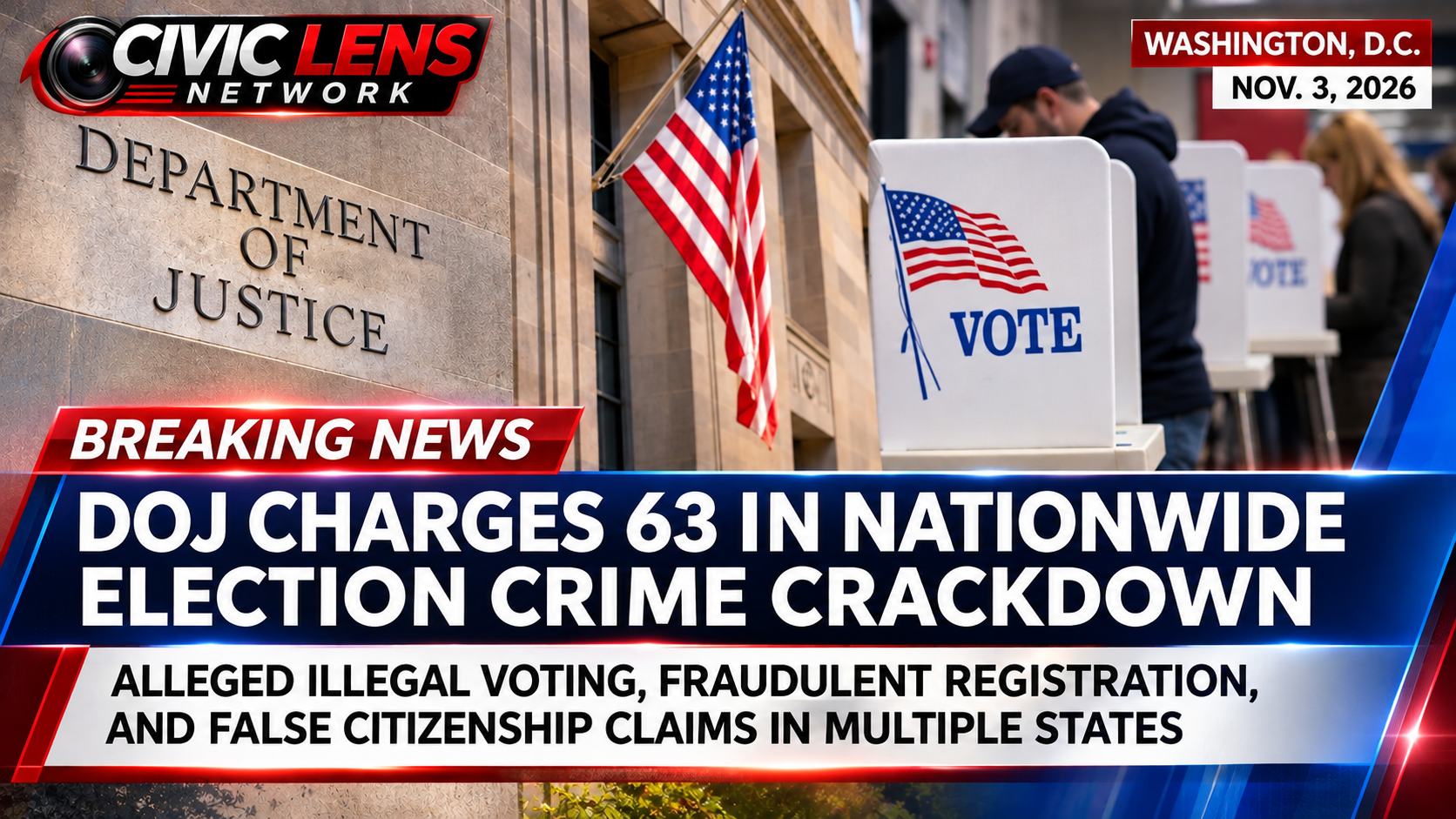
WASHINGTON, D.C. — With Americans heading to the polls for the November 3 midterm elections, the Trump administration’s Department of Justice has announced criminal charges involving 63 individuals across the United States in a sweeping election-integrity crackdown targeting allegations of illegal voting, fraudulent voter registration, and false claims of American citizenship.
The announcement puts renewed attention on one of the most fiercely debated issues in American politics: whether election officials are doing enough to ensure that only eligible American citizens cast ballots in federal elections.
Federal prosecutors have identified cases involving foreign nationals who allegedly registered to vote, falsely represented themselves as American citizens, or participated in federal elections despite lacking the citizenship required by law.
The cases span multiple states and involve conduct from previous election cycles, including the 2020, 2022, and 2024 elections.
The Justice Department’s actions represent a significant federal enforcement effort at a moment when control of Congress hangs in the balance.
Federal Prosecutors Target Illegal Voting
Under federal law, noncitizens generally cannot vote in elections for president, the U.S. Senate, or the House of Representatives.
That restriction applies not only to people living in the country unlawfully but also to lawful permanent residents who possess green cards.
A green card grants an individual permission to live and work in the United States. It does not grant American citizenship or the right to vote in federal elections.
Federal investigators say some of the defendants knowingly crossed that legal boundary.
The allegations include falsely declaring American citizenship on voter-registration applications, casting ballots while ineligible, and making inaccurate statements during immigration or naturalization proceedings.
The charges vary by defendant, and the government must establish the allegations in court.
Tennessee Cases Reveal Alleged Voting Violations
In Tennessee, federal prosecutors announced five cases involving foreign nationals accused of participating unlawfully in American elections.
Three defendants in Middle Tennessee were identified as Garfield St. Vincent Bruce, a Jamaican citizen; Mariela Elizabeth Avila Ortiz, a Honduran citizen; and Allison Melissa Wilkes, a citizen of Trinidad and Tobago.
Prosecutors allege the three voted in the 2024 election and falsely represented themselves as United States citizens on voter-registration applications.
Two additional cases were announced in western Tennessee.
Cesar Sanchez Correa, a Mexican citizen, is accused of unlawfully voting in Haywood County during the 2024 election.
Andreas Van Der Werf, a German citizen, is accused of voting unlawfully in Fayette County during both the 2022 and 2024 elections.
Federal authorities also allege that the two men falsely claimed American citizenship when registering.
The five defendants were identified as lawful permanent residents, demonstrating that the investigation is not limited to people who entered or remained in the country illegally.
The FBI and Homeland Security Investigations participated in the cases, with assistance from Tennessee election officials.
North Carolina Investigation Expands
North Carolina has also become a significant focus of federal election-related prosecutions.
Authorities announced additional charges involving individuals accused of voting without American citizenship.
One case involves Selvin Porfidio Gonzalez Escobar, a Guatemalan national living in Robeson County.
Federal prosecutors accuse him of falsely claiming citizenship and casting ballots in the 2020 and 2024 general elections.
The allegations raise questions about how an ineligible individual could allegedly register and participate in multiple election cycles without being identified earlier.
Federal authorities have also pursued cases involving lawful permanent residents accused of voting before completing the naturalization process.
According to reporting on the Justice Department’s enforcement efforts, federal prosecutors have brought charges against 195 individuals across 25 states over approximately nine weeks.
That broader figure includes cases announced before the latest group of 63 defendants.
California Faces Fresh Scrutiny
California is facing its own election-integrity controversy after federal prosecutors announced charges against six lawful permanent residents accused of falsely claiming citizenship to register and vote.
The defendants include nationals of Iran, Canada, the Philippines, Mexico, and Israel.
Some are also accused of making false statements during naturalization proceedings.
Authorities say the cases emerged during a broader examination of voter-registration records.
Investigators have identified a list of more than 20,000 people suspected of potentially lacking citizenship while appearing on California voter rolls.
However, being included on that list does not establish that a person is ineligible, committed fraud, or actually voted unlawfully.
Each case requires individual verification.
The federal government has also sought judicial intervention concerning how ballots associated with disputed eligibility records should be handled.
The controversy illustrates the growing tension between federal election-integrity enforcement and state election administration.
What the Charges Could Mean for Election Security
The central issue extends beyond the individuals currently facing prosecution.
American elections depend on maintaining accurate voter rolls, verifying eligibility, and ensuring that ballots are cast according to federal and state law.
When investigators identify cases in which noncitizens allegedly voted in multiple elections, those allegations naturally raise concerns about whether existing safeguards are sufficient.
Election officials generally rely on registration records, citizenship attestations, database comparisons, and other administrative procedures to determine eligibility.
But these systems are not identical across all states, and differences in verification procedures can create challenges.
Supporters of stronger election-integrity measures argue that the latest prosecutions demonstrate why states should regularly review voter rolls and improve methods of verifying citizenship.
Voting-rights advocates, meanwhile, warn that broad challenges based on incomplete government records can mistakenly target eligible American voters.
Both concerns require careful consideration.
The confirmed existence of criminal charges demonstrates that authorities have identified specific suspected violations. It does not, by itself, establish widespread election fraud or prove that previous election outcomes were changed.
Penalties Can Include Federal Prison Time
The consequences for knowingly violating federal election laws can be serious.
Making a false claim of American citizenship for voting-related purposes can carry a maximum federal penalty of five years in prison and a $250,000 fine, depending on the statute and circumstances.
Unlawful voting by a noncitizen can carry a maximum sentence of one year in prison and a $100,000 fine.
False statements during immigration proceedings can also produce additional criminal and immigration consequences.
The ultimate penalties depend on the charges, evidence, applicable statutes, and individual circumstances.
A Major Test for Election Integrity
The timing of the Justice Department’s announcement is particularly significant.
As millions of Americans participate in the 2026 midterm elections, federal prosecutors are publicly emphasizing that violations of election law can result in criminal prosecution.
The administration’s enforcement campaign sends a message that citizenship requirements for federal voting are not optional.
At the same time, the distinction between allegations and proven offenses remains essential. The 63 individuals have been charged, not collectively convicted.
The prosecutions also concern earlier elections, rather than evidence that fraudulent ballots are being cast in the November 3 midterms.
For voters concerned about election security, the cases provide concrete examples of suspected violations that federal investigators believe warrant prosecution.
For policymakers, they raise questions about whether existing voter-registration systems can identify ineligible registrations before ballots are cast rather than years afterward.
The larger challenge is ensuring that election laws are enforced consistently while protecting the rights of eligible citizens.
With congressional control at stake and public confidence in American elections under intense scrutiny, the Justice Department’s nationwide crackdown is likely to remain a major political and legal issue well beyond Election Day.