A political controversy surrounding Alaska’s closely watched U.S. Senate election has intensified after a New York Times investigation uncovered evidence that operatives aligned with Democratic candidate Mary Peltola helped recruit a second candidate named Dan Sullivan, raising serious questions about political manipulation, voter confusion and the limits of election law.
The revelations have triggered criminal investigations, federal legal action and demands for accountability just as Alaskans head to the polls on November 3.
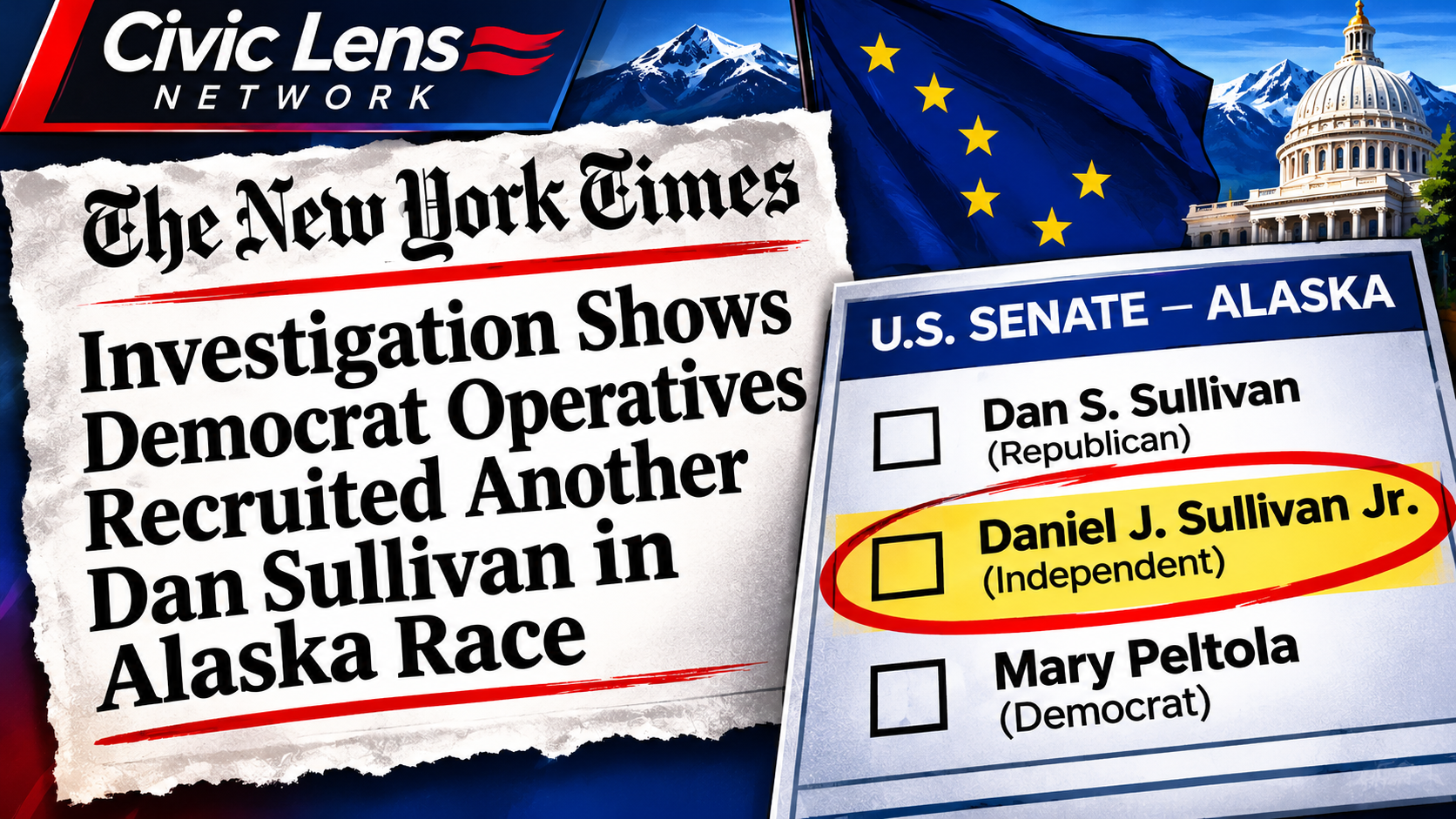
At the center of the controversy is a remarkable situation: two candidates named Dan Sullivan appearing on the same U.S. Senate ballot.
One is Republican incumbent Senator Dan S. Sullivan. The other is Daniel J. Sullivan Jr., a retired teacher from Petersburg who entered the race as a political newcomer.
The similarity is not disputed. What has become the focus of investigations is how the second Sullivan entered the race and whether political operatives deliberately recruited him to draw support away from the incumbent Republican.
The New York Times Investigation Changes the Story
On October 28, The New York Times published an investigation drawing on interviews, text messages and documents prepared for potential litigation.
Its findings went beyond speculation about whether two candidates happened to share the same name.
The investigation described an organized effort involving individuals connected to Peltola’s political operation who sought to recruit candidates capable of weakening Senator Sullivan’s electoral support.
According to the reporting, a Peltola campaign staff member was assigned to identify people in Alaska named Dan Sullivan.
A political operative also reportedly approached potential candidates in an effort to persuade them to enter the Senate contest.
The operation was not limited to the second Sullivan. Another candidate, Gerald Heikes, was reportedly recruited as part of the broader effort.
The reported objective was to divide votes that otherwise might have gone to the Republican incumbent.
These revelations provided significant new evidence about the origins of the competing candidacies and intensified scrutiny of the Democratic campaign.
However, Peltola has denied knowing about or participating in the recruitment effort. Her campaign and the Democratic Senatorial Campaign Committee have also denied involvement.
A former Peltola campaign manager reportedly told The New York Times that Peltola knew about the operation, although the former manager subsequently attempted to retract those statements.
That conflict remains an important question for investigators.
Alaska Election Officials Had Already Raised Concerns
Long before the Times investigation, Alaska election officials had questioned the legitimacy of Daniel J. Sullivan Jr.’s candidacy.
In June, the state’s Division of Elections determined that the available evidence did not support treating his campaign as a genuine good-faith candidacy.
Officials expressed concern that the candidate’s presence could mislead voters.
Daniel J. Sullivan disputed the allegations and challenged the state’s attempt to remove him from the ballot.
A state judge subsequently overturned the exclusion, finding that election officials had relied on a good-faith candidacy requirement that was not established in the governing law.
The Alaska Supreme Court later upheld his ballot access.
The legal decisions meant that Daniel J. Sullivan could remain a candidate even while questions about the political motivations behind his campaign continued.
That distinction is now central to the controversy.
Justice Department Launches Criminal Investigation
The controversy escalated further when federal authorities began examining possible criminal wrongdoing connected to the recruitment effort.
By October 29, the Justice Department had issued additional subpoenas targeting Democratic officials believed to have connections to the operation.
Federal investigators also began contacting individuals who had donated to the second Sullivan’s campaign.
According to reporting by the Associated Press, investigators questioned some donors about whether they had been misled concerning which candidate they were supporting.
Alaska Governor Mike Dunleavy separately ordered state authorities to investigate whether the recruitment operation violated Alaska law.
The governor cited the newly published evidence and called for investigators to determine whether criminal charges or civil action were warranted.
These developments mean the controversy is no longer confined to campaign accusations and political arguments.
It is now the subject of formal investigative activity.
Federal Judge Dismisses Election Certification Lawsuit
Despite the mounting controversy, a federal judge dismissed a Justice Department lawsuit on November 1 that sought to prevent certification of an election result potentially affected by voter confusion.
U.S. District Judge Sharon Gleason ruled that federal attorneys had failed to present a workable method for separating ballots cast for Daniel J. Sullivan Jr. and determining whether those voters actually intended to support the incumbent senator.
The judge also raised concerns about protecting ballot secrecy and changing election procedures immediately before Election Day.
The Justice Department quickly filed an appeal.
The dismissal did not establish that the reported recruitment operation never occurred. Nor did it resolve the separate criminal investigations.
Instead, the ruling addressed the legal remedies requested by federal prosecutors and whether the court could impose them under the circumstances.
For Americans following the controversy, that leaves two separate questions.
First, what exactly happened during the candidate recruitment operation?
Second, what legal consequences, if any, should follow from the evidence investigators uncover?
Ranked-Choice Voting Adds Another Complication
Alaska’s ranked-choice voting system makes the potential electoral consequences more complicated than they would be in a traditional election.
Voters can rank multiple candidates in order of preference.
If no candidate receives a majority of first-choice votes, lower-ranked candidates are eliminated and eligible ballots transfer to voters’ next preferences.
That system could limit the effect of the second Sullivan’s candidacy if voters who selected him also ranked the incumbent senator.
However, voters who do not rank additional candidates could still create circumstances in which votes for the second Sullivan affect the final outcome.
The actual impact cannot be determined simply by assuming that every vote for Daniel J. Sullivan Jr. was intended for Senator Dan S. Sullivan.
Investigators and election analysts will have to distinguish between the documented recruitment effort and its measurable effect on voting.
Accountability Remains the Central Question
The New York Times investigation has established that the controversy involves more than a coincidental similarity between two candidates’ names.
Evidence described in its reporting points to an organized recruitment effort involving political figures aligned with the Democratic candidate.
State and federal authorities are now examining whether that effort crossed legal boundaries.
Peltola continues to deny personal knowledge or involvement, while Republican officials argue that the revelations demand serious consequences.
The courts, meanwhile, have declined to grant the specific election-related remedies sought in the litigation so far.
The distinction between political misconduct and criminal conduct will be central to determining what happens next.
Recruiting additional candidates is not automatically illegal. But deceptive representations, improper financial arrangements or violations of election filing requirements could raise separate legal issues depending on the evidence.
The public deserves a clear accounting of who organized the recruitment effort, who authorized it, how it was financed and whether any voters or campaign donors were deliberately misled.
An Election Under a National Spotlight
Alaska’s Senate race has become a national flashpoint because control of the U.S. Senate could depend on a handful of closely contested races.
The controversy surrounding the two Dan Sullivans has added another layer of uncertainty to an already consequential election.
For voters, the immediate task is to distinguish the candidates clearly on the ballot.
For investigators, the task is to establish the complete chain of decisions behind the recruitment operation.
And for the courts, the continuing challenge is determining what remedies are legally available if wrongdoing is established.
The New York Times revelations have brought significant new evidence into public view. Whether that evidence ultimately produces criminal charges, additional litigation or other consequences remains to be determined.
What is already clear is that the recruitment operation and the questions surrounding it will remain part of the national debate over election integrity long after Election Day.