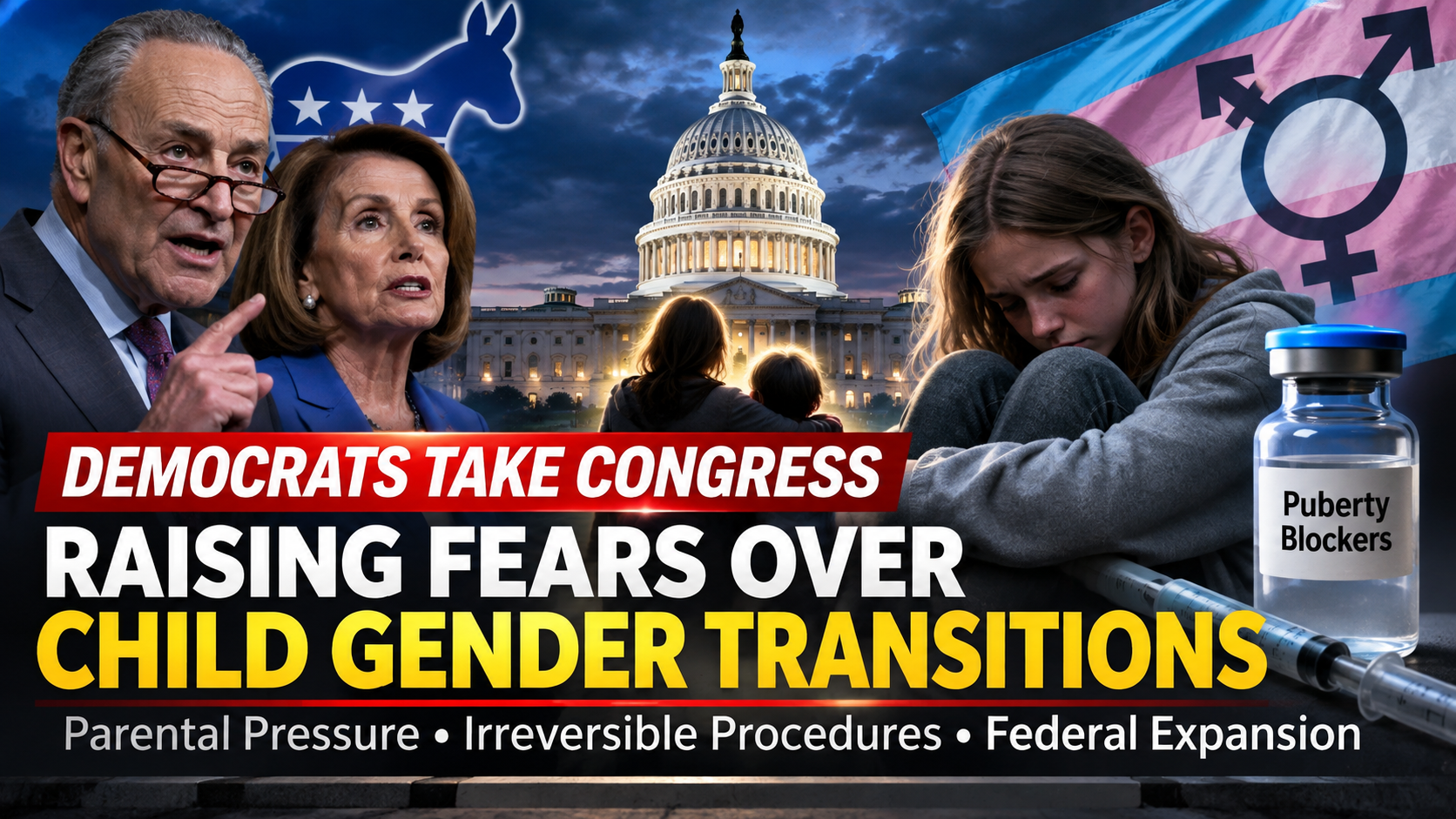
WASHINGTON, D.C. — The Democratic Party’s stunning takeover of Congress in the 2026 midterm elections has triggered a new wave of concern among conservatives, parents, and medical critics who fear that protections against controversial gender transition procedures involving children could soon come under attack.
Beginning January 3, 2027, Democrats will control both chambers of Congress, giving the party a powerful opportunity to challenge restrictions on puberty blockers, cross-sex hormones, and surgical procedures involving minors.
For Americans who believe children should be protected from permanent medical decisions until adulthood, the political shift represents a serious warning.
At the center of the controversy is a fundamental question that Washington has repeatedly failed to settle.
Should children who are legally too young to vote, purchase alcohol, or enter binding contracts be permitted to undergo medical treatments that could permanently alter their bodies and reproductive capabilities?
And perhaps more importantly, who is protecting children from pressure by adults, medical professionals, and political activists when those decisions are being made?
Democrats Could Move to Reverse Restrictions on Child Gender Transitions
During the Trump administration, federal officials pursued restrictions on taxpayer funding for certain gender transition treatments involving minors.
Those efforts reflected a broader Republican position that children should not be subjected to potentially irreversible medical interventions while their bodies and minds are still developing.
Democratic lawmakers have generally taken the opposite approach, supporting broader access to gender-affirming healthcare and opposing restrictions enacted by Republican-controlled states.
With Democrats now preparing to assume congressional control, legislation expanding federal protections for such treatments could return to the national agenda.
That raises the possibility of greater access to puberty blockers, cross-sex hormones, and other medical interventions in states where they remain legal.
The exact impact would depend on legislation, court decisions, insurance policies, and whether President Trump exercises his veto authority.
Nevertheless, opponents argue that even attempting to remove existing safeguards would send a dangerous message about the government’s willingness to prioritize political ideology over medical caution.
The Disturbing Question of Adult Pressure on Children
One of the most troubling concerns surrounding childhood gender transitions is the possibility that some young people are being influenced or pressured by adults before they fully understand the consequences.
Children naturally look to parents, teachers, counselors, and medical professionals for guidance.
That dependence creates an enormous responsibility for adults involved in decisions that could affect a child’s body for life.
Researchers examining parental experiences have documented concerns about pressure to affirm a child’s gender identity and support transition.
A published survey involving 1,655 adolescents and young adults, based on reports from parents who believed their children experienced rapid-onset gender dysphoria, found that participating parents frequently described feeling pressured by clinicians to support their children’s transitions.
The research was based on a self-selected group of parents and cannot establish how frequently coercion occurs among all transgender adolescents.
It nevertheless raises an issue that deserves serious investigation.
Are some adults encouraging medical transitions before children have received sufficiently thorough psychological evaluations?
Are parents being presented with an incomplete picture of medical risks?
And are vulnerable adolescents receiving the time and independent counseling necessary to distinguish persistent gender dysphoria from other forms of emotional distress?
Any credible system designed to protect children must be willing to investigate those questions without dismissing concerned families.
Coercion should never be tolerated, whether it involves pressuring a child toward medical transition or preventing a child from expressing concerns about their own treatment.
Permanent Consequences That Cannot Simply Be Reversed
Supporters of pediatric gender-affirming care frequently describe treatment as medically necessary for selected adolescents experiencing significant gender dysphoria.
But opponents argue that the public deserves a much clearer explanation of the physical consequences.
Cross-sex hormones can produce lasting changes to the body, including voice changes, breast development, and potential effects on fertility.
Certain surgeries permanently remove or alter healthy reproductive anatomy.
Puberty blockers are sometimes described as a temporary pause in development, but questions remain about long-term outcomes, including bone health and subsequent fertility when treatment is followed by cross-sex hormones.
The possibility of irreversible consequences is precisely why critics believe stronger safeguards are necessary.
A child who makes a medical decision at 13 or 14 may view that decision very differently at 25 or 35.
For patients who later regret treatment or decide to discontinue it, some physical changes may remain permanent.
Not every patient experiences regret, and existing evidence does not establish that regret is common. But the possibility deserves serious consideration when evaluating treatments for minors.
Europe Has Already Raised Serious Medical Questions
While American political leaders continue fighting over transgender healthcare, several European health systems have moved toward greater caution.
The United Kingdom’s Cass Review, published in 2024, examined the evidence surrounding medical treatment for young people experiencing gender-related distress.
The review identified significant weaknesses in the available research and recommended a more comprehensive approach to assessing young patients.
British health authorities subsequently restricted routine access to puberty blockers for gender dysphoria among minors.
These developments challenge the argument that broader access to medical transition treatments is the only scientifically defensible approach.
They also raise questions about why American policymakers should rush to expand access while other developed countries are reassessing treatment standards.
American medical organizations, including the American Academy of Pediatrics, have supported access to individualized gender-affirming care. But professional disagreement and gaps in long-term research make continued scrutiny essential.
The Supreme Court Delivered a Major Victory for State Restrictions
In June 2025, the Supreme Court upheld Tennessee’s law restricting certain gender transition treatments for minors.
The ruling represented an important legal victory for states seeking to regulate medical interventions involving children.
It confirmed that the challenged restrictions did not violate the Constitution’s Equal Protection Clause on the grounds presented.
For conservatives, the decision reinforced the principle that elected lawmakers have authority to address uncertain medical risks affecting minors.
Democratic lawmakers could now attempt to challenge that framework through new federal legislation.
However, the Supreme Court’s ruling remains in effect, and congressional majorities alone cannot erase state laws or constitutional limits.
Washington Democrats Already Passed a Law That Alarmed Parents Nationwide
For parents wondering how far Democratic lawmakers are willing to go in limiting parental authority over children’s gender-related healthcare, Washington State offers a controversial example.
In 2023, Democratic Governor Jay Inslee signed Senate Bill 5599, legislation that expanded protections for runaway and homeless minors seeking gender-affirming treatment or reproductive healthcare.
Under the law, certain licensed youth shelters can decline to notify parents directly when a minor enters their care seeking these services. Instead, the shelter must notify the Washington State Department of Children, Youth, and Families.
The legislation also permits qualifying host-home programs to provide housing to minors seeking protected healthcare services without first obtaining parental authorization.
For conservative parents, the implications are deeply troubling.
Imagine discovering that your child has left home, entered a state-recognized shelter, and is seeking gender-related medical treatment while you have not been told where your child is staying.
That possibility raises serious questions about parental rights, government authority, and whether families are being pushed aside during some of the most consequential decisions of a child’s life.
Washington law defines gender-affirming treatment broadly enough to include medical and surgical interventions. However, Senate Bill 5599 does not itself authorize surgery without legally required medical consent, nor does it permit strangers to abduct children.
The state requires its child welfare department to make a good-faith attempt to notify parents after receiving the relevant report and to offer services intended to resolve family conflicts and facilitate reunification.
Supporters argue the legislation protects vulnerable young people who might otherwise face homelessness or unsafe family situations.
Critics counter that seeking gender-related healthcare should not, by itself, become a reason for parents to lose immediate access to information about their child’s whereabouts.
The controversy illustrates why conservatives are demanding stronger parental protections before Democratic lawmakers pursue additional federal legislation involving minors and gender transition treatments.
For families across America, the question is no longer merely theoretical.
Washington has already demonstrated that Democratic lawmakers are willing to create exceptions to traditional parental notification requirements when children seek gender-related healthcare.
As Democrats prepare to control Congress in January 2027, parents have every reason to examine whether similar approaches could become part of the national political agenda.
Parents Deserve Transparency, Not Political Pressure
The controversy surrounding childhood gender transitions is about more than Democrats and Republicans.
It concerns the relationship between children, families, doctors, and government.
Parents deserve complete information about potential medical consequences, the strength of scientific evidence, and available alternatives before consenting to treatment.
Children deserve evaluations that consider mental health, family circumstances, developmental maturity, and possible coexisting conditions.
Medical professionals should be free to raise legitimate concerns without political intimidation.
And policymakers should recognize that protecting vulnerable children requires more than repeating slogans about healthcare access.
Conservatives argue that when a treatment carries potentially lifelong consequences, the burden should fall on those advocating intervention to demonstrate that its benefits outweigh its risks.
That principle is especially important when the patient is a minor.
January 3, 2027, Could Begin a New Fight Over America’s Children
The incoming Democratic Congress will have opportunities to introduce legislation, hold hearings, influence federal spending, and challenge Trump administration healthcare policies.
Whether those efforts succeed remains uncertain.
President Trump will retain veto authority, Republican-controlled states will continue defending their restrictions, and federal courts will remain central to the debate.
But the political stakes are unmistakable.
A Democratic Congress could pursue policies making medical gender transition treatments more accessible to minors, even as questions persist about long-term outcomes, informed consent, and the influence adults may exert over vulnerable young people.
For conservatives, the priority is clear.
Children should not be rushed into life-altering medical decisions. Families should receive honest information about risks. Allegations of coercion should be investigated. And medical policy should be based on reliable evidence rather than political demands.
The question is whether America’s political leaders will establish sufficient safeguards before allowing minors to undergo medical treatments that may permanently change their bodies.
As Democrats prepare to take power on Capitol Hill, that debate is likely to become one of the most contentious battles of the coming congressional session.