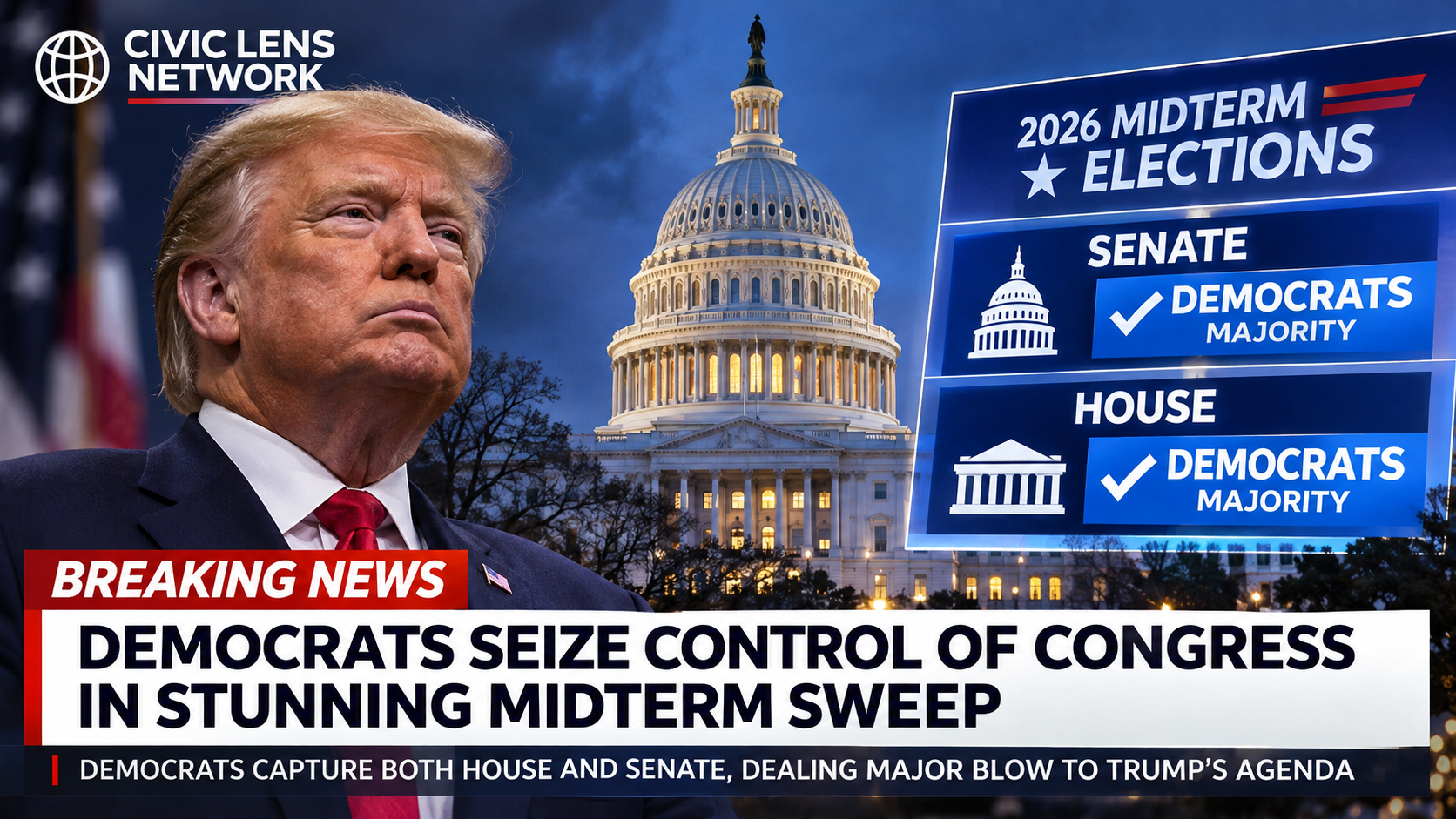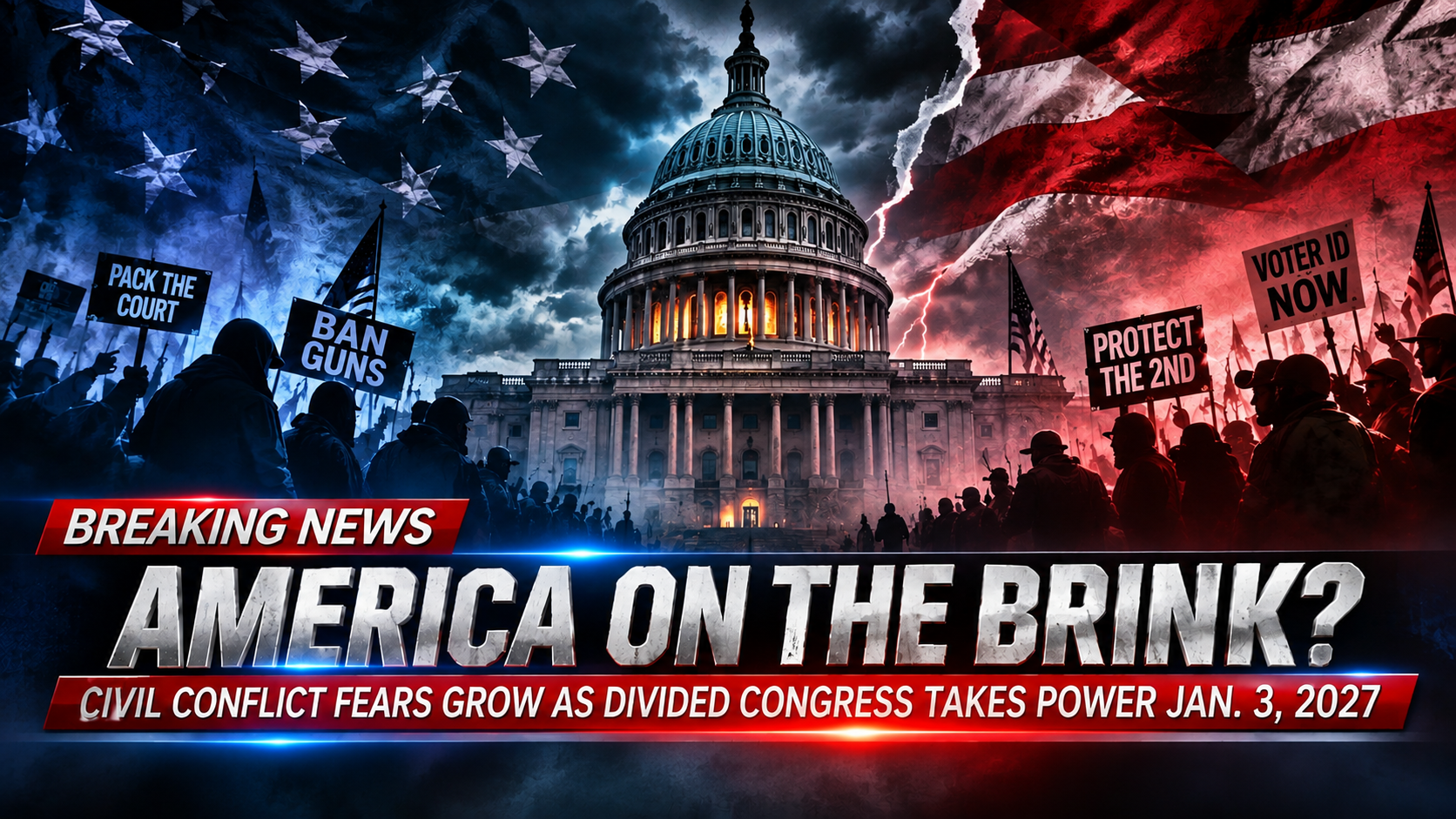
WASHINGTON, D.C. — The United States is approaching a potentially explosive political turning point. On January 3, 2027, a new Congress will take office following a dramatic midterm election that handed Democrats control of both the House of Representatives and the Senate.
With Republican President Donald Trump remaining in the White House, Washington is preparing for a confrontation between two branches of government controlled by opposing political parties.
The question now extends beyond whether Washington will experience another two years of legislative gridlock.
Could America’s deepening political divisions eventually produce widespread civil unrest, escalating political violence, or even another civil war?
There is credible evidence that a second American civil war is imminent. Nevertheless, political violence researchers have identified troubling levels of hostility, institutional distrust, and willingness among some Americans to justify violence for political purposes.
The stakes are particularly high because several of the country’s most divisive constitutional questions could become central battles in the next Congress.
January 3 Could Mark the Beginning of a Constitutional Showdown
The incoming Democratic majority will have the power to introduce legislation, conduct investigations, issue subpoenas, and challenge the Trump administration’s policies.
However, controlling Congress does not give Democrats unrestricted authority to rewrite federal law.
President Trump retains his constitutional veto power. Unless Congress can assemble two-thirds majorities in both chambers to override a veto, legislation opposed by the president generally cannot become law.
That reality could produce a prolonged political standoff.
Democrats may attempt to advance legislation addressing voting rights, firearm restrictions, judicial reform, and presidential authority. Republicans may respond by accusing congressional leaders of threatening constitutional protections or undermining the administration’s agenda.
But political disagreement, even when intense, remains a normal feature of America’s constitutional system.
The greater danger emerges when citizens begin viewing their political opponents not merely as people with different ideas, but as enemies who have no legitimate right to govern.
Supreme Court Expansion Could Become a Flashpoint
One of the most controversial proposals in modern American politics involves expanding the number of Supreme Court justices.
The Supreme Court currently has nine members, but the Constitution does not permanently establish that number. Congress has the authority to change the Court’s size through legislation.
Supporters of expansion argue that restructuring the Court could address concerns about its composition and legitimacy.
Opponents describe the proposal as court packing, warning that changing the number of justices to influence judicial outcomes could damage public confidence in an independent judiciary.
If Democrats attempt such legislation after January 3, President Trump could veto it.
Even an unsuccessful proposal could become a major political flashpoint, particularly among Americans who believe the judiciary represents one of the last remaining checks on congressional or presidential power.
At present, however, introducing or debating Supreme Court expansion should not be confused with actually possessing the votes needed to enact it.
Voter ID Laws Could Ignite Another National Battle
Election integrity is another issue capable of generating intense political conflict.
Republicans have generally supported stricter identification requirements, arguing that verifying voters’ identities helps protect public confidence in elections.
Democrats have frequently opposed certain strict requirements, arguing that they can create unnecessary barriers for eligible citizens who lack accepted identification.
A Democratic Congress could consider federal legislation affecting voter identification requirements in federal elections.
However, federal authority over elections has constitutional boundaries, and legislation would still face presidential review and potentially judicial challenges.
The underlying disagreement goes beyond identification cards.
For many Americans, trust in election administration has become closely connected to whether they believe the government itself is legitimate.
When voters lose confidence that elections are administered fairly, accepting unfavorable outcomes becomes more difficult.
That erosion of confidence represents a serious challenge for any constitutional democracy.
Gun Rights and the Second Amendment
Few issues generate stronger reactions than proposals to restrict firearms.
The Second Amendment protects the right to keep and bear arms, and Supreme Court decisions have established important constitutional limits on government restrictions.
Democratic lawmakers could pursue additional gun-control measures, including restrictions on certain firearms or expanded federal regulations.
Supporters of these measures argue that stronger laws could reduce shootings and prevent dangerous individuals from obtaining weapons.
Opponents argue that restrictions can burden law-abiding citizens while failing to address the underlying causes of violent crime.
A sweeping attempt to prohibit commonly owned firearms would face substantial constitutional obstacles.
President Trump could also veto federal legislation that he opposes.
The potential for conflict comes from the extraordinary importance many Americans attach to gun ownership as both an individual liberty and a constitutional guarantee.
Nevertheless, political opposition to gun legislation does not automatically translate into organized violence.
Researchers Are Warning About Political Violence
Concerns about political instability are not limited to partisan commentary.
An August 2026 survey conducted by the University of Chicago’s Chicago Project on Security and Threats identified substantial public tolerance for certain forms of political violence.
Researchers reported that 41 percent of Americans expressed support for at least one of two politically charged uses of force examined in the survey.
Those findings are troubling, although agreement with a survey statement does not establish that respondents intend to commit violence.
Other research provides an important counterweight.
An October 2026 report from the University of California, Davis found that 77 percent of respondents believed violence to advance a political objective was never justified.
The researchers also reported declining support for political violence across numerous scenarios, even as expectations of a possible civil war increased.
These findings suggest that Americans can be deeply worried about political conflict without actually supporting it.
A nation where citizens fear violence is not necessarily a nation preparing to fight a war.
What Would a Modern American Civil War Look Like?
A second American civil war would not necessarily resemble the conflict between the Union and Confederacy from 1861 to 1865.
Modern political divisions do not fall neatly along a single geographic boundary.
Republicans and Democrats live throughout the same states, cities, neighborhoods, and sometimes the same households.
Researchers studying political violence have warned that the more realistic danger involves isolated attacks, threats against elected officials, confrontations surrounding protests, and retaliatory violence between extremist individuals or groups.
Such incidents could seriously damage public safety without becoming a civil war.
A genuine civil war would involve sustained, organized armed conflict on a much larger scale.
The Center for Strategic and International Studies concluded in a September 2025 analysis that the United States was not approaching that threshold, identifying sporadic political violence as a more plausible danger.
That assessment does not guarantee future stability, but it provides an important distinction between political turmoil and organized warfare.
Could a Confrontation Between Congress and Trump Escalate?
The most consequential test after January 3 may involve how Washington handles competing claims of constitutional authority.
A Democratic Congress could launch aggressive investigations into the administration, challenge executive policies, and attempt to block presidential initiatives.
Trump could respond with vetoes, legal challenges, and the executive powers available to his office.
The federal courts could be called upon to resolve disputes involving congressional authority, executive privilege, federal spending, or administrative decisions.
These conflicts could generate enormous public anger.
However, investigations, vetoes, lawsuits, and impeachment proceedings are constitutional mechanisms, not evidence that the country has entered a civil war. But may start one.
The situation would become substantially more dangerous if political leaders openly encouraged violence, government institutions refused binding legal decisions, or organized groups attempted to impose political outcomes through force.
Those would represent serious warning signs requiring immediate public attention.
The Role of Economic Pressure and Public Distrust
Political division does not exist in isolation.
Americans are also confronting concerns about household expenses, economic uncertainty, government spending, and the consequences of overseas military involvement.
Economic hardship can intensify resentment toward political institutions, especially when citizens believe their elected representatives are more interested in partisan battles than solving everyday problems.
The 2026 midterm elections demonstrated the political importance of those frustrations.
If the new Congress and the White House become locked in prolonged confrontation, Americans could experience further disappointment with Washington’s ability to govern.
But economic dissatisfaction and political frustration alone do not establish that violent conflict will follow.
The central question is whether Americans continue to believe disputes can be resolved through elections, legislation, and the courts.
America’s Greatest Test May Be Its Ability to Disagree
January 3, 2027, will not automatically mark the beginning of a national emergency.
It will mark the beginning of a new Congress operating under a constitutional system specifically designed to divide government power.
Democrats will have substantial legislative and investigative authority.
President Trump will retain executive powers, including the ability to veto legislation.
The Supreme Court will continue to interpret constitutional disputes brought before it.
That division of authority can create frustration, but it also prevents any single political institution from exercising unlimited power.
The greatest danger to the country may not be disagreement over the Supreme Court, voter identification, or the Second Amendment.
It may be the growing belief that political defeat justifies abandoning the constitutional process altogether.
America has survived bitter elections, presidential impeachments, economic crises, mass demonstrations, and periods of severe civil unrest.
The country has also experienced the catastrophic consequences of an actual civil war.
Whether the coming political confrontation produces another period of difficult but peaceful governance or something more dangerous will depend on decisions made by political leaders, institutions, and citizens.
For now, the evidence points toward a serious risk of political confrontation and isolated violence, not an inevitable nationwide armed conflict.
January 3, 2027, may begin one of the most contentious chapters in modern American politics. But the future of the republic will depend less on which party controls Congress than on whether Americans continue to settle their differences through the Constitution rather than through violence.