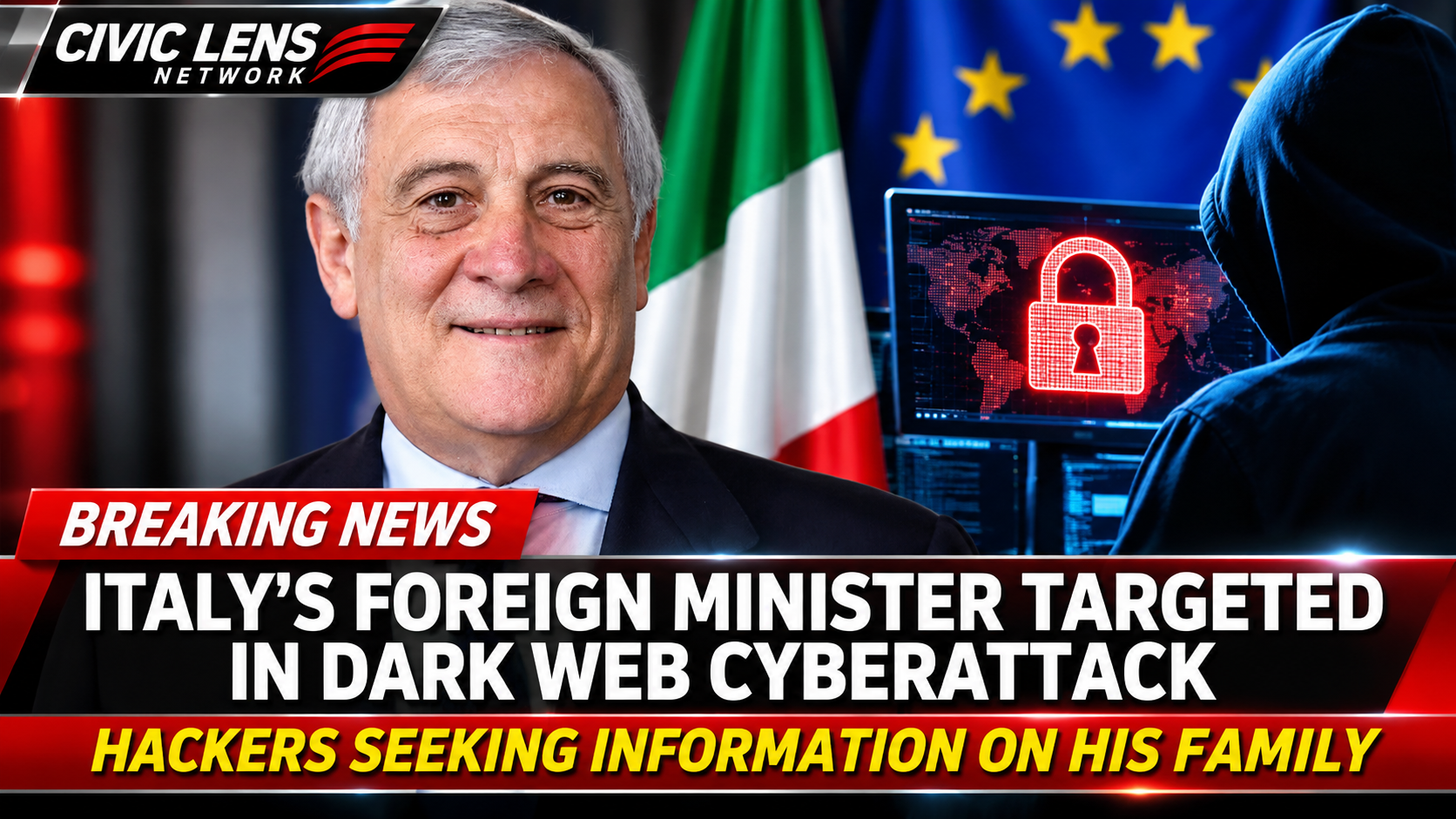
A disturbing cybersecurity incident has struck the highest levels of Italy’s government after Foreign Minister Antonio Tajani revealed that cybercriminals have been circulating his personal information on the dark web while actively seeking additional details about his family.
The revelation has raised serious national security concerns across Europe, where governments are already confronting cyberattacks, threats against public institutions, and attempts to disrupt critical infrastructure.
Italian Prime Minister Giorgia Meloni has blamed pro-Russian hackers for the incident, while Tajani believes his government’s support for Ukraine has made him a political target.
But the developing investigation raises a much larger question: Are European governments facing a coordinated campaign designed to intimidate political leaders, expose sensitive information, and undermine national security?
The available evidence has not established that the various incidents are connected, but the timing and nature of the threats have intensified concerns about Europe’s vulnerability.
Hackers Target One of Italy’s Most Powerful Officials
Tajani, who serves as both foreign minister and deputy prime minister, publicly disclosed that cybercriminals had been distributing his personal information through underground online networks.
The information was reportedly circulating for several days before his announcement.
More troubling was his allegation that those responsible were attempting to obtain additional personal details about his relatives.
According to Tajani, individuals operating on the dark web were offering money for information about him and his loved ones.
The apparent objective extends beyond ordinary financial cybercrime.
Personal information about senior government officials can potentially be exploited for intimidation, harassment, identity fraud, surveillance, or attempts to compromise sensitive communications.
Information concerning family members can create additional security risks, particularly when individuals close to government leaders do not receive the same protective measures as the officials themselves.
Authorities have not publicly disclosed the full contents of the exposed information.
It also remains unclear whether the material originated from a direct intrusion into government systems, compromised personal accounts, commercial databases, or another source.
Those distinctions will be critical in determining whether the incident represents a broader government cybersecurity failure.
Prime Minister Meloni Points Toward Pro-Russian Hackers
Prime Minister Giorgia Meloni responded by expressing solidarity with Tajani and identifying pro-Russian hackers as responsible for the targeting.
Meloni warned that attempts to sell confidential information about government officials represent a serious security concern requiring a determined response.
Tajani similarly connected the attack to Italy’s position on the war in Ukraine.
Italy has maintained support for Ukraine’s sovereignty and independence, a position that has placed the country alongside other European governments opposing Russia’s military campaign.
Tajani believes this political alignment has contributed to his selection as a target.
However, the public evidence has not yet established whether the perpetrators acted independently, belonged to an organized hacking group, or received instructions from a foreign government.
A political motive does not automatically establish government sponsorship.
Determining who actually obtained the information, how it was acquired, and whether it was used in further operations will require forensic evidence.
A Dark Web List Raises Additional Questions
The incident may involve more than a single Italian government official.
Screenshots reviewed by investigators and journalists reportedly showed Tajani’s photograph included on a list identifying 18 individuals considered hostile to the Russian Federation.
Cybersecurity experts were also reportedly among those named.
Such a list could potentially serve several purposes.
It might be intended to intimidate officials, encourage the collection of personal information, or draw attention to individuals involved in government cybersecurity and foreign policy.
It does not, by itself, establish that everyone named has been hacked or that the list represents an operational targeting plan.
Nevertheless, the appearance of a senior European diplomat on such a list warrants a serious investigation.
If criminals are offering financial incentives for private information about public officials, authorities must determine whether those offers have produced additional compromises.
Another Cyberattack Hits Major European Infrastructure Project
The disclosures surrounding Tajani come as another significant cyber incident has emerged involving one of Europe’s major transportation construction projects.
BBT SE, the company responsible for the Brenner Base Tunnel connecting Austria and Italy, confirmed that it experienced a cyberattack on October 17.
The planned 55-kilometer railway tunnel is intended to improve transportation through the Alps and strengthen European freight and passenger connections.
According to the company, affected computer systems were isolated and outside cybersecurity specialists were brought in to investigate.
Reports indicate that nonpublic information was stolen after attackers gained access to an internet-connected network.
Early reporting has suggested a possible connection to a pro-Russian hacking group known as Everest, although that attribution has not been conclusively established.
There is currently no verified evidence that the attack on BBT SE and the targeting of Tajani were carried out by the same perpetrators.
Still, the incidents illustrate how cybercriminals can threaten both political institutions and companies involved in important infrastructure.
A successful attack on a transportation project does not necessarily require physical sabotage to create serious consequences.
The theft of internal documents, financial information, technical records, or employee details can generate financial losses and potentially expose further vulnerabilities.
Europe Faces a Wider Wave of Security Disruptions
The Italian disclosures also arrive during a period of unusual security incidents across Europe.
Airlines have faced hoax bomb threats that triggered diversions, aircraft searches, and emergency responses.
Broadcasters in several countries have also reported security threats.
Separately, attacks involving supermarket refrigeration systems have highlighted how internet-connected equipment can become a target for cybercriminals.
These incidents differ considerably in their methods and potential motivations.
Some involve threatening communications, while others concern unauthorized access to computer systems.
Investigators have not established that the incidents form a single coordinated campaign.
Nevertheless, the developments raise an important concern about the security of increasingly interconnected European infrastructure.
Modern transportation, communications, food distribution, and government administration rely heavily on digital systems.
That dependence creates opportunities for attackers seeking to cause disruption without conventional military force.
Italy’s New Cybersecurity Directorate Faces a Major Test
Tajani revealed that Italy’s Foreign Ministry established a dedicated cybersecurity directorate on January 1 to strengthen defenses against hostile cyber operations.
The department was created to address threats involving criminal organizations and potentially state-linked actors.
The timing of the current incident raises questions about whether the ministry’s protective measures have been sufficient.
However, the publication of Tajani’s personal information does not necessarily mean the Foreign Ministry’s computer systems were breached.
Sensitive information can be collected from numerous sources, including private accounts, previous data breaches, public records, and compromised third-party services.
Investigators must establish the origin of the exposed material before assigning responsibility for any security failure.
Among the most important questions are whether government communications were compromised, whether relatives were directly threatened, and whether other officials face similar exposure.
The ministry’s ability to identify the perpetrators and prevent further leaks will be an important test of its cybersecurity capabilities.
Could This Be Political Intimidation Rather Than Ordinary Cybercrime?
One of the most significant aspects of the incident is the apparent interest in Tajani’s political position and family members.
Traditional cybercriminals frequently seek financial information, passwords, or data that can be sold for profit.
Political targeting may involve additional objectives, including pressure on officials, reputational damage, or attempts to influence government decisions.
Publishing personal information can also encourage harassment by individuals who were not involved in the original data theft.
Tajani has indicated that he considers the activity an attempt to intimidate him because of his support for Ukraine.
That explanation is consistent with the political messaging reportedly associated with the incident, but investigators must still establish the perpetrators’ identities and objectives.
For European governments, the distinction matters.
A financially motivated criminal operation requires one type of response.
An organized foreign influence or intelligence operation could require a substantially different diplomatic and security response.
European Leaders Must Answer Difficult Security Questions
The incident highlights several vulnerabilities that governments cannot afford to ignore.
Officials responsible for foreign policy and national security may possess sensitive information that makes them attractive targets.
Their personal lives, relatives, and private communications can create additional avenues for exploitation.
At the same time, government agencies increasingly depend on outside technology providers, digital communications platforms, and interconnected databases.
Each connection can create another potential point of exposure.
The immediate challenge for Italian authorities is to determine precisely what information was compromised and whether any government operations were affected.
The broader challenge for Europe is identifying whether separate cyber incidents reflect independent criminal activity or an organized effort to destabilize institutions.
Without credible forensic findings, political accusations alone cannot settle that question.
An Investigation With International Consequences
Tajani has pledged that the threats will not change his position or prevent him from carrying out his responsibilities.
He has also emphasized the importance of cooperation with Italy’s international allies to strengthen cybersecurity defenses.
But the investigation is far from over.
Authorities must establish who collected and distributed the information, whether money changed hands, and whether additional officials or relatives were targeted.
They must also determine whether the material was obtained through a security breach that could expose other sensitive information.
The answers could have implications far beyond Italy.
If the incident is ultimately linked to an organized foreign cyber operation, it could intensify diplomatic tensions and lead to additional security measures across Europe.
If the perpetrators turn out to be independent criminals, the case would still expose the growing risks created by the commercial trade in personal information.
Either outcome deserves serious scrutiny.
The targeting of a senior government official and his family demonstrates how digital threats can move beyond computer networks and into the personal security of individuals responsible for national policy.
For now, Italy’s foreign minister remains defiant, while investigators face the urgent task of identifying those responsible.
The larger concern is whether this incident represents an isolated act of intimidation or another warning that Europe’s political and digital security systems are becoming increasingly vulnerable.